
Evolving markets, emerging tools: building the future of energy trading in Asia-Pacific
- Tue 14 October 2025
- 5 MIN READ
As the energy transition accelerates, Australia is well-positioned to play a leading role in the evolving energy trading landscape.
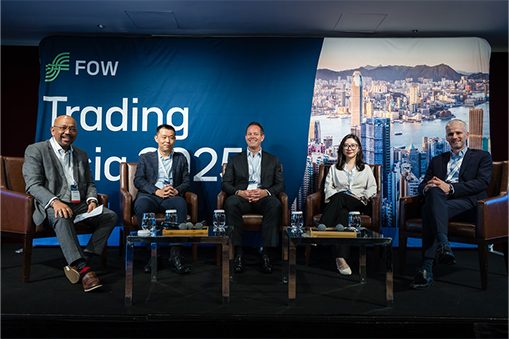
With world-leading renewable adoption and deep derivatives markets, we’re shaping tools to manage volatility and support net zero. From electricity to carbon and gas, Australian markets are powering a more resilient, sustainable future. Our vast natural resources, mature and deep markets, and our stable and trusted trading and regulatory infrastructure offer a natural springboard for the innovation now needed. This conviction was brought into sharp focus at the recent FOW Trading Asia 2025 conference in Hong Kong, where I joined a moderated panel with three colleagues from the world of power and energy derivatives.
When asked to sum up the new energy market in one word, Cygnus Capital CEO Lawrence Lu described it as “chaotic”, referring to the difficulty investors face in understanding and capitalising on what’s driving volatility. In contrast, China’s Huatai Futures’ Yarina Chen opted for “promising”, focusing on the opportunities presented by the market liquidity and new products to be listed. European Energy Exchange’s Steffen Riediger described it as “transitioning”, echoing my own view of an “evolving” market.
This variety of answers highlights why the Asia-Pacific region is at the forefront of the energy transition with the fastest economic growth worldwide with three of the world’s biggest economies: China, Japan and India.
The region is a major producer and consumer of oil, gas and coal, but also leads in renewable technologies, pushing advancements in solar power, electric vehicles and critical minerals fundamental to a low-carbon future. Balancing industrial growth and decarbonisation, the region’s energy markets demand integrated solutions that blend traditional and clean technologies.
Just hours after we left the stage, Australia announced a new target to reduce greenhouse gas emissions by 62–70% by 2035. It was a perfect example of policy moves that can affect electricity prices, carbon credit valuations and critical mineral markets, shaping hedging and trading needs.
Across Asia, the deregulation of power markets is creating new opportunities and risks. In Japan, liberalisation has driven rapid growth, with trading volumes expected to double year on year. The shift towards renewables has introduced new hedging requirements, while in China, futures exchanges are expanding product scope with LNG contracts under development – a significant potential opportunity for Australia, given our role as a major LNG exporter and price setter.
These developments highlight a broader regional trend: Asia’s markets are maturing quickly. This reinforces the need for robust, standardised tools to manage volatility, which is an area where Australia and ASX are well placed to lead.
Building on Australia’s strong foundation
ASX has an established track record as a leading commodity and energy derivatives platform and serves as the main market for Australian and New Zealand power derivatives.
The ASX 24 market operates with some of the world’s longest trading hours, supported by a stable political environment, a AAA credit rating and robust regulation. It is also modernising its core trading and clearing platforms. This uplift will provide greater resilience, scalability and flexibility, ensuring we can deliver product innovation more efficiently and support sustainable market development into the future.
Since listing Australian Electricity Futures contracts in 2002, trading volumes have grown substantially, now regularly exceeding the underlying National Electricity Market demand. In FY25, ASX 24 Electricity derivatives contracts traded 923 terawatt hours – 530% of the associated regions’ demand – with average contract volumes doubling since 2018 to around 20,000.
Our goal is to build a broader product ecosystem supporting the energy transition while accelerating internationalisation to attract regional and global interest.
Expanding tools for energy transition
To address transition needs, we recently launched Morning and Evening Peak Electricity Futures. These contracts provide market participants with targeted hedging and trading opportunities to manage the growing demand during morning and evening peaks driven by the shift to solar-led generation. In addition, we are developing a geographically diverse gas futures product ecosystem extending coverage across Australia’s east coast gas hubs. We’ve also introduced environmental derivatives, including carbon contracts for Australia and New Zealand and a renewable energy certificate. These contracts now form a foundational suite of environmental products: Australian Carbon Credit Units, New Zealand Units and Large-scale Generation Certificates. Together, they provide transparent benchmarks to help participants manage environmental risk.
In Australia, renewables like rooftop solar – now on one in three homes – improve sustainability but create grid volatility due to intermittent generation. Gas remains vital to balancing supply, highlighting the need for tailored market instruments.
Australia has the potential to be the largest carbon credit issuer globally due to its large landmass and natural solutions in agriculture and reforestation. A major shift is underway from voluntary to compliance carbon markets. Whereas voluntary markets can struggle with inconsistent credit integrity, limiting liquidity and growth, compliance markets provide stable demand.
The Clean Energy Regulator currently recognises approximately 30 methodologies for generating carbon credits, but market valuation varies based on perceived integrity, leading to fragmentation in the over-the-counter market. ASX’s carbon futures contract will aggregate liquidity by accepting all regulator-approved credits equally, establishing a centralised pricing benchmark. This allows over-the-counter markets to continue managing integrity preferences independently.
This approach enhances liquidity, transparent price discovery and scalability – all key for a functional carbon market.
Turning volatility into opportunity
One key takeaway from the panel was the increased interest in power and energy derivatives markets from new participants, motivated by the energy transition story and the prospect of a new pool of less-correlated investments.
ASX is well positioned to help new and existing customers alike navigate these volatile markets and manage risk with confidence. By combining stability, liquidity and innovation, we aim to be a trusted partner in managing the challenges and opportunities associated with the energy transition.
Learn more about ASX’s electricity, gas and environmental derivatives and how they can support your trading and risk management strategies.
Email: Commodities@asx.com.au
Webpage: asx.com.au/markets/trade-our-derivatives-market
About the author

Disclaimer
Information provided is for educational purposes and does not constitute financial product advice. You should obtain independent advice from an Australian financial services licensee before making any financial decisions. Although ASX Limited ABN 98 008 624 691 and its related bodies corporate (“ASX”) has made every effort to ensure the accuracy of the information as at the date of publication, ASX does not give any warranty or representation as to the accuracy, reliability or completeness of the information. To the extent permitted by law, ASX and its employees, officers and contractors shall not be liable for any loss or damage arising in any way (including by way of negligence) from or in connection with any information provided or omitted or from any one acting or refraining to act in reliance on this information.
© Copyright ASX Operations Pty Limited ABN 42 004 523 782. All rights reserved 2025.