
Institutional S&P/ASX 200 option trades reveal a divided outlook for the second half of 2026
- Mon 09 February 2026
- 5 MIN READ

As of Tuesday 30 June 2026, the S&P/ASX 200 was higher by just under 1% on the year, despite the tumultuous first half of the year. We explored some longer-dated option trades to see how S&P/ASX 200 traders are positioned for the second half of 2026. The following trades were institutional size executions over the past few weeks that have a bullish or bearish outlook over the next few months.
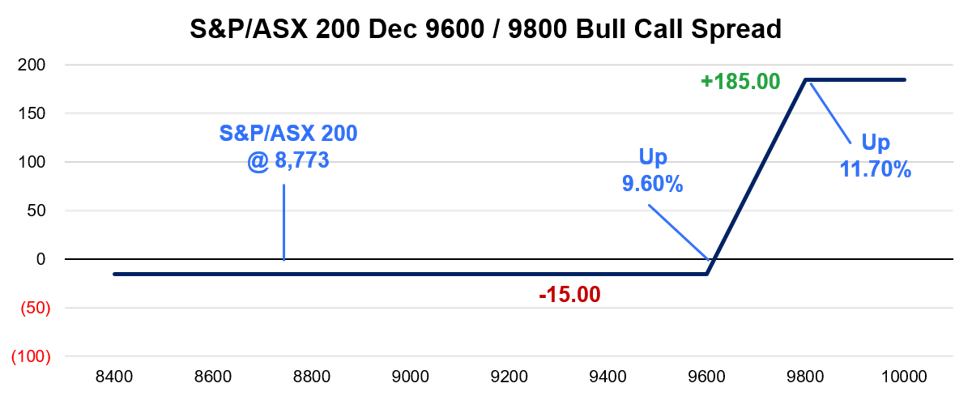
The first trade with a very bullish outlook entered the market on Friday 17 July through purchasing the S&P/ASX 200 Dec 9,600 Call for 38.00 and selling the S&P/ASX 200 Dec 9,800 Call for 23.00 spending a total of 15.00 per spread. This trade was executed when the index was quoted at 8,773. The payoff at December expiration appears below.
Data sources: Bloomberg and author calculations
This trade was entered into for a modest cost, but to recoup that cost, the S&P/ASX 200 should be at 9,615 at expiration, an upside move of 9.60%, which is aggressive but not outside of historical performance. The maximum profit for this trade is 185.00 points, which is reliant on the index closing at 9,800 or higher. This requires a rally of 11.70%, again aggressive but possible based on historical market performance.
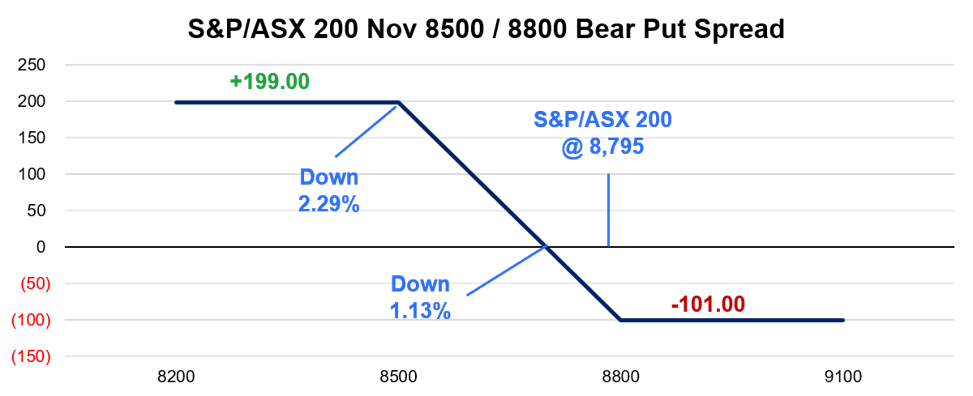
A second trade looking farther out on the calendar expects modest downside using November options. With the S&P/ASX 200 at 8,795, a trader purchased the S&P/ASX 200 Nov 8,800 Puts for 245.00 and sold the S&P/ASX Nov 8,500 Puts at 144.00 for a net cost of 101.00 for each bear put spread. The payout diagram below shows the outcome at November expiration for this moderately bearish trade.
Data sources: Bloomberg and author calculations
Break-even for this trade occurs with the index at 8,699 or 1.13% lower than the market when the trade was initiated. A 2.29% drop is required to realise a maximum profit of 199.00.
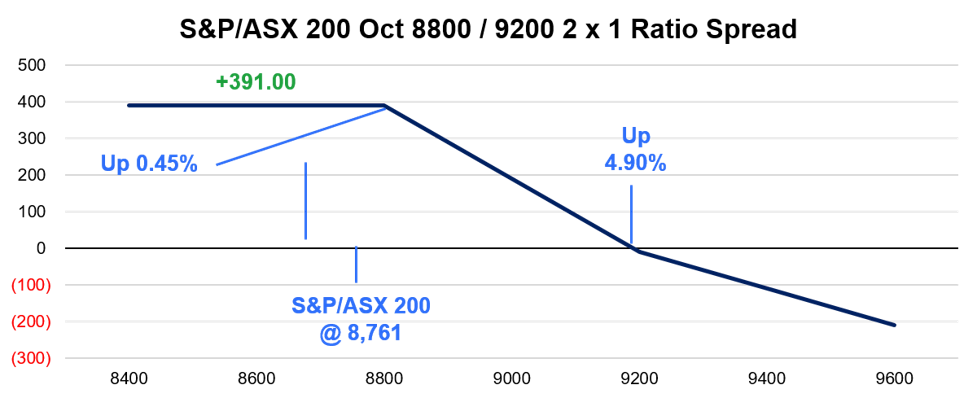
A final longer-dated trade worth noting is bearish with an upside cushion. On Friday 26 June, with the S&P/ASX 200 at 8,761, a trader sold two S&P/ASX Oct 8800 Calls for 235.50 each and purchased one S&P/ASX 200 Oct 9200 Call for 80.00. The result is a 2 x 1 spread executed at a credit of 391.00 per spread and a payout at October expiration displayed below.
Data sources: Bloomberg and author calculations
This trade is a bit unusual as normally a spread results in defined gains and losses. The maximum potential gain for this trade occurs as long as the index closes under 8,800 at October expiration. Over 8,800 the trade still results in a profit, although less than the initial credit until hitting the 9,191 level. This is approximately 4.90% higher than the index when the trade was executed. Once the 9,200-price level is hit the trade incurs losses on a one for one basis with the index.
Taken together, these institutional trades do not point to a clear market consensus for the remainder of 2026. The December bull call spread was executed with a bullish outlook and an expectation that may be a substantial year-end rally while the November bear put spread is positioned based on the potential for a moderate decline. The October ratio spread reflects a more nuanced outlook, benefiting if the index remains below 8,800 and retaining a profit through 9,191, but assuming increasingly large losses above 9,200. Collectively, the trades suggest that institutional investors are preparing for a wide range of outcomes rather than committing to a single directional forecast.
Other insights
To receive regular insights via email, please subscribe to the ASX Equity Derivatives monthly newsletter.
Insights
Equity options trading observations and insights
ASX has partnered with Dr Russell Rhoads to create a series of articles which provide observations and insights for options trading.
About the author
Disclaimer
The views, opinions or recommendations of the author in this article are solely those of the author and do not in any way reflect the views, opinions, recommendations, of ASX Limited ABN 98 008 624 691 and its related bodies corporate (“ASX”). ASX makes no representation or warranty with respect to the accuracy, completeness or currency of the content. The content is for educational purposes only. Examples used are intended to detail the performance of historic trading strategies. Past performance is not a reliable indicator of future performance. The content does not constitute financial advice. Independent advice should be obtained from an Australian financial services licensee before making investment decisions. To the extent permitted by law, ASX excludes all liability for any loss or damage arising in any way including by way of negligence. © Copyright ASX Operations Pty Limited ABN 42 004 523 782. All rights reserved 2026.