
Digital gold or dangerous gamble?
- Fri 03 October 2025
Before adding Bitcoin exposure to portfolios, recognise the features, benefits and risks of investing in digital currencies.
Key points
- The article considers how Bitcoin has evolved from a decentralised payments experiment into an asset class used in some portfolios.
- VanEck believes President Trump’s policy initiatives may have strengthened support for Bitcoin at the highest levels of the US Government.
- But extreme volatility, unregulated exchanges, speculative pricing, and global policy uncertainty present significant ongoing risks for investors in Bitcoin and warrant careful allocations within portfolios to digital currencies.

Developed in 2009 as a secure digital platform for transferring money without the need for governments or banking middlemen, Bitcoin has become the world’s most popular digital currency.
Since President Trump took office in January, the price of Bitcoin has reached an all-time high of more than US$122,000 [1]. This gave Bitcoin a combined value in excess of US$2 trillion, placing it among the ranks of the Magnificent 7 tech ‘mega-cap stocks’ by market capitalisation.
However, Bitcoin also experienced double-digit price drops this year and remains among the most highly volatile assets – a key risk for investors.
Chart 1: Bitcoin (USD) price over the past five years
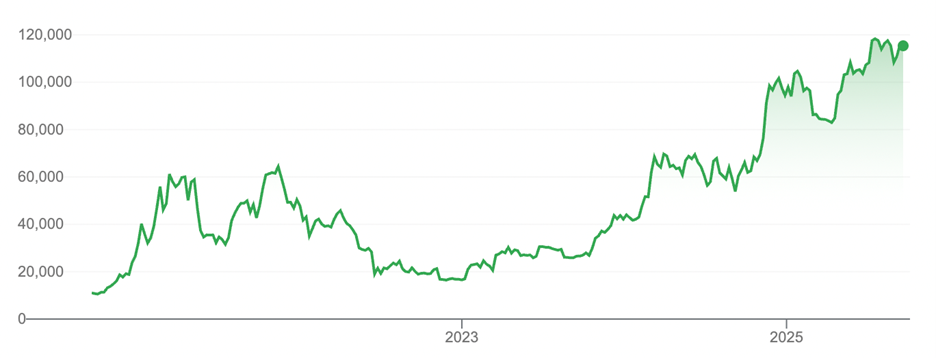
Source: Google Finance - 8 September 2025
VanEck believes much of this price momentum has been driven by adoption of Bitcoin Exchange Traded Funds (ETFs) and the Trump administration’s pro-crypto stance [2].
The US Securities and Exchange Commission (SEC) approval of Bitcoin ETFs in January 2024 and the first Bitcoin ETF listing on ASX in the following June was a defining moment.
This created a regulated pathway to invest in Bitcoin which opened the asset up to more investors, making it easier for institutions, pension funds and individuals to gain exposure.
In July this year, more than US$5 billion flowed into US-listed Bitcoin ETFs [3]. The monthly record was set last November when US$6.5 billion was recorded following Trump’s election victory [4].
In VanEck’s opinion, policies and greater regulatory clarity from the Trump administration since then have led to structural changes in the US financial system, potentially embedding Bitcoin and the broader digital asset class into its architecture.
Trump’s presidential blessing for crypto
Challenging longstanding conventions has been a defining characteristic of President Trump’s second term, and further legitimising cryptocurrency has become one of his key focus areas.
Stating that he wants the US to be the “crypto capital of the world” and “the entire world running on the backbone of American technology”, Trump and his administration have moved quickly with a raft of policies and initiatives to ensure regulation supports and encourages innovation and growth of crypto asset markets.
In July, the GENIUS Act was passed into law, which includes a regulatory framework for stablecoins – a subset of cryptocurrencies that are pegged to a traditional currency like the US dollar.
The same month, the SEC launched a new initiative entitled ‘Project Crypto’ to modernise the securities rules to reduce barriers for digital assets and foster a crypto asset economy.
Trump has also established a Strategic Bitcoin Reserve and US Digital Asset Stockpile, making the US the first major economy to hold digital assets alongside gold and foreign currency reserves.
In VanEck’s opinion, these developments have potentially entrenched Bitcoin and other digital assets into the financial system of the world’s largest economy, paving the way for other countries to follow suit.
Bitcoin as an investable asset
Bitcoin’s potential appeal lies in its scarcity and growth potential. With only 21 million coins ever to exist, supply is finite. At the same time, demand is expanding.
As at November 2024, the US reserve already holds close to 200,000 bitcoins and has signalled plans to increase this to one million by 2029, according to the Bitcoin Act.
For investors who are comfortable with the high risk and extreme volatility, Bitcoin offers potential growth and diversification qualities. Bitcoin has historically shown low correlation to traditional assets like equities and bonds.
Although it is only a new asset class, Bitcoin has shown elements of a hedge against inflation, currency debasement, and sovereign debt risks because of its fixed supply and independence from government control.
In VanEck’s view, within a portfolio, Bitcoin may form part of an investor’s alternatives ‘bucket’, alongside gold.
The chart below shows how a small allocation to bitcoin significantly enhanced the cumulative return of a traditional 60% equity and 40% bond mix.
Chart 2: Allocating 0.5% and 1% to Bitcoin in a 60/40 portfolio

Source: VanEck. Bloomberg. Equities is MSCI World Net Total Return Index. Bonds is Bloomberg Global Aggregate Index. Bitcoin is Market Vector Bitcoin Benchmark Rate Index. Date from 31 December 2015 to 9 September 2025. Performance in AUD. You cannot invest in an index. The chart shows cumulative returns of hypothetical portfolios and are not indicative of future performance.
Bitcoin’s evolving risk landscape
Despite its growth history, investors must also weigh the significant risks of this asset. Price swings remain sharp, fuelled by speculative leverage and sentiment driven trading.
When Trump announced his tariff agenda earlier this year in February, a sell-off in risk assets pushed down the price of Bitcoin, risk assets pushed down the price of Bitcoin. At the start of February, Bitcoin was trading above U$100,000 and then it fell below US$85,000 by the end of February. That equates to more than US$300 billion coming off the value of Bitcoin [5].
Unlike equities, bonds or property, Bitcoin is not underpinned by earnings, cash flow or rental yields. It does not have any intrinsic value. Bitcoin’s value is driven primarily by supply and demand, which are often influenced by sentiment, leverage and speculation.
Furthermore, while the US is making vast strides toward regulating cryptocurrencies including Bitcoin, the rest of the developed world is not following at the same pace. This lack of global alignment creates uncertainty and additional risks.
Custody risks and fraud are also concerns. Owning Bitcoin directly requires digital wallets and private keys, which can be vulnerable to theft or loss. For this reason, many investors prefer exposure to Bitcoin via ETFs, which provide institutional-grade custody and regulatory oversight.
------------------------
[1] Source: MarketVector Bitcoin Benchmark Rate, using closed price on 13 August 2025, in USD.
[2] In the lead-up to the US election, Trump positioned himself as pro-crypto through a number of announcements and speeches. These include appointing known crypto advocates to key executive positions like SEC Commissioner (Paul Atkins, took the role in April, 2025), establishing a strategic Bitcoin reserve and digital assets stockpile and the GENUIS Act. Additional “achievements” can be found here: whitehouse.gov/issues/tech-innovation
[4] Ibid.
[5] Source: Bitcoin price according to the MarketVector Bitcoin Benchmark Rate in USD and Bitcoin Total Supply average of 19.2m using CryptoCompare. Date taken from 1 February to 28 February 2025, using close prices.
About the author
DISCLAIMER
Any views expressed are opinions of the author at the time of writing and are not a recommendation to act.
VanEck Investments Limited (ACN 146 596 116 AFSL 416755) (VanEck) is the issuer and responsible entity of all VanEck exchange traded funds (Funds) trading on the ASX. This information is not personal advice and is general in nature, and does not take into account any person’s financial objectives, situation or needs. The product disclosure statement (PDS) and the target market determination (TMD) for all Funds are available at vaneck.com.au. You should consider whether or not an investment in any Fund is appropriate for you. Investments in a Fund involve risks associated with financial markets. These risks vary depending on a Fund’s investment objective. Refer to the applicable PDS and TMD for more details on risks. Investment returns and capital are not guaranteed.
More Investor Update articles
Don’t miss the latest insights from ASX Investor Update on LinkedIn
The views, opinions or recommendations of the author in this article are solely those of the author and do not in any way reflect the views, opinions, recommendations, of ASX Limited ABN 98 008 624 691 and its related bodies corporate (“ASX”). ASX makes no representation or warranty with respect to the accuracy, completeness or currency of the content. The content is for educational purposes only and does not constitute financial advice. Independent advice should be obtained from an Australian financial services licensee before making investment decisions. To the extent permitted by law, ASX excludes all liability for any loss or damage arising in any way due to or in connection with the publication of this article, including by way of negligence.