
Interest rate winners and losers
- Wed 11 November 2026
- 5 MIN READ
How rising rates affect global and Australia shares, and bond markets.
Key points
- This article considers the outlook for Australian interest rates and the possible effect of higher rates on shares and bonds.
- Betashares notes that global equity valuations have withstood higher interest rates this year due to strong corporate earnings growth in the US.
- In Betashares’ opinion, the outlook for Australian shares has become more challenging due to higher rates and falling property prices.

It has been a challenging year for investors in fixed-rate bonds, but less so for those more exposed to equities – especially global markets.
In Betashares’ view, with the Iran war and the global artificial intelligence (AI) boom both placing upward pressure on inflation, many central banks have had to abandon plans to cut rates further this year and instead increased them.
Including the latest rate rise in November, the Reserve Bank of Australia has now raised rates five times this year. In Betashares’ view, further rate rises next year can’t be ruled out. In the United States, the Federal Reserve has so far raised rates once this year, while rates have also been increased in Europe and Japan.
The disruption to global oil supply due to the war in Iran has led to a surge in global oil prices – which has directly fed into consumer price inflation. The stimulus to economic activity from the AI investment boom in data centres has helped offset the otherwise depressing effect on economic activity caused by higher oil prices, but the boom has intensified the upward pressure on inflation.
The AI boom has also increased demand for debt funding, with many private technology companies increasingly competing with governments running large budget deficits for scarce capital.
All up, the combination of higher inflation, central bank rate hikes and greater competition for funds has led to a notable rise in bond yields. US 10-year government bond yields, for example, have increased from 4.2% at the start of the year to a recent peak of 5.3%. In Australia, 10-year bond yields rose from 4.7% to a recent peak of 5.4%.
How rates affect markets
Higher yields have, in turn, hurt fixed-income returns. When bond yields rise, the capital value of bonds declines as the future stream of interest payments they promise is worth less in today’s dollars.
Higher interest rates also pose challenges for equity markets. For starters, if the yield available on cash or bonds increases, it tends to depress the price investors will pay for the stream of earnings and dividends company shares offer. Equity valuations come under downward pressure.
Higher interest rates can also have an indirect negative effect on shares, to the extent that higher rates depress the outlook for economic growth and hence corporate earnings. Indeed, raise rates far enough and economic growth and earnings will likely decline – hurting stocks.
Yet so far this year, equity markets have proven fairly resilient. Why? Largely because economic growth and corporate earnings have also, so far, been resilient to the impact of rising interest rates.
As noted above, that’s partly because the AI investment boom has helped not only to raise bond yields but to support economic growth and earnings, especially in the technology area. (The orange line in the chart below shows analyst expectations for earnings per share (EPS) growth for global equities).
It may surprise some investors to know that equity valuations have actually fallen so far this year. Global equities were valued at 19 times forward earnings at the start of the year but this valuation has since fallen to about 16, a decline of around 15%, as the black line in the chart below shows.
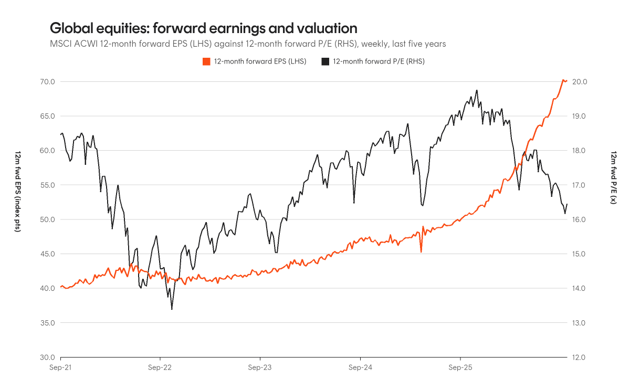
Source: LSEG/Refinitiv. Sep 2021 to Sep 2026. You cannot invest directly in an index. Actual results may differ materially from forecast.
Global equity prices have nonetheless increased this year due to the sheer strength in corporate earnings – forward earnings having increased by approximately 30% (see chart above). Strength in the global technology sector has been one factor, but there’s also been earnings strength across a range of sectors such as energy and financials.
In Australia, valuations have fallen by less but earnings have also grown by much less than global equities overall – resulting in a much more muted price performance for local stocks.
Global outlook
Globally, the two key drivers of equity performance remain the Iran war and the AI boom. While the Iran war continues, the disruption to global oil supplies will persist and risk a further significant lurch higher in oil prices. In turn, that could place further upward pressure on global inflation and risk even further rate rises from central banks.
Higher oil prices and higher interest rates could also crunch household budgets and slow economic activity. This would also result in negative consequences for investors: higher inflation yet weaker economic growth.
There’s more certainty that the AI investment boom is likely going to be with us for a while longer. Major global technology companies still have major investment plans in place for the next few years. So, AI’s support to economic activity – and inflation – will likely persist.
What’s less certain is whether investors will continue to value AI-related companies as highly as they are now, given the mounting costs being incurred in rolling out AI services and growing competition among language models, chip makers and data centre operators. Also uncertain is how much revenue will ultimately be generated from the take-up of AI services by households and businesses.
Australian outlook
In Australia, inflation remains stubbornly high. One way or another, economic growth will need to slow over the coming year to help bring down domestic price pressures in areas such as housing and market services. The only question is how much further the RBA will need to raise rates to bring this about. Betashares’ view is: the RBA will feel the need to hike rates at least once more early next year, and possibly twice, to ensure a decent slowing in domestic demand.
Even assuming the US and Iran can agree to a deal and get the global supply of oil moving again, global interest rates are likely to remain uncomfortably high for a while longer, courtesy of the AI boom.
Equity valuations, at least, have already adjusted to the reality of higher interest rates and the corporate earnings outlook remains robust, based on Betashares’ analysis of consensus analyst forecasts.
In Australia, however, the equity outlook is more challenging. In Betashares’ view, equity valuations now appear somewhat expensive relative to global peers and the earnings growth outlook here is weaker.
With local economic growth slowing under the weight of higher interest rates and falling house prices – there may be more downside risk to the local earnings outlook.
Some market commentators note that differences in economic conditions and earnings expectations between regions can influence how investors assess diversification opportunities.
From ASX
ASX content on-demand is a great way to stay up-to-date with the latest market trends and issues.
About the author
DISCLAIMER
Betashares Capital Limited (ACN 139 566 868 / AFS Licence 341181) (“Betashares”) is the issuer of this information. This is general information only and we have not taken your individual circumstances, financial objectives or needs into account when preparing it. You should consider your circumstances and obtain professional financial advice before making any investment decision. This information is not a recommendation to invest in any financial product or to adopt any particular investment strategy. Future results are impossible to predict. This information may include opinions, views, estimates and other forward-looking statements which are, by their very nature, subject to various risks and uncertainties. Actual events or results may differ materially, positively or negatively, from those reflected or contemplated in such forward-looking statements. Opinions and other forward-looking statements are subject to change without notice. Any opinions expressed are not necessarily those of Betashares.
The views, opinions or recommendations of the author in this article are solely those of the author and do not in any way reflect the views, opinions, recommendations of ASX Limited ABN 98 008 624 691 and its related bodies corporate (“ASX”). ASX makes no representation or warranty with respect to the accuracy, completeness or currency of the content. The content is for educational purposes only and does not constitute financial advice. Independent advice should be obtained from an Australian financial services licensee before making investment decisions. To the extent permitted by law, ASX excludes all liability for any loss or damage arising in any way due to or in connection with the publication of this article, including by way of negligence.
More Investor Update articles
Don’t miss the latest insights from ASX Investor Update on LinkedIn
The views, opinions or recommendations of the author in this article are solely those of the author and do not in any way reflect the views, opinions, recommendations, of ASX Limited ABN 98 008 624 691 and its related bodies corporate (“ASX”). ASX makes no representation or warranty with respect to the accuracy, completeness or currency of the content. The content is for educational purposes only and does not constitute financial advice. Independent advice should be obtained from an Australian financial services licensee before making investment decisions. To the extent permitted by law, ASX excludes all liability for any loss or damage arising in any way due to or in connection with the publication of this article, including by way of negligence.