
Outlook for listed property in FY27 and beyond
- Fri 07 August 2026
- 5 MIN READ
Opportunities and risks for Australian Real Estate Investment Trusts (A-REITs).
Key points
- The article considers the outlook for A-REITs, including sub-sectors within listed property.
- According to SG Hiscock, the bull case for A-REITs is based on valuations, interest rates, the Federal budget and population growth. The bear case includes the potential for higher bond yields and weak consumer sentiment.
- Like all investments, A-REITs have risks. A-REITs can be sensitive to rising interest rates and they have property market, occupancy, tenancy and other risks. Investing in A-REITs has information on their features, benefits and risks.

Australian Real Estate Investment Trusts (A-REITs) enter FY27 with a two-sided investment case.
In SG Hiscock’s view, several factors could influence the A-REIT sector, including interest rate settings, income distributions from listed property vehicles and potential impacts of federal budget measures on different asset classes.
However, there are A-REIT risks: real bond yields remain elevated, consumer budgets are under pressure, and artificial intelligence is reshaping property demand in ways that create both risks and opportunities.
Case for listed property in FY27
1. Valuation and income
Many traditional rent-collecting A-REITs - those focused on owning and leasing commercial property rather than developing or managing funds - may trade at material discounts to the independently assessed value of their underlying real estate.
2. Bond yields
Property is a long-duration asset class whose value is derived from future income streams, making real (inflation-adjusted) bond yields the more relevant benchmark than the cash rate.
Property has historically provided some inflation protection over the long term through rising rents, although rents are also influenced by shorter-term demand and supply conditions, meaning this relationship is not automatic.
When real bond yields are high, investors can earn a meaningful inflation-adjusted return from lower-risk assets, making it harder for property investments to compete. When real bond yields fall, that hurdle is lowered, making property income streams relatively more attractive. As a result, more capital flows into the property sector, supporting higher asset values.
Ten-year inflation-linked Commonwealth Government bond yields (see chart below) currently sit at approximately 2.5% [1], which is elevated by post-GFC standards.
Chart: Commonwealth Government 10-year bond yield
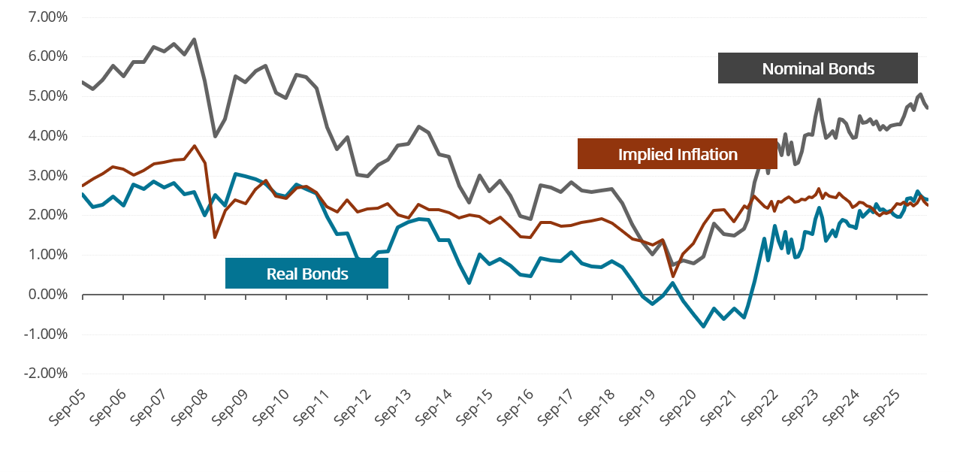
Source: SG Hiscock and Company Limited, June 2026
Changes in inflation and real bond yields may affect A-REIT valuations, although the direction and magnitude of any impact is uncertain.
3. The Budget
The Federal Budget has not made property a less attractive asset class, but it has materially shifted where investors may find the best after-tax returns.
A significant proportion of long-term commercial property returns has historically come from income rather than capital growth. In SG Hiscock’s view, commercial property is largely unaffected by the budget's residential-focused changes and becomes relatively more attractive by comparison.
Proposed restrictions on borrowing within Self-Managed Superannuation Funds (SMSFs), if legislated, may further increase the relative attractiveness of liquid, listed property vehicles.
SG Hiscock believes income-oriented investment strategies are potentially more tax-efficient under new rules in the Budget. A significant proportion of long-term commercial property returns has historically come from income rather than capital growth. Under the legislated indexed cost base framework (which applies from 1 July 2027), investors in assets where long-term capital growth broadly tracks inflation may incur little or no real capital gains tax over extended holding periods. This may increase the relative importance of recurring income in total return.
4. Population growth
Australia's population growth remains among the strongest in the developed world. Our population is expected to reach approximately 32 million by 2035, adding around 4 million people over the decade [2]. More people need more housing, more shops, more warehouses and more office space.
The supply side of that equation is also constructive. CBRE Research (see chart below) forecasts that new supply across all major property sectors will fall to 20–50% below historic levels through 2025–2030, while demand is forecast to grow across every sector, most notably office and shopping centres, where the supply shortfall is most pronounced.
Supply is falling across real estate classes, undershooting demand significantly
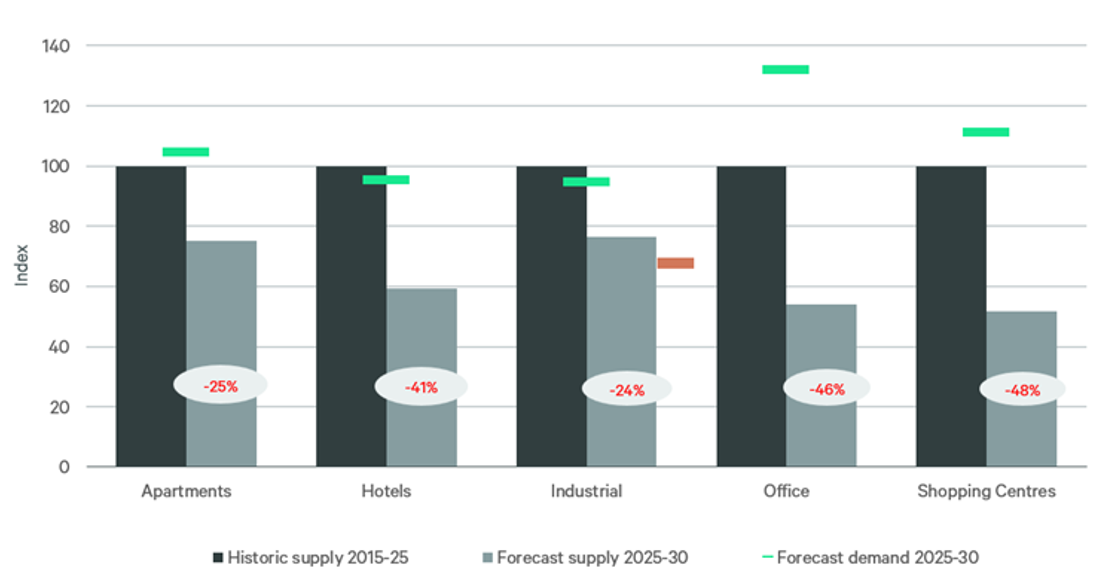
Source: CBRE Research, Pacific Market Outlook 2026 June 26 [3]
Risks for listed property in FY27
1. Real yields could stay higher for longer
The primary risk is that real bond yields do not ease, or they rise further. If inflation proves stickier than expected and the Reserve Bank maintains or lifts the cash rate, A-REIT valuations could face further pressure.
2. Consumer pressure
Higher rates and cost-of-living pressures are squeezing household budgets, which could affect tenant quality and occupancy particularly in discretionary retail and residential property. Prime retail assets have demonstrated resilience to date, but conditions may become more challenging if spending weakens through FY27.
Sub-sector listed property outlook for FY27
Office
In SG Hiscock’s view, office is the most unloved sub-sector in Australian listed property now. Gross effective rents grew across all major CBDs over the year to June 26, while office supply is constrained and vacancy is falling for prime assets [4].
Retail
Major retail groups have demonstrated that the structural threat from online retail was less severe than feared. In SG Hiscock’s view, major shopping centres have high occupancy and healthy tenancy rates. That said, their operating metrics appear to be approaching a cyclical peak.
Retail property valuations have re-rated from pandemic lows, potentially leaving less upside than other subsectors, in our view.
Industrial
Industrial property continues to benefit from e-commerce and supply chain demand, though the exceptional rental growth of 2021–2023 is now very modest, with the exception being in Brisbane.
Residential
In SG Hiscock’s view, housing demand remains strong, while building approvals remain well below the levels needed to address the supply deficit.
The budget creates a clear distinction: new housing builds retain negative gearing and offer investors a choice of capital gains tax methods at sale, while established residential property has become comparatively less attractive. This could support scaled property developers and build-to-rent platforms over the medium term.
Data Centres
Data centres represent the fastest-growing area of listed property investment but introduce unfamiliar risks.
The Australian Government has flagged legislation requiring new large-scale data centres to generate as much power as they consume and meet water efficiency standards. This adds a further layer of regulatory and cost risk to domestic data centre development [5].
There is also a strong element of speculative development in data centres, where the tenant is not secured during early-stage development, leading to increased risk.
Conclusion
Listed property in FY27 presents a range of different characteristics across A-REIT sectors and business models, including differences in income generation, asset mix, growth prospects and valuation metrics.
The structural case for A-REITs with income, population growth and the budget may provide a supportive long-term foundation for the sector. But the price you pay matters; in parts of the listed property market today, that price may be attractive, according to SG Hiscock.
However, the macro backdrop with elevated real yields, consumer pressure and AI disruption demands careful selection of listed property sub-sectors and A-REITs.
From ASX
Investing in A-REITs has information on their features, benefits and risks.
----------------------------
[1] RBA https://http://www.rba.gov.au/statistics/tables/?v=2017-05-03-03-17-44 / Bloomberg, 2026
[2] Australian Government, Centre for Population, 2025 Population Statement
[3] CBRE Research, June 26, Pacific Market Outlook 2026. Updated following the Federal Budget
[4] JLL and Macquarie Research, 2026. Based on discussions between SGH and analysts at those firms.
[5] AFR, 'Data centres forced to generate more power than they use under new laws,' Australian Financial Review’, 15 July 2026.
About the author

DISCLAIMER
SG Hiscock & Company has prepared this article for general information purposes only. Any advice that may have been given is general only and has been prepared without taking into account readers’ objectives, financial situations or needs. Readers should consider the appropriateness of the advice in light of their own objectives, financial situations or needs before acting on the advice.
This article has been prepared by SG Hiscock & Company Limited (ABN 51 097 263 628, AFSL 240679) for general information and educational purposes only. It does not constitute financial product advice and should not be relied upon as such. All opinions expressed are those of the author and do not reflect the views of ASX Limited. Past performance is not a reliable indicator of future performance. The information is current as at the date of preparation and is subject to change. Readers should obtain independent financial advice from an Australian financial services licensee before making any investment decision. Equity Trustees Limited (ABN 46 004 031 298, AFSL 240975) is the Responsible Entity for the SGH Property Income Fund. A Product Disclosure Statement and Target Market Determination are available at www.sghiscock.com.au.
More Investor Update articles
Don’t miss the latest insights from ASX Investor Update on LinkedIn
The views, opinions or recommendations of the author in this article are solely those of the author and do not in any way reflect the views, opinions, recommendations, of ASX Limited ABN 98 008 624 691 and its related bodies corporate (“ASX”). ASX makes no representation or warranty with respect to the accuracy, completeness or currency of the content. The content is for educational purposes only and does not constitute financial advice. Independent advice should be obtained from an Australian financial services licensee before making investment decisions. To the extent permitted by law, ASX excludes all liability for any loss or damage arising in any way due to or in connection with the publication of this article, including by way of negligence.