
ASX listing a pipeline for Channel Infrastructure’s future Aussie projects
- Tue 27 October 2026
- 6 MIN READ
The Kiwi firm’s first major Melbourne investment opens the door to more asset acquisitions.
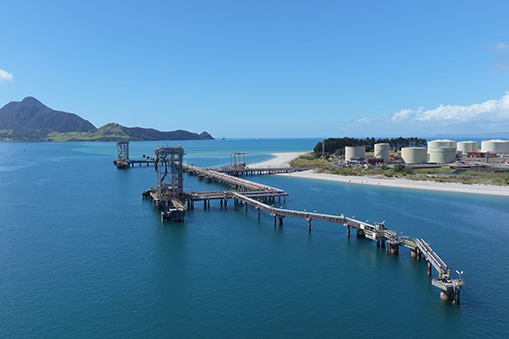
Channel Infrastructure (ASX:CHI) listed on the ASX in late 2025, around the same time it invested in Melbourne’s Somerton jet fuel pipeline. The New Zealand fuel infrastructure leader wants to lend its substantial experience to customers outside its home market to help generate shareholder returns.
As New Zealand’s largest fuel import terminal business, every year about 3.5 billion litres of fuel comes through Channel Infrastructure’s Marsden Point import terminal, north of Auckland. About 40% of New Zealand's fuel is imported, stored and distributed through the facility’s impressive infrastructure, including about 80% of the country's jet fuel.
Marsden Point is the only place in New Zealand that can berth fully laden Long Range 2 class or Suezmax vessels, the largest refined fuel vessels that visit New Zealand. In an attractive proposition for shareholders, much of Channel’s revenue is drawn from long-term contracts with its three major customers, Ampol, bp and Exxon Mobil. Channel has also recently won important new business diversifying its customer base.
“The New Zealand government has become a customer, with the completion of our storage initiative two months ago,” says Channel Infrastructure CEO, Rob Buchanan. Higgins will also join the customer base after construction of a bitumen import terminal at Marsden Point completes at the end of 2026.
Around half of Channel’s revenue is based on fixed or capacity-based contract payments, which means customers pay for Channel’s infrastructure to be available, with the balance of its revenue based on the volume of fuel that goes through its infrastructure. Channel also has take-or-pay arrangements in place. Channel’s aim is to lift the capacity of its fixed-based contracts, like the recently signed 15-year agreement with bp to store diesel and jet fuel at Marsden Point.
“These contracts are all subject to PPI indexation. So, to the extent there's inflation, our prices and revenue increase,” says Buchanan.
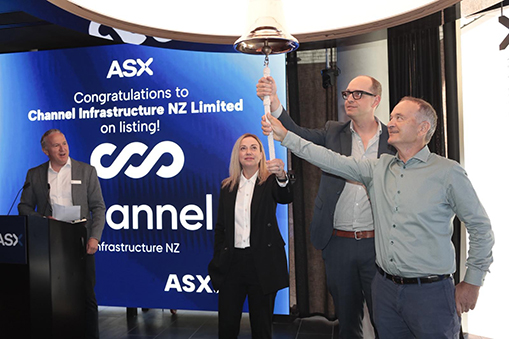
Channel Infrastructure team prepare to ring the bell at Exchange Place
As the geopolitical backdrop unfolds, Channel has adapted its assets to capture new contracted revenue. “Fuel security is a national priority, and we have more than 350 million litres of tank capacity storage available for repurposing to finished product storage to support fuel security projects and a further 45 hectares of consented, freehold land available for greenfields fuel storage projects at Marsden Point. We continue to assess other opportunities in line with our strategy and we're looking at supporting the Australian government, too,” Buchanan explains.
Capital allocation becomes pointed with so many growth paths and given how capital intensive the underlying infrastructure is. Between 8% and 10% of Channel’s annual revenues are invested just in maintenance capital to fulfil contracts. When it comes to new initiatives, capital is allocated to projects that make the most of Channel’s capabilities and experience.
“We focus on contracted revenue and above WACC returns. We are really clear about that in our investor presentations and materials, and we are fully focused on creating value for shareholders,” he says.
"Fuel security is a national priority, and we have more than 350 million litres of tank capacity storage available for repurposing."
Good decision making is critical, given the extensive real estate still available at Marsden Point. One project Channel is exploring is an international consortium’s proposal to develop a biofuels plant on the site. Buchanan says: “This is a long-term tenant that needs a significant amount of fuel storage, which is the type of contracts we look for. We remain disciplined with our shareholders capital and without contracted revenues and above WACC returns, we won't make a growth investment.”
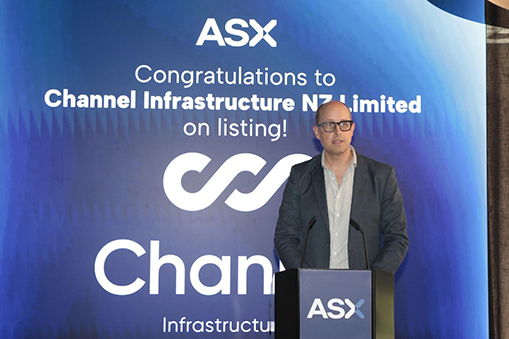
Channel Infrastructure CEO Rob Buchanan speaking at ASX’s Exchange Place
Channel’s acquisition of 25% of the Somerton jet fuel pipeline to Melbourne Airport with bp, ExxonMobil and Viva Energy is a first step in the Australian market. There is potential for future partnership opportunities to make this supply chain more efficient.
“We were really deliberate about the Somerton investment. What we love about Marsden Point is we supply all the jet fuel for Auckland Airport from there and there's a similar opportunity in Melbourne Airport’s jet fuel supply chain,” says Buchanan.
“We see long-term growth for jet fuel, as airports continue to develop new routes and we really like Melbourne Airport. It runs 24-hours, has a third runway is under construction, and new terminal infrastructure is being built. This should attract new routes and increase traffic and activity and lift demand for jet fuel.”
Given the Melbourne connection, ASX is a natural market for Channel. Half of Channel’s institutional share register is now held in Australia, with ongoing investor interest.
"We already own the single largest jet fuel pipeline in New Zealand and, as we look to add to our portfolio and deploy our world-class operating capability, Australia is a logical market in which to own more assets."
“A growth infrastructure play resonates with Australian investors. We already own the single largest jet fuel pipeline in New Zealand and, as we look to add to our portfolio and deploy our world-class operating capability, Australia is a logical market in which to own more assets. Building an Australian share register with investors who understand the market and can support us with capital to grow is an important part of our strategy,” says Buchanan.
About the author
Disclaimer
Independent advice from an Australian financial services licensee is needed before making financial decisions. This is not intended to be financial product advice. To the extent permitted by law, ASX Limited ABN 98 008 624 691 and its related bodies corporate excludes all liability for any loss or damage arising in any way including by way of negligence.
© Copyright ASX Operations Pty Limited ABN 42 004 523 782. All rights reserved 2026.