Australia’s kangaroo bond market is entering a new growth phase, with Asian issuers and investors playing a larger role as regional capital reallocates toward stable, rules‑based markets.
Debt securities issuance in Australia is rising, with kangaroo bonds a particular bright spot. Issuers are being drawn by favourable 'landed' funding costs once swaps are taken into account, deepening secondary liquidity and the ability to print long tenor paper, 10-20 years in some cases, at competitive levels.
Recent deals such as CLP Power and MTR Corporation’s kangaroo bonds highlight how Asia-Australia activity is maturing and starting to rival European markets in depth and sophistication.
These themes were front and centre at a recent ASX–BNY seminar hosted at BNY’s offices in Hong Kong, where participants from across the region discussed Australia’s role as a regional funding and investment hub, and the scope for deeper intra‑Asian use of the kangaroo market.
During the first session we explored some of the key drivers including diversification of funding, which is being looked at by both issuers and investors. Recent geopolitical events have only reinforced that trend. Australia offers a sizeable, transparent bond market operating under common law, with strong regulatory oversight and an open, well‑established institutional investor base. A rapidly growing superannuation pool is seeking high‑quality credit, including offshore, creating a natural demand for global names. For Asian investors, the combination of yield, rule of law and prudential supervision makes Australian dollar assets a compelling complement to home‑market and US dollar exposure rather than a niche yield trade.
Technology and the true cost of funds
Technology and market structure play a growing role in how issuers assess the attractiveness of the AUD market. Rather than looking only at coupon levels, treasurers increasingly focus on the true, or 'landed', cost of funds after FX and cross‑currency swaps back into home currencies. The interaction of Australian swap markets, basis levels and investor demand can make AUD funding cost‑competitive with, or even cheaper than, traditional US dollar or euro routes for some Asian credits, particularly at longer tenors.
On the infrastructure side, Australia’s post‑trade arrangements have been modernised. Austraclear has upgraded its technology stack and is moving toward greater digitisation of security creation and lifecycle management, including straight‑through upload of new issues and richer reference data. A semi‑annual release cycle supports incremental enhancements so the platform can keep pace with changing market practice and global standards while still serving local needs. These developments sit alongside work by market participants to improve transparency in debt and repo activity, helping issuers and investors better understand real pricing and depth in an otherwise OTC market.
Service providers are also applying technology to core trust and agency processes - automating cashflows, coupon and principal reconciliations, and investor reporting. For cross‑border issuers and investors, this reduces operational friction and supports higher volumes without compromising control or resilience.
Investor demand
During the second session, moderated by my colleague Frederik Van den Weghe, the discussion turned to the distinctive strength of the Australian market and how straightforward it is for offshore issuers and investors to participate. The central securities depository operates on a fully dematerialised basis; access is via standard channels such as SWIFT or a graphical interface, and back‑office functions can be located anywhere. Clear, legislated rules and oversight by the Reserve Bank of Australia and ASIC underpin confidence in the system.
Issuers do not need an on‑the‑ground presence in Australia. Securities can be deposited through recognised issuer representatives (global and local agents that already understand both Australian and international documentation norms), allowing inaugural issuers to rely on established operational and legal frameworks. On the investor side, positions can be held directly or via international platforms such as Euroclear and Clearstream, using existing bridge arrangements through global custodians.
Ease of access
Against this backdrop, intermediaries are helping to connect issuers, investors and infrastructure. As Jamie Pratt of BNY Mellon noted , “BNY and Austraclear have a longstanding partnership supporting cross‑border settlement and infrastructure for global issuers and investors. From our hubs in Hong Kong, Singapore and Sydney, we help clients access the Australian market and connect AUD issuance into regional funding corridors.” This perspective reflects a broader industry push to make Australia’s market easier to plug into regional funding and investment strategies, rather than to promote any single institution.
Taken together, these developments suggest the kangaroo bond market is evolving from an opportunistic funding option into a central component of Asia–Pacific’s fixed‑income architecture: a market where Asian issuers can secure long‑dated, competitively priced capital, and Asian investors can find diversified, well‑regulated AUD exposure anchored in robust infrastructure and governance.
For more information contact:
Email: Austraclear@asx.com.au
About the presenters
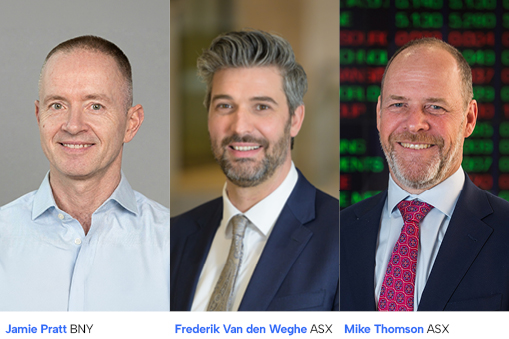
Jamie Pratt, Managing Director, Head of Corporate Trust, APAC, BNY
Based in Hong Kong, Jamie is an executive member of BNY’s Corporate Trust Executive Council and the Asia Pacific Leadership Council. With more than 25 years of experience spanning corporate trust, private capital, securitization, research, credit, coverage, and sales, Jamie joined BNY from HSBC, where he led the Issuer Services business across the Americas, delivering solutions across corporate trust, loans, structured finance, and project finance for both domestic and international transactions.
Previously, Jamie held leadership roles at BNP Paribas in London and New York within Private Capital and Corporate Trust, expanding the business across Europe and the United States with a focus on accounting, loan administration, and ancillary products and services in the Alternatives space. He also served as a securitization banker at Barclays Capital and Deutsche Bank and began his career as a structured finance lawyer in London.
Frederik Van den Weghe, General Manager, Fixed Income and Resilience, ASX
Frederik has accountability for the strategy, performance, and delivery of ASX’s Debt Capital Markets services, including Austraclear and ASX Tri-Party Collateral. With close to 20 years’ experience in financial services, Frederik has held a number of senior executive roles at ASX, including General Manager, Business Analysis and Project Delivery, Head of Product and Client Relationships, and Head of Product for Equity Post Trade.
Frederik’s international experience includes capital markets consulting roles in Paris. He holds an MBA in Entrepreneurial Management and is fluent in English, French and Swedish.
Mike Thomson, Head of Austraclear, ASX
Mike is responsible for the Austraclear CSD and Issuing and Paying Agent businesses. Mike is a banker with 30 years’ experience in providing asset servicing, trust and agency services for banking and debt capital markets with particular focus on structured finance and securitisation. During that time Mike has overseen the provision of services on thousands of debt and equity linked transactions spanning more than 40 jurisdictions and covering a broad range of industries and clients including governments, government agencies, banks, financial institutions, funds, multinational corporations, asset managers and custodians.
Mike has worked in senior executive roles in London, Hong Kong, Singapore and Sydney, building businesses and managing local and regional APAC teams in sales and relationship management, client service, analytics, operations and transaction management.
Disclaimer
Information provided is for educational purposes and does not constitute financial product advice. You should obtain independent advice from an Australian financial services licensee before making any financial decisions. Although ASX Limited ABN 98 008 624 691 and its related bodies corporate (“ASX”) has made every effort to ensure the accuracy of the information as at the date of publication, ASX does not give any warranty or representation as to the accuracy, reliability or completeness of the information. To the extent permitted by law, ASX and its employees, officers and contractors shall not be liable for any loss or damage arising in any way (including by way of negligence) from or in connection with any information provided or omitted or from any one acting or refraining to act in reliance on this information.
© Copyright ASX Operations Pty Limited ABN 42 004 523 782. All rights reserved 2026.