
Cash in your portfolio: how to make it work harder
- Fri 01 May 2026
Like all investments, holding cash has investment trade-offs to consider.
Key points
- This article considers the roles that cash plays in portfolios.
- The main benefits of cash include having funds when you need it and capital stability. The main limitations are inflation and interest rate risk.
- Short-term fixed income, which sits between cash and fixed income, may be a consideration. It has a higher risk profile than cash.

For many investors, cash can feel like a safe harbour in an uncertain world. Knowing that part of your portfolio isn't going anywhere can be deeply reassuring, particularly when markets are volatile.
But like every investment decision, holding cash involves trade-offs. Understanding what cash does well, where it falls short and what easily accessible alternatives are available, may help make your money work harder for you.
Why investors hold cash
There are three main reasons investors hold cash in their portfolios.
1. Liquidity
This is the ability to access your money when you need it. Cash is generally the most accessible asset class, though it's worth noting that certain structures, like term deposits, can limit that flexibility if you need funds before maturity.
2. Capital stability
Unlike shares or property, cash doesn't fluctuate in value. For investors who prioritise stability, this is a meaningful attribute.
3. Optionality
Cash can provide optionality for investors during market volatility. Cash can act as 'dry powder' allowing investors to act when opportunities arise, such as investing in after-market sell‑offs or reallocating when asset prices adjust, without needing to sell other assets.
How much cash should an investor hold?
There is no universal rule – neither the Australian Securities & Investments Commission (ASIC) nor the Australian Prudential Regulation Authority (APRA) prescribes a specific cash allocation. The right amount depends on your risk profile, investment time horizon and personal goals.
That said, looking at how industry super funds approach their cash holdings may offer a helpful reference point.
According to PIMCO analysis, data from major super fund websites, including Australian Super, Aware Super and Hostplus shows that cash allocations typically range from:
- 3%–5% in growth-oriented options
- 5%–9% in balanced options
- as high as 19%–45% in conservative or defensive options.
A pattern can be inferred: the more conservative or defensive your investment portfolio, the more that cash tends to feature in your portfolio.
Limitations of cash
Cash has a genuine role to play in portfolios, but it is not without risk. Here are five limitations that investors often overlook:
1. Inflation risk
Over time, inflation can eat away at the real value of your cash. If the cost of living rises faster than the interest your cash earns, you are effectively going backwards in purchasing power terms, even if your balance looks the same.
2. Interest rate risk
The income cash generates is generally not fixed. It rises and falls in line with interest rate decisions. When the Reserve Bank of Australia (RBA) cuts the cash rate, deposit rates often fall quickly, and sometimes faster than expected, reducing your income.
3. Liquidity trade-offs
Chasing a higher deposit rate often means accepting restrictions. Term deposits, for example, may lock your money away or charge fees for early access.
4. Opportunity cost
The old investing adage, time in the market beats timing the market, exists for good reason. Holding higher cash balances may result in different long-term outcomes compared to assets with higher volatility.
5. Pass-through risk
Bank deposit rates are set at the discretion of individual institutions. They can be cut quickly, inconsistently and without much notice, meaning your income from cash may not behave the way you expect.
Understanding the spectrum: cash and its neighbours
Not all cash-like options are the same, and it's worth understanding where different products sit.
- Term deposits offer a fixed rate for a set period. They are predictable, but potentially inflexible.
- Savings and cash accounts offer floating rates that move with the market. They are flexible, but your income moves up and down with RBA decisions.
- Active short-term fixed income sits one step beyond cash. It also offers a floating-style return, but one that is actively managed across multiple income sources, potentially providing more resilient outcomes than relying on a single bank's rate.
Taking one step away from cash
For investors who want to remain defensive but are concerned about falling income, short-term fixed income may be worth considering.
Think of short-term fixed income as sitting between cash and traditional bonds on the investment spectrum, designed to provide defensive characteristics while offering the potential for a more durable income stream.
Short-term fixed income has low sensitivity to interest rate movements, meaning its value doesn't swing significantly when rates change. Income is drawn from a diversified range of high-quality, short-dated securities, rather than relying on a single bank's deposit rate.
One way in which Australian investors can access this type of strategy is through short-term fixed income exchange traded funds (ETF).
A short-term fixed income ETF invests primarily in bonds with short maturities (typically under 1–3 years). These ETFs are expected to exhibit lower volatility than longer-duration bond funds and equities. However, like all bond ETFs, they remain exposed to risks including changes in interest rates, credit quality and fluctuations in income (yield)
Take for example, the PIMCO Short Term Active Yield Active ETF (ASX:EARN). EARN invests in a diversified portfolio of investment-grade Australian and global bonds, targets monthly income distributions and offers daily liquidity [1].
As at Tuesday, 31 March 2026, EARN's yield compared favourably to the average term deposit rate across Australia's four major banks (CBA, Westpac, ANZ, NAB), based on balances over A$50,000.
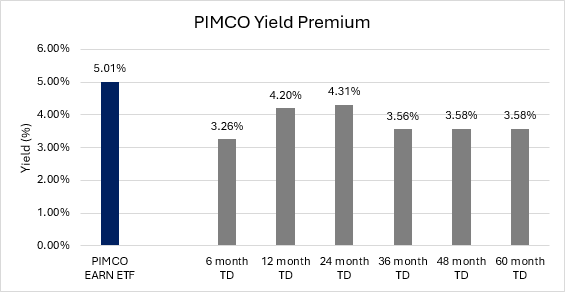
Source: CBA, Westpac, ANZ, NAB as of Tuesday, 31 March 2026. On balances over A$50,000. Average term deposit (TD) rate defined as the average rate between the big four banks in Australia. PIMCO STAY Yield is represented by PIMCO’s proprietary metric 'Carry'.
As with all investments, EARN is subject to risks, including interest rate, credit and market risk, which may impact returns.
Conclusion
Cash has a genuine and important role in portfolios. But holding too much cash, or holding it too passively in term deposits or savings accounts, may quietly cost you through inflation, interest rates or missed opportunities.
Understanding how much cash is appropriate for your goals, and where the limitations lie, is the first step to making it work harder.
For investors who want to stay defensive but improve the quality and resilience of their income, short-term fixed income may be a consideration, just one step away from cash.
From ASX
The free online Bonds Course has information on the features, benefits and risks of investing in interest rate securities.
--------------------------
[1] According to PIMCO analysis, as at Tuesday, 31 March 2026, EARN's yield compared favourably to the average term deposit rate across Australia's four major banks (CBA, Westpac, ANZ, NAB), based on balances over A$50,000.
About the author
DISCLAIMER
Investing in the bond market is subject to risks, including market, interest rate, issuer, credit, inflation risk, and liquidity risk. The value of most bonds and bond strategies are impacted by changes in interest rates. Bonds and bond strategies with longer durations tend to be more sensitive and volatile than those with shorter durations; bond prices generally fall as interest rates rise, and low interest rate environments increase this risk. Reductions in bond counterparty capacity may contribute to deceased market liquidity and increased price volatility. Bond investments may be worth more or less than the original cost redeemed. Securities and other instruments of non-U.S. issuers or collateralised by assets located outside the U.S. may be subject to unexpected regulatory changes, political and economic instability, fluctuations in currency exchange rates and different auditing and financial control standards. Swaps are a type of derivative; swaps are increasingly subject to central clearing and exchange-trading. Swaps that are not centrally cleared and exchange-traded may be less liquid than exchange-traded instruments.
The foregoing is only a description of certain key risks relating to a Strategy’s investments, and is not a complete enumeration of all risks to which a Strategy will be subject. A Strategy will be subject to numerous other risks not described herein. Prospective investors must carefully review the Documents (including, without limitation, the risk factors contained in the potential CLO’s private placement memorandum) prior to making any investment decision.
A purchase of interests involves a high degree of risk that each prospective investor must carefully consider prior to making such an investment. Investors should thoroughly review the Documents for a more complete description of these risks. All investments contain risk and may lose value. Prospective investors are advised that an investment in a private Fund is appropriate only for persons of adequate financial means who have no need for liquidity with respect to their investment and who can bear the economic risk, including the possible complete loss, of their investment.
This material (including, without limitation, certain price and other information presented herein) reflects the current opinions of the manager, and such opinions are subject to change without notice. None of PIMCO, or their respective affiliates shall have any duty to update the information contained herein. There can be no assurance that such opinions are or will remain accurate, or that other opinions or methodologies would not produce different results. Information contained herein has been obtained from sources believed to be reliable, but not guaranteed. Certain information presented herein is as of a specified reference date, and may have changed significantly since such date.
This publication contains general information only and has been prepared without taking into account the objectives, financial situation or needs of investors. Because of this, before acting on any information in this publication investors should obtain professional advice (including, if applicable, from a financial adviser) and consider whether the information is appropriate having regard to their objectives, financial situation and needs. Investors should obtain a copy of the Product Disclosure Statement (PDS) relating to the product and consider the PDS before making any decision about whether to acquire an interest in any PIMCO fund mentioned in this publication. PIMCO Australia has determined the target market for this product which is set out in the target market determination (TMD) published on our website. The current PDS and TMD can be obtained via www.pimco.com/au/
Past performance is not a reliable indicator of future results. This publication is issued by PIMCO Australia Pty Ltd ABN 54 084 280 508, AFSL 246 862. Interests in any PIMCO fund mentioned in this publication are issued by PIMCO Australia Management Limited ABN 37 611 709 507, AFSL 487 505 of which PIMCO Australia Pty Ltd is the investment manager (together PIMCO Australia). Investment management products and services offered by PIMCO Australia are offered only to persons within Australia, and are not available to persons where provision of such products or services is unlawful or unauthorised.
This publication may include economic and market commentaries based on proprietary research, which are for general information only. PIMCO Australia believes the information contained in this publication to be reliable, however its accuracy, reliability or completeness is not guaranteed. Any opinions, estimates or forecasts reflect the judgment and assumptions of PIMCO Australia based on information at the date of publication and may later change without notice. No representation, assurance, or guarantee is given that any opinions, estimates or forecasts will materialise or investments will provide any level of returns. This publication should not be taken as a recommendation of any particular security, strategy or investment product. All investments carry risk and may lose some or all of its value. To the maximum extent permitted by law, PIMCO Australia and each of their directors, employees, agents, representatives and advisers disclaim all liability to any person for any loss arising, directly or indirectly, from the information in this publication. No part of this publication may be reproduced in any form, or referred to in any other publication, without express written permission of PIMCO Australia. PIMCO is a trademark of Allianz Asset Management of America LLC in the United States and throughout the world © PIMCO, 2026.
To the extent this publication includes references to Pacific Investment Management Co LLC (PIMCO LLC) and/or any information regarding funds issued by PIMCO LLC and/or its associates, such references are to PIMCO LLC (and/or it associates, as the context requires) as the investment manager of the fund, and not as the issuer of the fund. PIMCO LLC is exempt from the requirement to hold an Australian financial services licence under the Corporations Act 2001. PIMCO LLC is regulated by the Securities and Exchange Commission under US law, which differ from Australian law. PIMCO LLC is only authorised to provide financial services to wholesale clients in Australia.
More Investor Update articles
Don’t miss the latest insights from ASX Investor Update on LinkedIn
The views, opinions or recommendations of the author in this article are solely those of the author and do not in any way reflect the views, opinions, recommendations, of ASX Limited ABN 98 008 624 691 and its related bodies corporate (“ASX”). ASX makes no representation or warranty with respect to the accuracy, completeness or currency of the content. The content is for educational purposes only and does not constitute financial advice. Independent advice should be obtained from an Australian financial services licensee before making investment decisions. To the extent permitted by law, ASX excludes all liability for any loss or damage arising in any way due to or in connection with the publication of this article, including by way of negligence.