
Defying gravity? Investing in space companies
- Fri 03 July 2026
- 5 MIN READ
SpaceX listing boosts global interest in space stocks, but understand the risks.
Key points
- This article examines the features, potential benefits and risks of investing in space-related companies.
- Interest in space companies has grown after SpaceX listed in the US in June and more use cases have emerged for space goods and services.
- Do not read this article as a recommendation to invest directly in space companies or exchange-traded (ETFs) funds that invest in space stocks. Companies associated with space operate in a complex, high-risk industry that depends on successful launches and rapid innovation. Like all investment products, ETFs have risks that investors should consider.

SpaceX’s share market debut on 12 June 2026 was monumental in many ways.
Listing on the Nasdaq under the ticker SPCX, the rocket, satellite and AI business raised US$75 billion at a valuation of approximately US$1.8 trillion. This made it the largest IPO in stock market history.
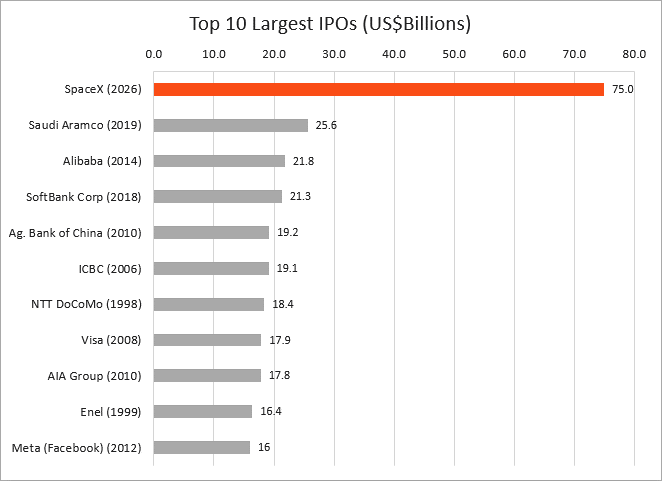
Source: Visual Capitalist [1]
SpaceX shares closed their first day of trading at US$160.95, up 19% from the initial IPO price, taking the company’s market capitalisation to US$2.1 trillion, rivalling the size of some of America’s largest technology companies including Amazon and Microsoft.
The listing marks a landmark moment for the space economy. The sheer size of this IPO highlights the potential commercial opportunities available for investors seeking new revenue streams from untapped markets including orbital data centres.
The trillion-dollar question, however, remains whether Elon Musk can make SpaceX as successful as he did Tesla when the latter IPO'd in 2010. Although Musk is a true visionary in the space race, it’s worth noting that there are other companies operating across the industry.
The LEO revolution
One fundamental driver of the massive expansion occurring across the space industry is the constellations of low Earth orbit (LEO) satellites.
These types of satellites provide low-latency communication services, and a number of companies are now generating meaningful revenues from this technology.
What’s the difference between LEO, MEO and GEO satellites?
| Low Earth Orbit (LEO) | Medium Earth Orbit (MEO) | Geosynchronous Earth Orbit (GEO) | |
|---|---|---|---|
| Orbit altitude | 160 km to 2,000 km | 2,000 km to 36,000 km | 35,786 km |
| Latency | Very low | Low | High |
| Coverage | Small | Large | Very large |
| Number of satellites to fully cover the Earth | Thousands | Six | Three |
| Ground stations | Local, many in fixed locations | Regional, flexible locations | Few, fixed locations |
| Satellite handovers | Every 10 mins | Every one hour | No need |
| Applications | Communication, imaging | Communication, navigation | Communication, broadcasting, weather, earth observation |
Source: Goldman Sachs Global Investment Research, ‘Satellites, Taking Flight, The Ecosystem and Hurdles’. March 2025.
Lower latency means faster, more responsive connectivity, and because LEO satellites are much closer to the earth’s surface than GEO satellites, the time taken for a signal to make the return trip is more than 10 times faster [2].
Speed matters in an increasingly digitalised and connected world. The trade-off for being closer to the earth is that a satellite’s field of view is narrower, and you therefore need many more satellites operating in a coordinated network or ‘constellation’ to provide constant connectivity.
SpaceX’s Starlink unit is the most prominent example with a constellation comprising over 10,000 LEO satellites, or roughly 65% of all active satellites in orbit, and serves more than 10 million subscribers globally [3]. The satellite internet division contributes approximately 60-70% of SpaceX’s total revenue [4].
Most of these revenues stem from monthly consumer internet subscriptions, government and defence agencies, but also maritime and aviation companies.
In Ukraine, Starlink became a cornerstone of civilian and military communications within hours of Russia’s 2022 invasion, supporting hospitals, railways and frontline operations after terrestrial networks were destroyed. By mid-2022, over 150,000 Ukrainians were relying on the service daily [5].
In Australia, Telstra and NSW Rural Fire Services are actively using Starlink for satellite broadband and mobile services [6].
Mobile coverage: AST SpaceMobile
While Starlink requires a dedicated terminal, an equally significant parallel technology is space-based mobile networks that connect directly to standard smartphones. The leading pure-play company here is AST SpaceMobile (ASTS).
In October 2025, the company signed a definitive commercial agreement with Verizon to provide direct-to-mobile service starting in the second half of 2026, following Verizon’s US$100 million strategic investment the prior year [7].
AST SpaceMobile has also secured agreements with AT&T and Vodafone and plans to deploy 45–60 next-generation satellites in LEO by the end of this year [8].
Although currently unprofitable [9], AST could become profitable next year as subscriber revenue and commercial services ramp up.
Space Data as a Service: Planet Labs
Beyond the infrastructure layer, space data as a service is becoming increasingly viable as sectors like defence and agriculture seek on-demand, scalable data sets to inform critical decision-making.
Planet Labs (PL) is a leader in this sector, operating the largest commercial earth observation constellation in history with over 200 satellites imaging the Earth’s entire landmass every 24 hours. PL overlays AI to generate valuable insights from this image data that are sold as a subscription, generating over 90% of revenue on a recurring basis [10]. Its client mix spans agriculture, forestry, defence, insurance and financial services.
In its most recent fiscal year, Planet Labs posted revenue of approximately US$308 million and achieved profitability for the first time. Defence and intelligence have been the key growth drivers — including a €240 million multi-year German government contract [11].
The enabler: falling launch costs
None of the above would be commercially viable without the dramatic decline in the cost of reaching orbit – a key metric underpinning the entire industry’s expansion.
Traditional launch vehicles have cost upwards of US$12,000 per kilogram to LEO. SpaceX’s Falcon 9, through reusable first-stage boosters, brought this to US$2,000–4,000 while next-generation vehicles like SpaceX’s Starship could push costs as low as US$100–200 per kilogram [12].
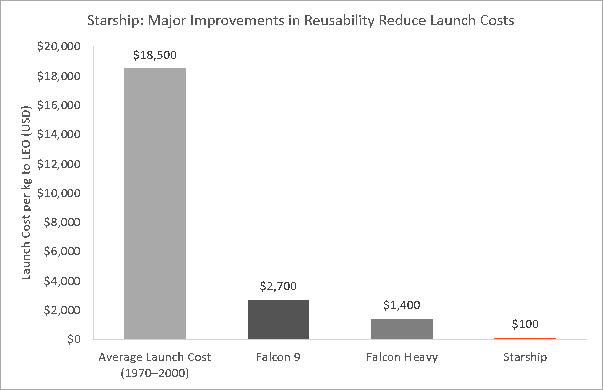
Source: SpaceX Roadshow Presentation [13].
This dynamic is self-reinforcing: lower launch costs enable larger constellations, which create more data and connectivity capacity, which attracts more commercial customers, and therefore funds further launches.
With launch capacity still a key bottleneck, vertical integration is becoming more common - traditional launch providers like Rocket Lab and Firefly Aerospace are now building their own satellites as well.
Risks
Companies associated with space operate in a capital-intensive, complex and high-risk industry that generally faces long development cycles and uncertain levels of demand.
The industry depends on successful launches and rapid innovation. Factors such as unsuccessful launches, in-orbit malfunctions and incidents, project delays, product obsolescence, cost overruns, a lack of commercialisation and changes in regulation or government and defence spending can materially affect business performance.
Also, the space industry is characterised by rapid technological change, competitive pressure and uncertain paths to profitability for some market participants. Regulatory developments may increase costs or restrict commercial activity.
Accordingly, such companies are generally subject to greater market risk, and may underperform other segments of the market or the equity market as a whole. This may cause a fund that invests in the space industry to experience higher volatility of returns than a fund that invests across a broader equity market.
Conclusion
While SpaceX remains front and centre for investors, other companies such as Rocket Lab, MDA Space and Viasat have staged some of their strongest share-price rallies in years following SpaceX’s S-1 draft filing on 1 April 2026.
The SpaceX IPO is functioning as a proof-of-concept for the entire sector, drawing capital to companies that were previously too niche or illiquid for many investors. For example, Starlink, SpaceX’s only profitable business segment, has helped validate satellite internet as a massive and commercially viable market.
The price action of SpaceX has been volatile since listing as a tight free float, intense retail demand and high expectations drive early price swings.
Exposure to the space industry can be obtained in different ways, including through individual companies or diversified products, each with differing risk profiles.
From ASX
ASX Content On-Demand provides information on latest market, sector and company trends.
-------------------------------------
[1] visualcapitalist.com/ranked-the-biggest-ipos-in-history-spacex/
[2] Goldman Sachs Global Investment Research. Goldman Sachs Global Investment Research, ‘Satellites, Taking Flight, The Ecosystem and Hurdles’. March 2025.
[3] SpaceX Roadshow Presentation.
[4] Sacra Research; The Information.
[5] x.com/FedorovMykhailo/status/1521115986711175168 (Mykhailo Fedorov, Ukraine’s Vice Prime Minister and Minister of Digital Transformation was posted on 2 May 2022… “Rough data on Starlink’s usage around 150K active users per day”)
[6] telstra.com.au/aboutus/media/media-releases/Telstra-announces-agreement-with-Starlink
[7] AST SpaceMobile press release via BusinessWire, 8 October 2025.
[8] AST SpaceMobile Q2 2025 Business Update, 11 August 2025; SEC Form 8-K filing.
[9] AST SpaceMobile Quarterly Results, ‘AST SpaceMobile Provides Business Update and First Quarter 2026 Results’.12 May 2026. AST reported a net loss attributable to common stockholders of US$191 million for the three months ended 31 March 2026.
[10] Planet Labs SEC filings.
[11] Planet Labs press release via BusinessWire, 1 July 2025.
[12] NASA Technical Reports, 'The Recent Large Reduction in Space Launch Cost', 2020; SpaceNexus, 'Space Launch Cost Comparison 2026'.
[13] content.spacex.com/cms-assets/assets/SpaceX%20IPO%20Roadshow.pdf
About the author
DISCLAIMER
There are risks associated with an investment in RCKT, including market risk, index methodology risk, international investment risk, thematic concentration risk, small and mid-cap company risk and currency risk. Investment value can go up and down. An investment in the Fund should only be considered as part of a broader portfolio, taking into account your particular circumstances, including your tolerance for risk. For more information on risks and other features of the Fund, please see the Product Disclosure Statement and Target Market Determination at www.betashares.com.au.
Betashares Capital Limited (ABN 78 139 566 868 AFSL 341181) is the issuer. The information contained in this article is general information only and does not take into account any person's financial objectives, situation or needs. Investors should consider the appropriateness of the information taking into account such factors and seek financial advice. This article is provided for information purposes only and is not a recommendation to make any investment or adopt any investment strategy.
Future outcomes are inherently uncertain. Actual outcomes may differ materially from those contemplated in any opinions, estimates or other forward-looking statements given in this article. Past performance is not indicative of future performance.
Any Betashares Fund that seeks to track the performance of a particular financial index is not sponsored, endorsed, issued, sold or promoted by the index provider. No index provider makes any representations in relation to the Betashares Funds or bears any liability in relation to the Betashares Funds.
No assurance is given that Space X or any of the companies in RCKT’s portfolio will remain in the portfolio or will be profitable investments.
More Investor Update articles
Don’t miss the latest insights from ASX Investor Update on LinkedIn
The views, opinions or recommendations of the author in this article are solely those of the author and do not in any way reflect the views, opinions, recommendations, of ASX Limited ABN 98 008 624 691 and its related bodies corporate (“ASX”). ASX makes no representation or warranty with respect to the accuracy, completeness or currency of the content. The content is for educational purposes only and does not constitute financial advice. Independent advice should be obtained from an Australian financial services licensee before making investment decisions. To the extent permitted by law, ASX excludes all liability for any loss or damage arising in any way due to or in connection with the publication of this article, including by way of negligence.