
Four strategies for investment leverage
- Fri 05 June 2026
A practical guide to benefits and risks of using geared strategies to potentially build wealth.
Key points
- This article explains four ways to use leverage investments: margin lending, leveraged or inverse exchange-traded funds (ETFs), options and warrants. The article is written for advanced investors and traders.
- Leverage can magnify gains and losses on investments. Some leveraged strategies can involve large or unlimited losses.
- Do not read this article as a recommendation to use leveraged strategies. Talk to a licensed financial adviser or do further research of your own before acting on themes in this article. ASX has a range of educational resources to help investors under the features, benefits and risks of leveraged ETFs, options and warrants.

Leverage can be a useful investment tool when used carefully. In simple terms, it allows an investor to gain a larger market exposure than the amount of capital they invest upfront. That can improve potential returns if markets move in the investor's favour. But it can also increase losses if markets move the other way.
For that reason, leverage is not just about opportunity. It is also about discipline, risk awareness and risk appetite, and choosing the right structure for the job.
Investors can access leverage in a range of ways, including margin lending, leveraged ETFs, warrants and options. Each works differently, and each comes with its own mix of benefits, risks and complexity.
1. Margin lending
Margin lending is one of the more familiar ways to use leverage. Rather than pay the full cost of a share upfront, the investor contributes part of the money and borrows the rest.
This may make it easier to potentially build a larger portfolio sooner, while still retaining direct ownership of the underlying shares. Investors may also continue to receive dividends and other benefits associated with holding those assets directly.
The main consideration is that borrowing through a margin loan increases risk. If the portfolio falls in value, losses on the investor's capital are magnified and the lender may require additional funds to restore the loan balance, commonly known as a margin call [when the value of the investment securing the loan falls, meaning the loan-to-valuation ratio exceeds the lender’s permitted limit].
Interest costs also need to be factored in as they can reduce overall returns.
Margin lending is typically used by investors who have the capacity to manage market volatility and meet additional funding requirements.
2. Leveraged ETFs
Leveraged ETFs offer geared market exposure through a listed fund that can be bought and sold on an exchange like other exchange-traded products. Unlike traditional ETFs that track market indices, leveraged ETFs are generally designed to deliver a multiple of the daily return of an index or asset. Leveraged ETFs typically use futures contracts or other derivatives to achieve leverage in the fund.
Their main attraction is convenience. Investors do not need to arrange a separate loan facility, and the product can be accessed through a standard brokerage account. This may make leveraged ETFs a consideration for traders and active investors who want to trade a bullish or bearish short-term view on market movements, cognisant that leverage magnifies gains and losses.
The key point for investors is that these products are usually designed around daily performance. Over longer periods, returns may differ from what an investor might expect if they simply multiply the benchmark's overall move, especially in volatile markets.
Fees and the effects of compounding can also influence outcomes. Depending on the gearing ratio and objectives of the investor, leveraged ETFs may be better suited to shorter-term positions.
However, in recent years, ETF product issuers have been launching ETFs with moderate levels of gearing for investors who want to get longer-term geared exposure to the market.
The ASX Investment Products Monthly Report lists a range of leveraged and inverse ETFs that investors can use to trade a positive or negative view on a market. [Inverse ETFs are designed to move in an opposite direction of a specific market index.]
3. Options
Options are among the most versatile tools available to investors. A call option gives the buyer the right to buy an asset at a set price, while a put option gives the right to sell.
Because the upfront premium is usually much lower than the value of the underlying asset, options can result in high levels of leverage. They can also be used for a range of purposes, including taking a market view, generating income, hedging a portfolio or adding downside protection.
That flexibility comes with complexity. Option prices are influenced not only by the underlying asset price, but also by time to expiry, market volatility and other pricing factors. Buyers can lose the full premium paid if the option expires without value, while some option-selling strategies can involve very large losses.
Options are best suited to investors who understand the payoff structure of their options strategy and have clear risk controls in place.
More information on the features, benefits and risks of options is available on the ASX Options knowledge hub.
4. Warrants
Warrants are exchange-traded instruments whose value is linked to an underlying asset such as a share, index or ETF. They can provide leveraged exposure because the initial outlay is typically lower than buying the underlying asset outright.
For investors, this may offer capital efficiency and a more tailored way to express a market view. Depending on the structure, warrants can also provide access to different payoff profiles and investment strategies. Unlike margin lending, the most you can lose with a warrant is your initial outlay.
The trade-off is that warrants can be more complex than direct share investing. Their value may be influenced by factors such as strike price, expiry date, volatility and the specific product terms set by the issuer.
Mini warrants, however, perform much like margin loans or contracts-for-difference (CFDs) and may be more of a consideration for investors first starting out with leveraged exposure.
In some cases, a warrant can expire worthless, resulting in a total loss of the amount invested. As such, warrants are generally more appropriate for investors who are comfortable with structured products and understand how the terms affect risk and return.
Examples of potential returns and losses
The table below uses simplified examples to show how leverage can amplify outcomes from the same share price movement.
It is illustrative only and excludes interest, fees, spreads, taxes, volatility effects and issuer-specific product terms.
Tool | Example structure | If share rises 10% | If share falls 10% | Considerations |
Margin lending | 50% investor equity, 50% borrowed | Approx. +20% on equity before interest | Approx. -20% on equity before interest | Returns and losses are magnified roughly in line with the borrowing ratio. Note: you can lose more than your initial investment |
Leveraged ETF | 2x daily exposure | Approx. +20% for a one-day 10% rise | Approx. -20% for a one-day 10% fall | Best understood on a daily basis; longer-term outcomes can diverge due to compounding. |
Warrant | Call-style exposure with embedded leverage | Potential gain depends on the leverage ratio – can be anywhere between 2x and 20x | Potential loss may be most or all of the initial investment | Upside can be amplified, but downside can reach 100% of capital invested – Most you can lose is your initial outlay |
Option | Long call option | Potential gain may be large relative to premium paid – leverage ratio can be 1x to 100x | Maximum loss for buyer is the premium paid | Small upfront cost can create high percentage sensitivity to the underlying move |
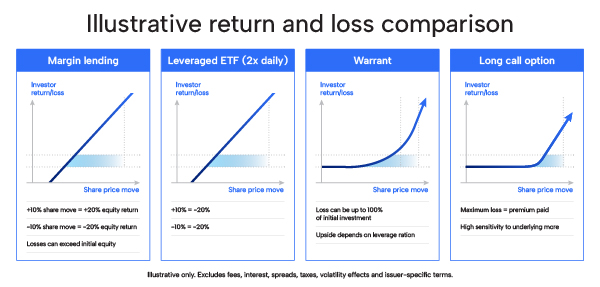
Source: ASX - Illustrative only. Excludes fees, interest, spreads, taxes, volatility effects and issuer-specific terms.
Conclusion
Leveraged tools can potentially create a steeper gain or loss profile compared to direct share investing, meaning investor outcomes can change more quickly.
Warrants and options can also behave differently depending on factors such as strike price, expiry and product design, which is why understanding the structure matters as much as the market view itself.
Leverage can play a role in an investment strategy, but it is not a one-size-fits-all solution. Margin lending offers direct ownership with borrowed funds, leveraged ETFs provide convenience through a listed structure, warrants offer tailored exposure, and options deliver broad strategic flexibility.
The most suitable approach depends on the investor's objectives, experience and tolerance for risk. In every case, it is important to weigh the potential for enhanced returns against the possibility of faster and larger losses.
From ASX
ASX Investor Education Hub provides links to a range of free ASX online tools and resources for all types of investors.
About the author
DISCLAIMER
Information provided is for educational purposes and does not constitute financial product advice. You should obtain independent advice from an Australian financial services licensee before making any financial decisions. Although ASX Limited ABN 98 008 624 691 and its related bodies corporate (“ASX”) has made every effort to ensure the accuracy of the information as at the date of publication, ASX does not give any warranty or representation as to the accuracy, reliability or completeness of the information. To the extent permitted by law, ASX and its employees, officers and contractors shall not be liable for any loss or damage arising in any way (including by way of negligence) from or in connection with any information provided or omitted or from any one acting or refraining to act in reliance on this information.
© Copyright ASX Operations Pty Limited ABN 42 004 523 782. All rights reserved 2026.
More Investor Update articles
Don’t miss the latest insights from ASX Investor Update on LinkedIn
The views, opinions or recommendations of the author in this article are solely those of the author and do not in any way reflect the views, opinions, recommendations, of ASX Limited ABN 98 008 624 691 and its related bodies corporate (“ASX”). ASX makes no representation or warranty with respect to the accuracy, completeness or currency of the content. The content is for educational purposes only and does not constitute financial advice. Independent advice should be obtained from an Australian financial services licensee before making investment decisions. To the extent permitted by law, ASX excludes all liability for any loss or damage arising in any way due to or in connection with the publication of this article, including by way of negligence.