
Pros and cons of investing in emerging markets
- Wed 11 November 2026
- 5 MIN READ
Analysts expect faster earnings growth in developing nations, but understand the risks.
Key points
- This article considers the features, benefits and risks of investing in emerging market equities. VanEck notes that analysts expect the rate of earnings growth of companies in emerging markets to significantly exceed those in developed markets.
- Like all asset classes, emerging markets have risks to consider. These include political and regulatory risk, currency risk, corporate governance risk, economic and capital-flow risk, liquidity and market-access risk. Emerging market equities have historically been more volatile than developed-market equities and are generally considered to have greater investment risk.
- Do not read this article as a recommendation to invest in emerging market equities or ETFs that provide exposure to them. Talk to a licensed financial adviser or do further research of your own before investing in emerging markets equities or ETFs over emerging market indices. Consider if an investment in an emerging markets ETF suits your financial goals, investment time horizon and risk appetite.

Investors deal with many numbers every day, but here’s one that may make you sit up: six.
According to analyst estimates compiled by Bloomberg [1], companies in the MSCI Emerging Markets Index are forecast to deliver higher earnings growth over the next 12 months than companies in the S&P/ASX 200. Forecasts are inherently uncertain and actual outcomes may differ from current expectations. Behind that forecast sits a broader investment story: global technology leaders, expanding consumer markets and stronger financial systems.
As the AI era unfolds, many of the businesses shaping its future lie beyond the United States. China is advancing lower-cost AI models, while Taiwan and South Korea are home to leading manufacturers of the semiconductors that power them.
While global growth is projected to be 2.6% this year, India is forecast to expand by 7.3%. and China by 4.5%, according to an October 2026 report from UNCTAD.
For Australian investors, emerging markets can provide exposure to companies and industries with little or no representation on the ASX, including economies and sectors experiencing different stages of economic development.
Discovering a new kind of growth
Emerging markets is a term that originated in the 1980s and is often used to describe countries or regions undergoing fast economic growth.
There is no universal agreement on which countries are ‘emerging,’ and certain countries float between developed and emerging depending on who is doing the analysis.
For example, South Korea is considered emerging by index provider MSCI but developed by FTSE. In reality, there is a subjective collection of countries that are considered ‘emerging’ and it includes some of the world’s largest economies.
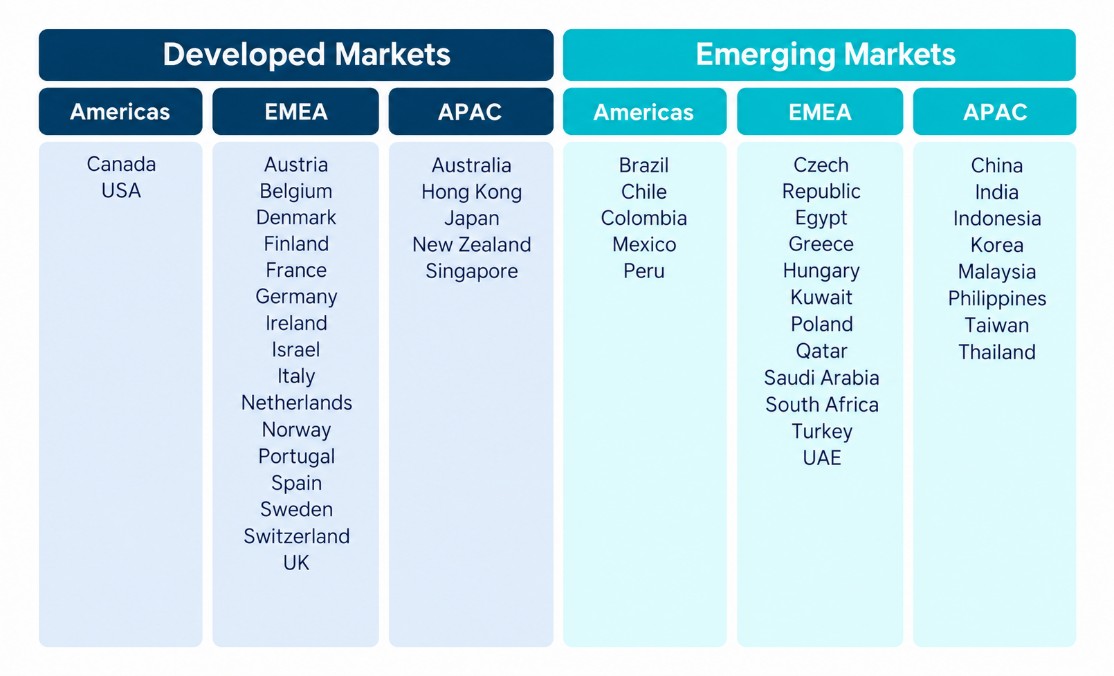
Source: MSCI, as at 20 October 2026.
Emerging markets’ fortunes were once closely tied to the commodity cycle. Rising prices benefited many commodity-exporting nations, while falling prices weighed on their performance. However, today, many emerging markets are now anchored by technology, advanced manufacturing and domestic consumption rather than commodities alone.
Emerging markets have become known for being at the forefront of innovation. Think Samsung and LG, both Korean, or the Taiwan Semiconductor Manufacturing Company. Information Technology (IT) is now the largest sector in the MSCI Emerging Markets Index, more than doubling since 2010. Among leading automobile firms, BYD, Kia and Hyundai are all out of emerging markets.
As at 16 October 2026, forecast earnings growth over the next 12 months was 52.47% for emerging markets, compared with 18.04% for developed markets excluding Australia and 8.43% for the S&P/ASX 200. (2) These forecasts were published against a backdrop of increased oil prices.. Forecasts are inherently uncertain, may change over time and are not reliable indicators of future investment performance.
A broader income world
Emerging market equities have changed significantly over the past 30 years, but the transformation in fixed income may be greater still. Many emerging economies have strengthened their financial systems by reducing reliance on foreign currency debt and developing deeper local bond markets. Central banks in these economies have adopted inflation targets and shown greater willingness to confront price pressures.
Conversely, we’ve seen increasing macroeconomic risks in the developed world - volatility from US policies (and their reversals), heightened geopolitical tensions and mounting government debt. It’s worth noting that the last major bond crises were from developed-market nations, including the UK and Japan.
In VanEck’s view, some emerging markets are performing better than historically developed markets. Broadly, emerging market countries continue to have better fundamentals compared to developed markets, including lower fiscal deficits, independent central banks and higher real rates.
Since 2023, emerging-market local currency government bonds have delivered higher returns and income with lower volatility than developed-market government bonds excluding the US, measured in US dollars [1]. As always, past performance does not indicate future performance.
Selectivity and expertise matter
Emerging markets have been outperforming developed market equities as a group this year [2] , but there is significant variation between individual emerging economies. The challenge for investors is being able to distinguish between those countries and companies that are genuinely reforming, innovating and strengthening and those that are not. This is where being selective in emerging markets is critical.
The research, depth of knowledge and ongoing monitoring required are generally beyond the time and resources of individual investors. Some investors may use professional investment managers when seeking exposure to emerging markets, while others may undertake their own research and investment selection.
For example, in our view, simply weighting companies by their size does not adequately capture this opportunity. Other investment approaches include looking beyond company size when evaluating opportunities in emerging markets.
Risks
Similar to investing in overseas developed markets, investors should be aware of the political, regulatory and tax risks that may arise from investing in emerging markets. Currency movements are an additional consideration as they can amplify or erode returns.
One of the most significant challenges for investors is access. Bond markets are generally not easily accessible to everyday investors. Some emerging markets restrict direct investment by foreign individuals. In China, for example, many companies trade only on mainland exchanges, where access for foreign investors remains restricted. Only select fund managers globally have the required licence, known as RQFII, to access these exchanges. VanEck is one such manager.
Inherently, emerging markets can also experience greater price volatility and lower trading volumes, making investments harder to sell at the desired price or time. Differences in accounting and auditing standards as well as a reduction in publicly available information are additional risks.
Bond investors in both developed and emerging markets also face the possibility that governments or companies fail to pay interest or repay their debt, while interest rate movements can affect bond values. Investing through an ETF does not remove these underlying risks.
Conclusion
The forecast growth expectations discussed in this article illustrate some of the factors that investors may consider when evaluating emerging markets alongside other investment opportunities. Forecasts may not be realised and should not be relied upon in isolation.
In VanEck's view, investors should assess emerging markets based on current economic and market conditions as well as relevant risks.
From ASX
ASX ETFs and ETPs has information on the features, benefits and risks of ETFs.
------------------------------------------
[1] Source: VanEck Research, Bloomberg. Data spans 1 January 2004 to 11 September 2026. EM local bonds represented by J.P. Morgan GBI-EM Global Diversified Index. DM bonds represented by J.P. Morgan GBI-DM Global ex-US Diversified Index.
[2] https://www.msci.com/indexes/index/891800/msci-em-emerging-markets-index-2
About the author
DISCLAIMER
Any views expressed are opinions of the author at the time of writing and is not a recommendation to act.
VanEck Investments Limited (ACN 146 596 116 AFSL 416755) (VanEck) is the issuer and responsible entity of all VanEck exchange traded funds (Funds) trading on the ASX. This information is general in nature and not personal advice, it does not take into account any person’s financial objectives, situation or needs. You should consider whether or not an investment in any Fund is appropriate for you. Investments in a Fund involve risks associated with financial markets. These risks vary depending on a Fund’s investment objective. Refer to the applicable product disclosure statement (PDS) and target market determination (TMD) available at vaneck.com.au for more details. Investment returns and capital are not guaranteed.
The views, opinions or recommendations of the author in this article are solely those of the author and do not in any way reflect the views, opinions, recommendations of ASX Limited ABN 98 008 624 691 and its related bodies corporate (“ASX”). ASX makes no representation or warranty with respect to the accuracy, completeness or currency of the content. The content is for educational purposes only and does not constitute financial advice. Independent advice should be obtained from an Australian financial services licensee before making investment decisions. To the extent permitted by law, ASX excludes all liability for any loss or damage arising in any way due to or in connection with the publication of this article, including by way of negligence.
More Investor Update articles
Don’t miss the latest insights from ASX Investor Update on LinkedIn
The views, opinions or recommendations of the author in this article are solely those of the author and do not in any way reflect the views, opinions, recommendations, of ASX Limited ABN 98 008 624 691 and its related bodies corporate (“ASX”). ASX makes no representation or warranty with respect to the accuracy, completeness or currency of the content. The content is for educational purposes only and does not constitute financial advice. Independent advice should be obtained from an Australian financial services licensee before making investment decisions. To the extent permitted by law, ASX excludes all liability for any loss or damage arising in any way due to or in connection with the publication of this article, including by way of negligence.