
The latest corporate results reporting season in February delivered a welcome surprise for income-focused investors. Aggregate dividends declared by ASX-listed companies increased, according to Argo analysis, marking a modest reversal for the local bourse after payouts had trended lower since the 2022 financial year.
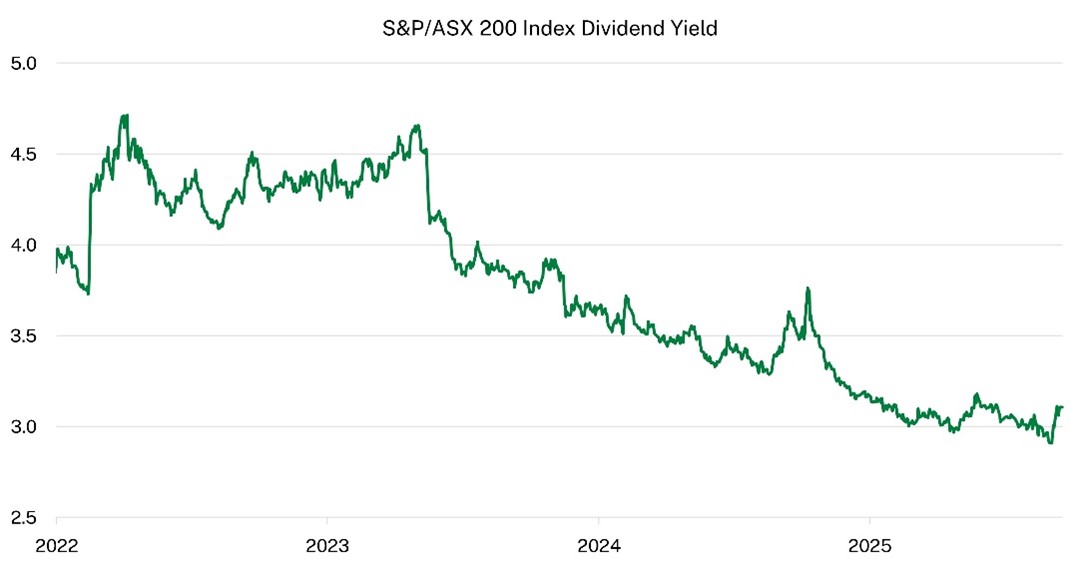
Source: Factset, June 2022 to March 2026.
Given our sharemarket’s composition, the dividend outlook can change quickly when a small number of large companies alter their dividend payout levels. That’s what we have seen over the past few years.
Why ASX dividends fell
The decline in market-wide dividends since FY2022 can largely be traced back to the major miners, particularly BHP Group (ASX:BHP) and Fortescue (ASX:FMG), which had underpinned the market’s earlier peak in dividend payouts.
In the post-COVID period, soaring commodity prices and elevated profit margins enabled these companies to generate considerable earnings and reward shareholders with generous dividends.
Those conditions were unlikely to persist indefinitely. As commodity prices normalised, so too did earnings and dividend payouts.
Consider BHP Group. Its dividend peaked in FY2022 with an annual payout of A$4.62 per share before declining to a low of A$1.70 per share by FY2025 [1].
BHP accounts for around 10%of our market [2], so that change alone has a meaningful impact on the aggregate dividend profile.
What is driving the recent turnaround?
The answer, in short, is banks and resource stocks. Together, these sectors dominate our sharemarket on a market-capitalisation basis, so changes in their dividends have an outsized effect on the overall outcome.
Encouragingly, many stocks in these sectors either lifted or maintained payouts in their latest reporting period.
The largest increases came from resource companies. Owing to robust commodity prices, particularly for copper, precious metals and rare earths, several mining businesses reported stronger earnings and lifted their dividends, in some instances materially.
BHP announced a +31.3% increase in its interim dividend relative to the previous half-year period [3].
Other resource companies also reported sizeable dividend increases, including iron ore miner Fortescue (up +24.0%) and Woodside Energy Group (ASX:WDS) (up +11.3%) [4].
The banks, which account for a significant share of the market by capitalisation, also supported the improvement in aggregate dividends by maintaining or modestly growing their payouts.
Commonwealth Bank’s (ASX:CBA) latest interim dividend rose +4.4% on the previous corresponding period, while Macquarie Group’s (ASX:MQG) rose +7.7% [5].
Bank earnings have been supported by improved operational efficiency and still-solid net interest margins (the difference between interest received and paid).
Importantly, the domestic economic backdrop has remained relatively supportive in Argo’s opinion, with low unemployment, solid wages growth and resilient economic activity contributing to lower bad debt charges, reasonable lending volumes and healthy deposit growth.
It is worth noting that, except Commonwealth Bank, most major Australian banks report financial results in May and November, while only providing trading updates during the traditional February and August reporting periods. Even so, their recent updates reinforced the positive outlook for earnings.
Outside of banks and resources, notable dividend increases included Technology One (ASX:TNE) (up +72.7%) and QBE Insurance Group (ASX:QBE) (up +23.8%) [6].
Dividend outlook
In broad terms, the outlook for aggregate Australian dividends is closely tied to commodity prices and the health of the domestic economy.
For miners, commodity prices and margins are among the key variables influencing dividend outcomes in the resources sector.
Argo Investments (ASX:ARG) expects banks to remain solid dividend contributors, too. Market estimates currently indicate earnings growth across parts of the sector, which is one of several factors that may influence dividend decisions [7].
Dividend risks
There are, however, clear risks to this dividend outlook. A global economic slowdown, including one triggered by a prolonged conflict in the Middle East, could weaken demand expectations and place downward pressure on commodity prices.
Closer to home, a significant deterioration in the Australian economy could weigh on bank earnings through slower loan growth and rising bad debts.
Inflation also remains a tangible risk. If it proves persistent, the Reserve Bank of Australia may need to adopt a more aggressive monetary policy stance (with another further interest rate rises possible after the increase in March). That could place many households under further financial strain and dampen consumer and business demand.
That said, banks are somewhat insulated, as higher rates can support net interest margins.
Other risks
A stronger dividend outlook is encouraging, but chasing yield is not without risks.
Chief among these is falling into a dividend trap. This can occur when an investor buys a stock primarily because it is offering an unusually high dividend, only to discover that the dividend was temporarily inflated or unsustainable.
To avoid this, it is critical to understand the underlying drivers of a company’s earnings. Are profits being supported by structural advantages and durable cash flows, or are they being bolstered by one-off events, such as asset sales, or cyclical tailwinds?
Mining companies illustrate the point. Their earnings are inherently cyclical because they are closely linked to commodity prices.
During the post-COVID period, many resource stocks paid generous dividends, and in some cases, special dividends as commodity prices surged. Some investors may have bought these stocks expecting those payouts to continue, only to be disappointed when earnings fell and dividends were cut.
A high payout ratio can also be a warning sign. Companies that distribute too much of their profit through dividends and leave too little capital to reinvest in their businesses may undermine their own future earnings capacity.
Using LICs for yield
One feature of the Australian LIC structure is the ability to retain profits and build reserves, subject to board decisions and prevailing condition.
In contrast, investment vehicles with a trust structure, such as Exchange Traded Funds (ETFs), must distribute all taxable income each year and therefore may produce more volatile income streams.
LICs can effectively 'save for a rainy day', which may help smooth dividends across market cycles and provide shareholders with a more stable and predictable income stream over time.
LICs can also pay fully franked dividends because, as companies, they pay Australian corporate tax on their profits and generate their own franking credits, in addition to any franking credits received from portfolio holdings.
As actively managed vehicles, LICs can also tilt their portfolios towards companies that themselves pay franked dividends. By contrast, the Australian sharemarket overall, and passively managed investments that replicate it, are only ever partially franked.
The value of franking credits is a key consideration when assessing income investments on an after-tax basis.
Like all investment structures, LICs have risks. For Australian equity LICs, these include sharemarket risk and the potential for the share price to trade below the value of the investments the LIC holds. The relatively low liquidity of some smaller LICs can exacerbate that discount.
LIC dividends are not guaranteed and may come under pressure if portfolio earnings soften over time.
Conclusion
The recent dividend improvement is encouraging, particularly after several years in which market-wide payouts were dragged lower by reduced dividends from big miners.
Even so, the market’s income profile remains heavily influenced by a relatively small number of large banks and resource companies. That means the outlook can still change quickly if commodity prices weaken or the domestic economy slows materially. Dividend sustainability is an important consideration when assessing income outcomes, alongside headline dividend yield.
From ASX
Dividend Search on the ASX website allows investors to search for dividends announcements for up to 10 companies at a time.
-----------------------------
[1] Company ASX announcements
[2] Factset
[3] Company ASX announcements
[4] Company ASX announcements
[5] Company ASX announcements
[6] Company ASX announcements
[7] Factset
DISCLAIMER
This article has been prepared by Argo Service Company Pty Ltd (ASCO) (ACN 603 367 479) (Australian Financial Services Licence 470477), on behalf of Argo Investments Limited (ACN 007 519 520).
ASCO’s Financial Services Guide is available on request or at argoinvestments.com.au.
This article contains unsolicited general information only, which does not take into account the particular objectives, financial situation or needs of any individual investor. It is not intended to be relied upon as a recommendation by any person.
Before making any decision about the information provided, an investor should consult their independent adviser and consider the appropriateness of the information, having regard to their objectives, financial situation and needs.
Past performance may not be indicative of future performance and no guarantee of future returns is implied or given. While all reasonable care has been taken when preparing this article, no responsibility is accepted for any loss, damage, cost or expense resulting directly or indirectly from any error, omission or misrepresentation in the information provided.
More Investor Update articles
Don’t miss the latest insights from ASX Investor Update on LinkedIn
The views, opinions or recommendations of the author in this article are solely those of the author and do not in any way reflect the views, opinions, recommendations, of ASX Limited ABN 98 008 624 691 and its related bodies corporate (“ASX”). ASX makes no representation or warranty with respect to the accuracy, completeness or currency of the content. The content is for educational purposes only and does not constitute financial advice. Independent advice should be obtained from an Australian financial services licensee before making investment decisions. To the extent permitted by law, ASX excludes all liability for any loss or damage arising in any way due to or in connection with the publication of this article, including by way of negligence.