All in the timing when you’re IPOing
- Wed 18 March 2026
- 10 MIN READ
The resurgence of the initial public offering market is an important opportunity for the many companies that need capital to grow. But a successful listing requires careful preparation. This Listed@ASX roundtable explores what this involves.
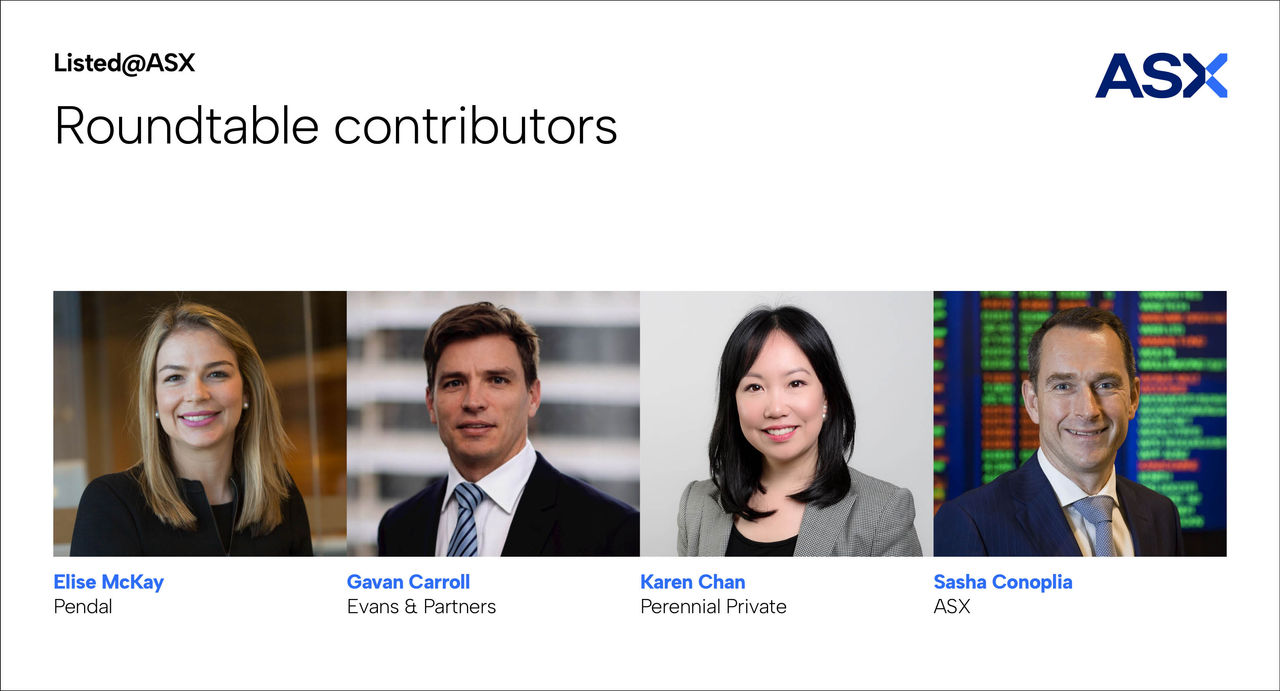
The ASX IPO market is vibrant, after 92 new listings in 2025 delivering an average 24.2% return, with more than twice the number of listings in the second half of the year versus the first. Many were substantial, with domestic as well as offshore companies coming to the ASX bourse. Industry leaders reveal what makes a successful listing and how the market might play out in 2026.
Alexandra Cain, Editor, Listed@ASX: How is the IPO market tracking and what trends are emerging?
Sasha Conoplia, Senior Manager, Listings, ASX: In 2025, we certainly saw a resurgence in IPOs and listings as companies and investors responded to some of the positive macroeconomic tailwinds. To list a few of the positives, we saw the S&P/ASX 200 index reached 20 new, all-time closing highs during 2025 and we saw a 37% increase in new listings at ASX. 16 international companies listed, of which eight were Canadian, many of those from resources. We also saw $36.8 billion in follow-on capital raised, with ASX-listed companies continuing to tap the market to raise capital.
Karen Chan, Portfolio Manager, Perennial Partners: The hunt for liquidity by private companies and private fund managers for their portfolios means the ASX is one of the key liquidity pathways.
Elise McKay, Portfolio Manager of the Horizon Fund, Pendal Group: I think the strength of the gold price and commodities overall has supported the IPO pipeline and it’s also quite interesting to look at what is happening with AI.
Sasha: The mining story is an interesting theme, if you look at commodity prices and the requirement to expand production or reinvest into developing more mines and capacity around that or M&A activity. That could drive more activity into the listing space. There has been great demand for capital from minerals, with about $12 billion raised from a total of $38 billion raised through listings last year.
Karen: AI's a really strong theme in private markets and that's also spilled into public markets. We've seen Firmus Technologies and Sharon AI come to market with pre-IPOs, which were very heavily supported with investor demand. Public markets support has also seen Sharon AI debuted on the NASDAQ in mid-February with plans for a secondary listing on ASX in 1H 2026.
Listed@ASX: Within AI, what assets are investors interested in seeing?
Karen: Neocloud and data centres are showing quite a bit of interest at the later stage as investors are showing interest in the infrastructure layer with offshore listed comparables providing guidance around the investment opportunity. More recently, we’ve seen a rotation out of software-as-a-service stocks with nearly US$1 trillion wiped from software and services stocks since Anthropic launched Claude Cowork in early February. Where AI was a tailwind for software, investors are now working through the longer-term impact. Like all disruptive technology, there will be both winners and losers. Earlier stage investors are also interested in the AI application layer. In the US, we're hearing OpenAI and Anthropic may IPO as well.
Elise: AI is a very capital-intensive industry. Businesses coming to market, or in a pre-IPO, have very high capex needs, so they need to access the market. And one very liquid pool of funding is public equity markets. So, it's a real shift for tech, which was historically a very capital light business. That will keep playing through markets.
Sasha: Goodman Group raised $4 billion for data centres last year, the largest follow-on raise of the year, and it was done very quickly, mostly overnight while ASX was closed and only at a 6.7% discount to last price.
Gavan Carroll, Managing Director, Head of Corporate Coverage, Evans & Partners: As is typically the case in technology, there's a strong lead being taken from the US and the winners there are very much where people are seeking exposure here, albeit from a more limited but growing number of opportunities, with a preference for the infrastructure layer.
"AI is a very capital-intensive industry. Businesses coming to market, or in a pre-IPO, have very high capex needs, so they need to access the market."
Listed@ASX: What’s the state of play in terms of local versus international listings?
"If you’re in that size range, then you’ll either qualify or be very close to qualifying for S&P/ASX200 flagship index inclusion and all the benefits that brings."
Sasha: Feedback suggests to IPO in the US market, where size and scale matter, you really need a market capitalisation/valuation of at least US$5 billion, some suggest even higher. With that option, you must consider what you're getting in return and how you plan to position yourself in the market.
Being part of the mega-cap S&P 500 index requires a market cap of around US$22 billion with an average market cap around US$280 billion. These mega-cap tech stocks, many of which have been hit hard by the AI-eating SaaS theme, are the ones people focus on when talking about US tech valuation, around seven times EV/forward sales.
But if you are not in that mega-cap territory and are more around a US$1 billion to $10 billion valuation, which is still an outstanding result for many companies, the US multiples fall off a cliff for those outside the S&P 500 Info Tech index to something around two times to two and a half times EV/forwards sales.
It’s been that sort of ratio as well through the cycle. But for comparable sized tech companies to the $1 billion to $10 billion listed on ASX, and of course the past few months has been difficult, but the multiples available here for similar sized companies are more around the four to five times EV/forward sales versus say two times in the US. So size matters re where you position yourself and how you will get attention in the market.
If you’re in that size range, then you’ll either qualify or be very close to qualifying for S&P/ASX 200 flagship index inclusion and all the benefits that brings. If you’re around US$400 million market cap, then the S&P/ASX 300 is also a target for inclusion.
Size matters in the US, and it matters here as well. It’s also crucial for attracting investor attention, brokerage coverage, index inclusion and returning to the market and raising capital, not just for the listing.
Listed@ASX: What about regulatory changes companies should be aware of when planning an IPO?
Sasha: The main development has been ASIC’s Fast-Track IPO process announced mid-way through 2025. It can be used by companies looking to list with a market cap at listing of more than $100 million and without any ASX escrow applying.
ASX Fast-track allows you to submit a pathfinder prospectus to ASIC a couple of weeks before the formal prospectus, aiming to reduce the IPO process by at least a week. ASIC retains the right to ask questions, which could extend the review. Feedback has been positive, as it reduces investor risk by allowing companies to enter the market more quickly and minimises market exposure. It was used by seven companies in the second half of 2025 for their ASX listing.
S&P also reduced their free float requirement for S&P/ASX index entry from 30% to 15% in the September 2025 rebalance period. Note ASX currently requires a 20% free float at listing.
Listed@ASX: How can companies position themselves to attract investors during their IPO?
Elise: Like any good relationship, trust and communication are incredibly important. Do pre-IPO roadshows and invest in relationships with institutional investors who may not participate in your IPO but might be there six or 12 months later. You need all these relationships to form a market because it doesn't stop at the IPO.
You also need clean, consistent financials. There's been examples in the past where companies have changed their accounting practices just before the IPO and restated accounts to give themselves some wiggle room to support future growth. Investors can see those accounts, and they're very good at reading them, so avoid anything that will erode confidence.
Karen: Investors want to see you can budget and meet forecasts, because once you're public, you will be providing guidance and your ability to meet or beat guidance is what you will be judged on.
Gavan: The entire finance function should ideally have been acting in a public company manner for a number of years, through audited financial periods, so they know the business and have the ability to forecast competently, and with a prudent degree of conservatism. What’s critical when raising money from new investors is the accretive and value-adding use of proceeds. This needs to be credible and complementary to the strategy articulated by management, who can deliver growing cash flows and an attractive return on invested capital over time.
Karen: Sentiment is super important, because it goes back to investor confidence. Oftentimes listed investors are fully invested, so they do need to trade out of their current stocks to put their capital into a new name. When the market confidence or sentiment doesn't support that, they're less likely to take that risk. It goes back to preparation and for companies to be ready to pull the trigger when sentiment and market conditions align.
"The entire finance function should ideally have been acting in a public company manner for a number of years… so they know the business and have the ability to forecast competently."
Elise: Especially when you've got a need for significant primary issuance.
Gavan: Have your prior year audits done before you move past your balance date into the IPO season. The company’s finance function can be doing a lot more value-added work than, for example, resolving historic accounting issues or dealing with prior year audits. When companies try to target a tight window, it can give rise to pressure on the timeline. The latter items that are actually far more important as you get closer to listing date might be competing for time with items that could have been addressed previously, be it accounting, tax, corporate governance or legal structures.
Listed@ASX: How are companies approaching valuation in the current market?

Elise: Nothing ruins an IPO more than a banker pitching an overly aggressive IPO valuation, which is unrealistic and gets the company’s hopes up. Then, the company pushes for that valuation, doesn't get the market support they need and the share price tanks on IPO. That damages long-term credibility. Find someone who gives you realistic advice about how to price an IPO for public equity markets. It's like many things in life; you benefit from under promising and over delivering.
Karen: You're transitioning your register and bringing on new investors. So, you want to give them a good experience and leave a little bit on the table, so they get that upside and continue to back the company.
Gavan: A company shouldn’t exhaust demand at the pricing of its IPO, and it’s important that the valuation is supportive for incremental buying in the aftermarket. Your new investors expect the stock to trade well, so a company doesn’t want to have exhausted that buyer interest by the pricing of its IPO. Peers are extremely important in the pricing, so favourably positioning your equity story relative to those peers is important. But also remember those peers may have been listed for many years and could well have re-rated over that time as they have demonstrated a strong record of growth and strategic execution.
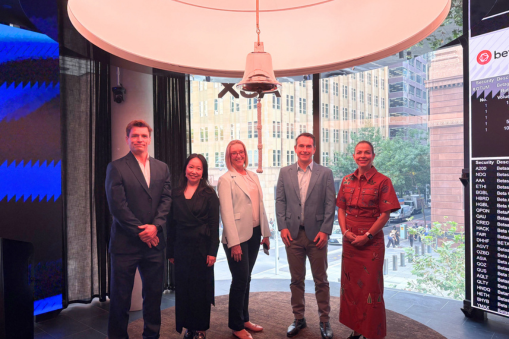
Roundtable participants Gavan Carroll, Karen Chan, Ali Cain, Sasha Conoplia and Elise McKay gather around the bell in ASX’s Exchange Place
Listed@ASX: What are the common pitfalls companies face when preparing an IPO?
Karen: We want to see a board in place at least a year before, with the right composition and a good blend of skills.
Gavan: Identify investor concerns early. If there are areas of pushback, identify and mitigate them to fortify your IPO offering.
Sasha: Take the opportunity to clean up the existing cap table. There may be an opportunity to do a pre-IPO round to allow early shareholders to get out earlier and simplify the cap table as your head towards listing and collapsing all holdings to ordinary shares.
Elise: There can be many advantages in doing pre-IPO rounds, blending that shareholder register earlier, enabling investors to have a longer time to do their diligence and build a track record, because they're the ones that will be there at the IPO to support you. Especially when you have a more complex story, or if you're doing a big raise.
Karen: Having a good investor relations strategy and communication strategy is essential, because you need to prepare your teams and employees on what it's going to be like post listing, what they can talk about and how you engage with investors post listing.
"Having a good investor relations strategy and communication strategy is essential, because you need to prepare your teams and employees on what it's going to be like post listing."
Listed@ASX: How should companies prepare for market volatility during the IPO process?
Gavan: It's maintaining flexibility on structure and timing and recognising that the optimal decision may be to temporarily defer in some specific circumstances and market conditions.
Listed@ASX: What’s your final piece of advice for companies preparing a listing?
Elise: Be prepared for that heightened scrutiny. People will ask questions on governance and disclosure, and there'll be different cultural expectations, being public. It's a stress testing of the story and being able to answer hard questions throughout your lifetime. Investor feedback is not criticism, it's a way of building deeper, more valuable relationships.
Gavan: Invest in people and processes to support your company function. You can have the most critical company with excellent prospects but make sure you're ready and appropriately resourced to deal with the rigour and scrutiny of operating as a public company.
Karen: Private companies are now thinking about liquidity but really think about whether IPOing is right for the business. Some companies may still be pivoting. They might have a long path to profitability. Public markets value predictability and the ability to meet what you said you would do. It's important you're doing it at the right time and for the right reasons.
Related links
About the author
Disclaimer
Independent advice from an Australian financial services licensee is needed before making financial decisions. This is not intended to be financial product advice. To the extent permitted by law, ASX Limited ABN 98 008 624 691 and its related bodies corporate excludes all liability for any loss or damage arising in any way including by way of negligence.
© Copyright ASX Operations Pty Limited ABN 42 004 523 782. All rights reserved 2026.