
S&P/ASX indices 101
- Thu 18 June 2026
- 10 MIN READ
ASX first published this article in March 2025 as a general guide on how index inclusion works and the key terms and methodology used. Since publication and following market consultation, S&P introduced modifications to the wider S&P/ASX Index series. Changes have been outlined below, and information has been updated to reflect the changes.
What are the changes?
Three modifications to the S&P/ASX Index Series were implemented in September 2025.
- Reduced calculation period - Prior to the change, the S&P/ASX 200 and S&P/ASX 300 consider companies for index inclusion based on a six-month average of their float-adjusted market capitalisation (market cap) and daily liquidity. This calculation period has been reduced to three months.
- Applying a two-way turnover - Prior to the change, stocks were added to an index once an existing constituent has exited the index due to a sufficiently low rank below an exit buffer. Now, once a company ranks above an index entry buffer, it can be added regardless of the ranking of other existing index constituents.
- Lower Investable Weight Factor (IWF) - The IWF is the ratio of available free float shares to total shares outstanding. It reflects the proportion of shares available for trading in the market. The minimum IWF prior to the change for index inclusion was 0.3 and this has been reduced to 0.15.

What is the impact of the changes?
These changes are intended to enhance the indices’ representativeness by allowing them to more quickly reflect changing market conditions while further aligning with S&P DJI index conventions.
So how do indices work and what are the keys to gaining index entry?
The below information has been updated as of June 2026 and is based on the S&P/ASX series of indices which is a result of a partnership between S&P Dow Jones Indices (a division of S&P Global) and ASX.
Key terms explained
An index (in the context of equity markets) is a measure of the performance of a selected group of companies – usually those that trade on one or more stock markets. In the case of the S&P/ASX index series, the companies must be listed on ASX to be eligible for index entry. The rules - outlined in publicly available methodology documents - articulate criteria by which companies will be included in an index as well as when they will be removed. In the case of the S&P/ASX indices the rules are set out in the S&P/ASX Australian Indices Methodology.
Some key concepts include:
Rebalance - Indices are reviewed at regular intervals and 'rebalanced’. The eligible company population is measured against the entry criteria, which can result in existing constituents falling out of the index, new companies entering the index and changes in 'weighting' (see below).
Float-adjusted market capitalisation (FMC) - Market capitalisation (market cap) is the number of shares multiplied by the share price. For the majority of S&P/ASX indices, the market cap used is an average of the daily market cap over a three-month period leading up to an index rebalancing reference date. For entry into the S&P/ASX 300 and above, the market cap is further refined by rebasing entry on a FMC basis. FMC is the total market cap weighted by the IWF. The IWF represents the proportion of a company’s total shares that are considered freely available for trading, as this will often feed into its liquidity. Share capital not considered available to trade includes, but is not limited to, that held by founders and management together with 'strategic' holders such as venture capital or private equity funds.
Relative liquidity - Liquidity in the context of share markets simply means how much of the stock turns over (is traded) on a regular basis (the normal measure is daily turnover in dollar value or number of securities). Relative liquidity measures how much trading has taken place in a company’s shares compared to the broader market. In the S&P/ASX Australian Indices methodology, relative liquidity is the median liquidity of an individual stock over the market liquidity – the latter of which, references the All Ordinaries index (All Ords). Individual stock median liquidity is that stock’s median daily value traded on ASX over the prior three months, divided by the float-adjusted market cap over the same three month period. The market liquidity is market capitalisation-weighted average of the stock median liquidities for the companies in the All Ords (for the S&P/ASX 300 and above 'free float' market cap is used and below that it’s full market cap).
Buffer - To minimise 'churn' (companies coming in and out of the index), there are buffers to both the entry and exit of major indices. For the S&P/ASX 300, a company is added if it meets the eligibility criteria and is ranked 274 or higher by three-month average FMC and will not be removed until it ranks 326 or lower. For the S&P/ASX 200, it’s a twenty-position buffer with entry being a rank of 179 or higher and removal at 221 or lower.
The highest ranked companies that do not exceed the buffer requirement may also be added if an existing constituent is ranked below the minimum buffer. So turnover takes place on a two-way basis.
Key S&P/ASX indices
The highest profile S&P/ASX indices are the All Ords (the largest 500 companies listed on the ASX by total market capitalisation) the S&P/ASX 200 (the largest and most liquid 200 companies on the ASX) and the S&P/ASX 300 (the largest and most liquid 300 companies on the ASX). In addition to these, there are many subsets of the S&P/ASX 300 and S&P/ASX 200 covering sectors and size segments and many thematic indices. For example, there are franking credit-adjusted indices, dividend-oriented indices, Environment Social and Governance (ESG) indices and indices covering industries such as resources or specific metals/minerals, property, healthcare, technology and many more.
Most indices are public, but there are also 'custom' indices developed by S&P specifically for certain clients (usually institutional investors). Altogether, excluding custom indices, there are over 1,000 S&P/ASX indices. Each index has a three-letter code for ease of reference.
All Ordinaries (XAO) - The All Ords (XAO) is the simplest of the indices because the only criteria to obtain entry, apart from listing on ASX, is three-month total market capitalisation (TMC). The index measures the largest 500 companies by TMC (as opposed to float-adjusted). The XAO is rebalanced twice a year in March and September. It is often seen as a proxy for the ASX 'market' even though the ASX has around 2,000 listed companies. Often you will see news services referring to the All Ords being up or down by certain percentage points which is a reference to the state of the market. The liquidity of the XAO is also used as the basis for setting the liquidity requirements for entry into the S&P/ASX 200 and S&P/ASX 300.
S&P/ASX 200 (XJO) - The XJO is often referred to as the 'benchmark' index for the Australian market. This is because many managed funds benchmark their performance against this index’s return. It also has some very large and liquid ETFs issued over it. The XJO is rebalanced quarterly (March, June, September and December).
S&P/ASX 300 (XKO) - The XKO broadens the 'benchmark' to include small and medium-sized companies by adding the next 100 largest and most liquid companies. The XKO is rebalanced semi-annually in March and September.
Foreign company inclusion criteria
S&P determines whether a company is domestic or foreign for index entry purposes. This is independent to any classification under the ASX Listing Rules as a standard 'ASX Listing' or 'Foreign Exempt Listing', or whether a listing is 'primary' or 'secondary'.
Companies that are incorporated outside Australia but are only listed on ASX are treated as domestic for index purposes.
Where companies are incorporated outside Australia and have more than one listing, S&P DJI will generally categorise them as foreign. However, if the majority (60% or more) of the company’s trading takes place on ASX for a sustained period (around 12 months), S&P DJI may reclassify the company as domestic.
For foreign companies, S&P DJI uses the amount of capital held on the Australian register to calculate their ‘quoted’ market capitalisation without applying the concept of free float discussed earlier (using a three-month average). For most foreign companies this means the number of CHESS Depositary Interests (CDIs) they have on issue. A CDI is an instrument traded on ASX that is very similar to depositary receipts used in other markets. Australia, New Zealand and certain other countries allow legal title in shares to pass electronically - negating the need for depositary receipts - so for these companies, it will simply be the number of shares held on the Australian register. In both cases, this is what is held in CHESS (maintained by ASX) and the issuer sponsored subregister (maintained by the company’s share registrar). S&P DJI uses the average number of securities held in Australia over a three-month period to give a more representative picture of the company’s Australian share capital.
ASX publishes this figure monthly in the “foreign entity report” to help S&P and the broader ecosystem understand the size of a company for S&P index entry qualification purposes.
Benefits of indices
For investors, indices provide a range of benefits including:
- measurement of the performance of a selected group of companies within a market
- a benchmark of performance for fund managers; a basis for a range of investment products which provide easy, cheap, diversified investment into a group of companies (in the case of the XJO and XKO, the largest and most liquid companies on the ASX market)
- identification of a group of companies that have desirable investment qualities such as sufficient size and liquidity to allow easy entry to and exit from the stock.
For companies, indices broaden the range of investors interested in or with a mandate to invest in the company, raise profile and add liquidity due to index trades. For example, 70% of the share capital in the XKO is institutional vs 30% retail. Furthermore, 45% of the share capital is held by overseas institutions.
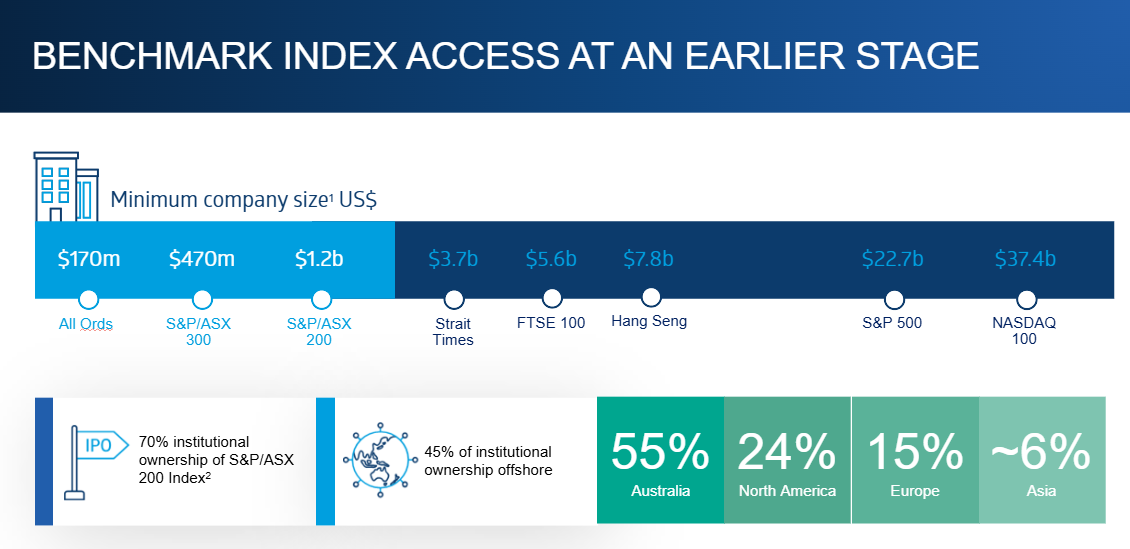
1 Bloomberg. Indicative values represent the 10th percentile of each index as a proxy for approximate entry as of 31 December 2025. S&P 500 entry sourced from S&P US Indices Methodology. ‘Company size’ is total market cap.
2 Orient Capital. Estimates based on investor holdings data. May 2024.
As capital market dynamics evolve, ASX and S&P Dow Jones Indices collaborate on index development to create new indices or modify existing indices to benefit the market. Recent examples of new indices include the S&P/ASX All Technology Index (XTX) and the S&P/ASX Agribusiness Index (XAG), where they both help identify investible companies in these specific sectors. In early 2025, a consultation proposal was approved to increase the rebalance frequency of the XAO to semi-annual to improve its currency.
Indices capture the performance of a broad range of asset classes, investable markets and specific segments. They are often referenced in financial markets - being used as benchmarks and linked to investment products. The S&P/ASX series of indices is tailored to meet the ever-evolving needs of investors and companies on ASX’s market.
Related links
About the author
Disclaimer
Independent advice from an Australian financial services licensee is needed before making financial decisions. This is not intended to be financial product advice. To the extent permitted by law, ASX Limited ABN 98 008 624 691 and its related bodies corporate excludes all liability for any loss or damage arising in any way including by way of negligence.
© Copyright ASX Operations Pty Limited ABN 42 004 523 782. All rights reserved 2026.