Geopolitical risk: positioning portfolios through volatility
- Fri 01 May 2026
How ETFs can be used to potentially build more resilient portfolios in a fast-changing world.
Key points
- This article explains how geopolitical risk affects investing and how BlackRock measures and tracks that risk.
- Exchange Traded Funds may help investors better respond to geopolitical risk and market volatility through diversification and access to a broader range of assets.
- Like all investments, ETFs are not a shield against geopolitical volatility. They can still fall in value during sudden or severe markets shocks.
Geopolitical risk is a term many investors are hearing more often following an extraordinary start to 2026.
In simple terms, geopolitical risk refers to international conflict or instability that has the potential to disrupt the global economy and financial markets. This can include war, trade conflict, supply chain disruption, cyber-attacks or political polarisation.
Recent global events, such as the Middle East conflict, have reinforced how quickly geopolitical tensions can surface and spill over into financial markets, contributing to heightened market volatility and uncertainty for investors.
At the same time, the shifts in geopolitical relationships are contributing to a more fragmented international landscape. This has exposed strains in long-standing alliances, encouraged the formation of new ones, and increased uncertainty around global trade and supply chains.
Against this backdrop, it is little surprise that geopolitical risk is front of mind for many investors.
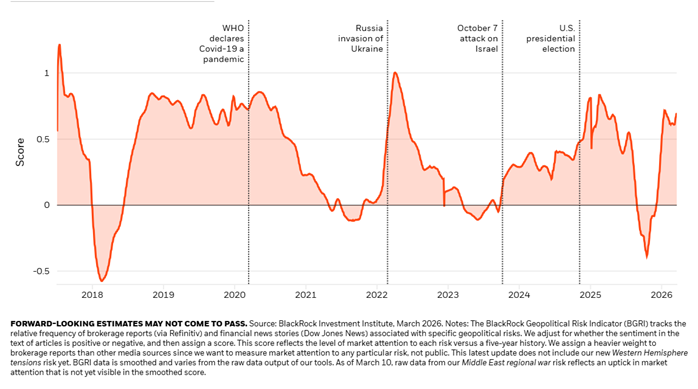
According to BlackRock’s Geopolitical Risk Indicator, market attention to geopolitical risk is close to levels last seen during the COVID-19 pandemic and Russia’s invasion of Ukraine, with risks such as the Middle East conflict, major cyber-attacks and terrorism currently assessed as having a high likelihood of impact.
Chart: BlackRock Geopolitical Risk Indicator
BlackRock views rising geopolitical fragmentation as a powerful macro force that will continue to shape the global economy for years to come, with implications for inflation, growth and volatility.
In an environment shaped by uncertainty and rapid change, how can geopolitical risk influence portfolio risk considerations?
Geopolitical volatility and portfolio implications
Geopolitical volatility can impact markets in different ways. Geopolitical risk events that disrupt global trade, energy supply or capital flows often have a more direct and immediate impact on international markets, while Australia’s domestic market may experience spillover effects through currency movements, inflation and sentiment.
Regions that rely heavily on imported energy or major trade routes, including parts of Asia and Europe, have historically been more exposed to market shocks when disruptions occur.
Although Australia is a major commodity exporter, it also imports a significant share of refined fuel and remains closely tied to global trade, meaning offshore events can still influence the local market, including fuel prices.
The Australian sharemarket’s relatively concentrated sector composition, with the financials and resources sectors playing a major role, means that we may see uneven market responses. Periods of geopolitical stress can drive higher commodity prices in which companies in the resources sector may experience a boost in earnings. At the same time, higher inflation and interest rate uncertainty could weigh on banks and broader market confidence.
For investors with international equity exposure, geopolitical risk can play out more directly. Global equities are often more sensitive to supply‑chain disruption and changes in trade and foreign policy settings, with currency movements adding another layer of variability for Australian investors.
These dynamics highlight that understanding how domestic and international equity exposures may respond differently during periods of disruption is foundational to managing geopolitical risk within a portfolio.
How ETFs can help position portfolios through geopolitical volatility [1]
Geopolitical risk is inherently uncertain, but its effects on markets may be felt through higher volatility, inflationary pressure and increased dispersion between winners and losers.
In this environment, ETFs may allow investors to adjust exposures efficiently, making it easier to access greater diversification, rather than relying on market timing or concentrated positions. Here are three potential benefits of ETFs:
1. Gain exposure to essential services and infrastructure
Recent Middle East volatility has highlighted the importance of securing energy supply and strengthening supply chains. ETFs can provide access to listed infrastructure and essential‑services companies that support critical economic activity and have historically demonstrated greater resilience during periods of volatility compared to broader equity markets.
2. Manage inflation risk driven by supply disruptions
Geopolitical events that disrupt energy and commodity markets can push up costs across the economy. Fixed income ETFs can provide exposure to asset classes that are commonly discussed in the context of inflation. Short-duration bond ETFs reprice quickly to keep up with interest rate rises, while inflation-linked bonds ensure investors’ capital value adjusts as CPI increases.
3. Use ETFs to access a broader mix of defensive assets
Although investors may have traditionally turned to bonds for portfolio protection, equities and bonds have tended to move together performance-wise in the years since the pandemic. This has prompted investors to look to other defensive exposures as part of their toolkit in times of volatility.
Investors can access some of these exposures through the expanding range of options available on the Australian ETF market.
For example, minimum-volatility ETFs aim to reduce ups and downs during market declines, while gold ETFs often move differently from shares and bonds when geopolitical tensions rise.
Key risks [2]
While ETFs can be a useful tool in building a diversified and flexible portfolio, they are not a shield against geopolitical risk. Assets that have historically behaved defensively can still fall in value, particularly during sudden or severe market shocks.
Geopolitical tensions can also ease more quickly than expected. In such cases, portfolios positioned conservatively may lag if risk assets rebound sharply.
Even broadly diversified ETFs remain exposed to market cycles, and correlations (relationships) between asset classes can rise during periods of stress.
Conclusion
The extraordinary start to 2026 has shown how quickly geopolitical risks can evolve and shape markets.
As geopolitical fragmentation accelerates and uncertainty is likely to remain a feature of global markets for some time, a disciplined, diversified approach remains central to navigating markets, with ETFs offering investors practical tools to potentially help position portfolios for resilience over the long term.
Form ASX
The free online ETFs course is designed for investors who are new to ETFs and want information on their features, benefits and risks.
------------------------
[1] Disclaimer: Diversification and asset allocation may not fully protect you from market risk.
[2] Disclaimer: Diversification and asset allocation may not fully protect you from market risk.
About the author
DISCLAIMER
Issued by: BlackRock Investment Management (Australia) Limited ABN 13 006 165 975, AFSL 230 523 ("BIMAL"). BIMAL is a part of the global BlackRock Group which comprises financial product issuers and investment managers around the world. Information provided is for illustrative and informational purposes and is subject to change. It has not been approved by any regulator.
Distribution: This material is not intended for distribution to, or use by, any person or entity in any jurisdiction or country where such distribution or use would be contrary to local law or regulation. No part of this material may be reproduced or distributed in any manner without the prior written permission of BIMAL.
General Advice: This material provides general advice only and does not take into account your individual objectives, financial situation, needs or circumstances. Before making any investment decision, you should assess whether the material is appropriate for you and obtain financial advice tailored to you having regard to your individual objectives, financial situation, needs and circumstances. Refer to BIMAL’s Financial Services Guide on its website for more information. This material is not a financial product recommendation or an offer or solicitation with respect to the purchase or sale of any financial product in any jurisdiction.
Investment Risk: Any investment is subject to investment risk, including the loss of income or the principal invested and delays on the payment of withdrawal proceeds. While any forecasts, estimates and opinions in this material are made on a reasonable basis, actual future results and operations may differ materially from the forecasts, estimates and opinions set out in this material. No guarantee as to the repayment of capital or the performance of any product or rate of return referred to in this material is made by any entity in the BlackRock group of companies.
Accuracy & Liability: BIMAL, its officers, employees and agents believe that the information in this material and the sources on which it is based (which may be sourced from third parties) are correct as at the date of publication. While every care has been taken in the preparation of this material, no warranty of accuracy or reliability is given and no responsibility for the information is accepted by BIMAL, its officers, employees or agents. Except where contrary to law, BIMAL excludes all liability for this information.
© 2026 BlackRock, Inc. or its affiliates. All Rights reserved. BLACKROCK, BLACKROCK SOLUTIONS, ALADDIN, iSHARES and the stylised i logo are registered and unregistered trademarks of BlackRock, Inc. or its affiliates. All other trademarks are those of their respective owners.
More Investor Update articles
Don’t miss the latest insights from ASX Investor Update on LinkedIn
The views, opinions or recommendations of the author in this article are solely those of the author and do not in any way reflect the views, opinions, recommendations, of ASX Limited ABN 98 008 624 691 and its related bodies corporate (“ASX”). ASX makes no representation or warranty with respect to the accuracy, completeness or currency of the content. The content is for educational purposes only and does not constitute financial advice. Independent advice should be obtained from an Australian financial services licensee before making investment decisions. To the extent permitted by law, ASX excludes all liability for any loss or damage arising in any way due to or in connection with the publication of this article, including by way of negligence.