
Time to buy tech?
- Tue 07 April 2026
Navigating the current sell-off in Australian technology stocks.
Key points
- This article considers the composition and performance of the S&P/ASX All Technology Index.
- Betashares notes that the listed Australian tech sector has historically had periods of significant price falls, but also some strong recoveries.
- Do not read this article as a recommendation to invest in tech shares or Exchange Traded Funds (ETFs) that provide exposure to the tech sector. Like all investments, ETFs have risks that investors should consider. Read more on the features, benefits and risks of ETFs.

With just a 4% weighting in the S&P/ASX 300 Index [1] (ASX 300), Australian tech companies punch above their weight in terms of investor interest.
As a small but dynamic part of Australia’s equity market, listed tech companies have historically experienced periods of outperformance against the broader Australian market and their global technology peers.
But, as the chart below shows, they have also had material drawdowns (how much an investment drops from its peak before it recovers) along the way.
The Australian technology sector has outperformed the broader market but with significant drawdowns
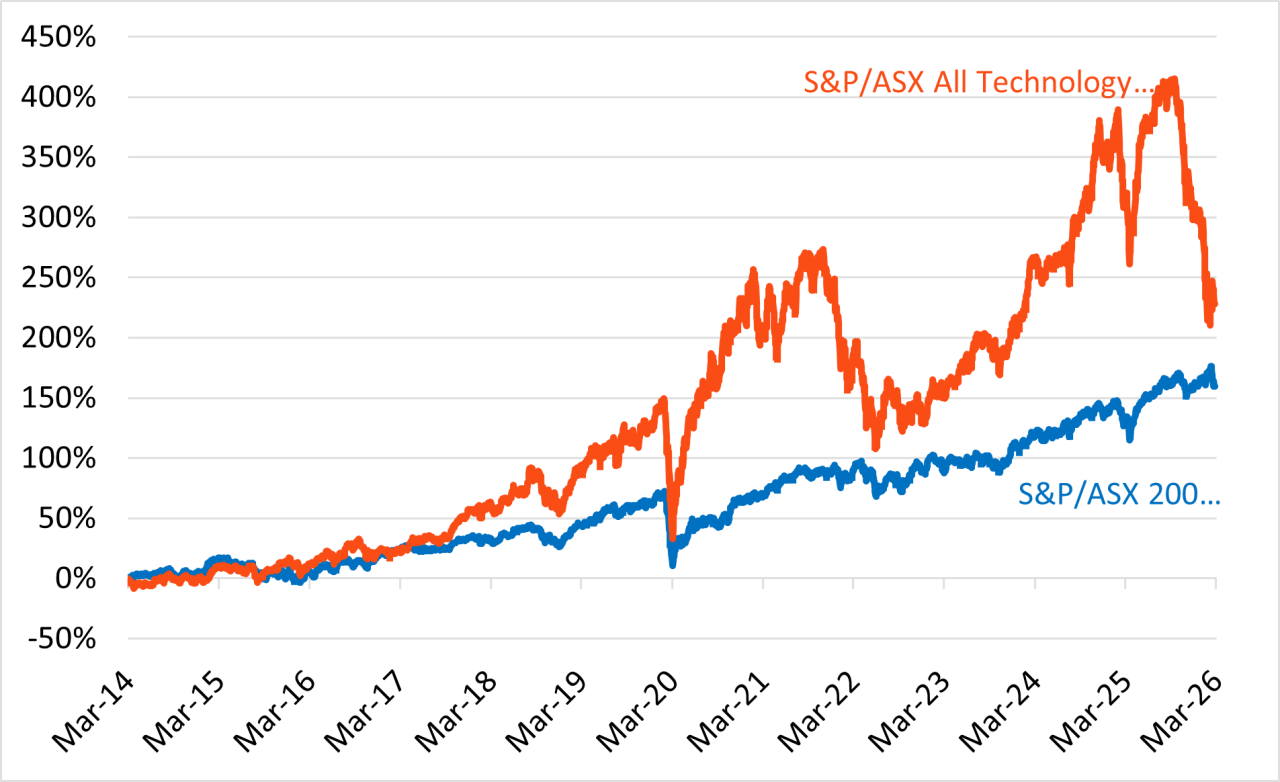
Source: Bloomberg. Since common inception 21 March 2014 to 16 March 2026. Chart is displaying total return indices. You cannot invest directly in an index. Past performance is not an indicator of future performance.
Since S&P’s launch of the S&P/ASX All Technology Index (the Index) in February 2020, investors have had a true benchmark for Australia’s technology sector, enabling analysis of both individual companies and the sector as a whole.
Amid a 35%+ drawdown from its latest peak [2] and as market uncertainty intensifies, Betashares unpacks the makeup of, and return drivers behind, the Australian tech sector and discusses the opportunities and risks ahead for investors.
Australian technology is no stranger to selloffs
While a drawdown of 35% might seem like a dramatic statistic for more 'traditional' sectors, it is not necessarily an anomaly for Australian technology.
For example, over the period from March 2014 to March 2026, the sector experienced six drawdowns of 20% or more, with three drawdowns greater than 35% since 2020, Betashares analysis shows.
Despite these historical pullbacks, over the longer term since March 2014, the sector has returned 10.1% p.a. [3] (noting the current drawdown's impact on this figure).
Australia’s listed tech sector has historically rebounded in the years following these significant sell-off troughs (remembering of course that past performance isn't indicative of future performance).
S&P/ASX All Technology Index drawdowns greater than 35% and days to recovery
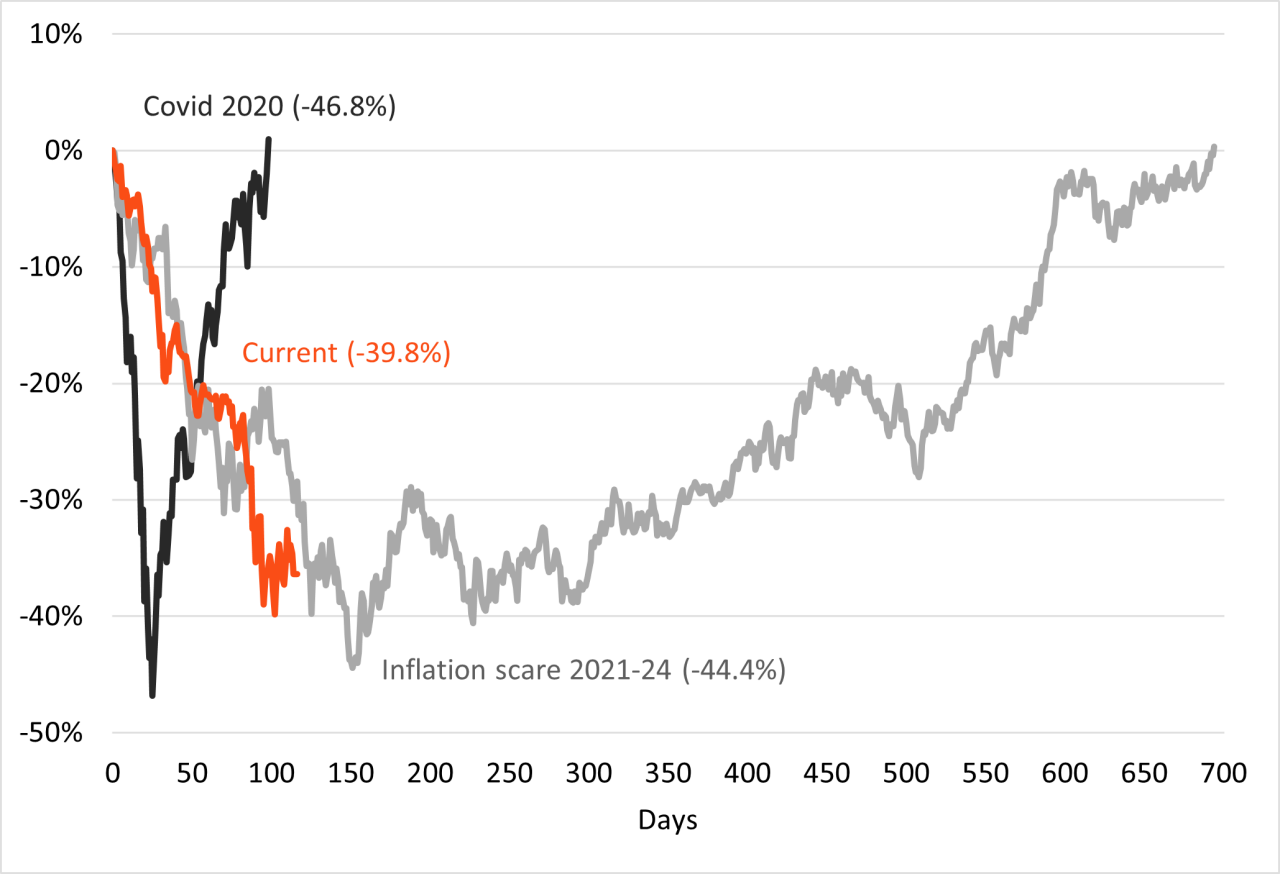
Source: Bloomberg. Since index inception 21 March 2014. Covid drawdown: 18 February 2020 to 2 July 2020. Growth scare drawdown: 19 November 2021 to 17 July 2024. Current drawdown: 6 October 2025 to 16 March 2026 (not yet recovered). You cannot invest directly in an index. Past performance is not an indicator of future performance.
Being a high-beta sector (meaning share prices tend to move more than overall market, up or down), Australia’s listed tech sector has historically experienced larger drawdowns than the broader market during growth scares, such as the March 2020 selloff due to the Coronavirus outbreak.
Additionally, the Australian tech sector is sensitive to interest rate expectations. Some tech companies attract high valuations due to strong earnings growth expectations and future upside potential.
For instance, markets pricing in higher future interest rates played a big role in both the 2022 selloff in listed tech stocks and in the current drawdown [4].
There is, however, a factor unique to the current selloff. In Betashares’ opinion, the threat from artificial intelligence (AI) to software has made the Australian tech sector particularly vulnerable and has seen its performance diverge from other regions, like the Nasdaq 100 index in the United States.
Australian technology universe
While traditional sector classifications like the Global Industry Classification Standard (GICS) identify the information technology (IT) sector, this does not guarantee that all tech companies in a market are captured within it.
In Australia for instance, Pro Medicus (ASX:PME) (a leading healthcare imaging software company) and Car Group (ASX:CAR) (an online automotive marketplace) are not classified in the IT sector, instead identified as healthcare and communication services companies respectively.
This is why S&P’s creation of the S&P/ASX All Technology Index was so important. The Index goes beyond the IT sector classification by including GICS sub-industries across sectors to capture the breadth of Australian technology companies, including:
- consumer electronics (consumer discretionary),
- health care technology (healthcare), and
- transaction and payment processing services (financials).
The result is a comprehensive portfolio of technology companies across Australia’s market.
Of the Index's 47 holdings, 31 tech companies appear in the ASX 300 yet collectively represent just 4% of that index [5]. The remaining 16 sit outside the 300 largest Australian companies entirely, meaning investors in broad market funds likely have little to no exposure to them.
Unpacking Australia’s technology sector
Examining the Australian technology sector’s composition helps to explain the current selloff.
79% of the Index’s holdings are software companies, with just 17% classified as hardware. Of the software companies, 69% operate business to business (B2B) models [6].
Compare this to the Nasdaq 100, with only 37% of current holdings classified as software companies and 42% hardware. The Nasdaq also has an almost even split of B2B versus business to consumer (B2C) models [7].
S&P/ASX All Tech | Nasdaq 100 | |
Sub-type |
|
|
Software | 79% | 37% |
Hardware | 17% | 42% |
Other | 3% | 21% |
Customer type |
|
|
B2B (software) | 69% | 45% |
B2B (all holdings) | 76% | 56% |
B2C (all holdings) | 24% | 44% |
Source: Betashares, Bloomberg. As at 13 March 2026. Sub-type and customer type as identified by Betashares by index weight.
Current concerns around AI disruption are being directed at B2B software companies as investors face uncertainty around their future profitability. The rapid advancement of AI capabilities is seen as a core threat to existing software moats that could be breached by cheaply created and implemented alternatives.
Additionally, B2B software companies relying on seat-count subscription models (where firms pay a licence fee per user) may face the threat of job reducing licence volumes across core business functions like finance (Xero, ASX:XRO) and HR/recruitment (SEEK, ASX:SEK).
Technology hardware companies, as the picks and shovels of AI infrastructure, have largely been spared this pressure.
Conclusion
In Betashares’ opinion, current investor uncertainty toward tech stocks is not misplaced. Disruption risk is a permanent feature of technology investing.
But disruption also presents potential opportunities for tech incumbents to integrate and adapt and new entrants to grow.
In a sector as dynamic and small as Australian technology, this points to the potential benefits of an indexed ETF approach.
Rather than concentrating risk in individual tech names, index ETFs can provide exposure to a broad basket of companies across a sector.
As leading companies or new disruptors grow, their weight within an index increases naturally and investors gain greater exposure to emerging winners over time while reducing exposure to those that do not adapt.
For example, the Betashares S&P/ASX Australian Technology ETF (ASX:ATEC) is one example of a product designed to track the S&P/ASX All Technology Index. This reference is provided for informational purposes only and does not constitute a recommendation.
---------------------------------------
[1] Source: Bloomberg. As at 16 March 2026. Weight of S&P/ASX All Technology Index constituents in the S&P/ASX 300.
[2] Source: Bloomberg. As at 16 March 2026.
[3] Source: Bloomberg. 21 March 2014 to 27 February 2026. Past performance is not an indicator of future performance. You cannot invest directly in an index.
[4] Source: Bloomberg, Betashares. Analysis of relationship between Australian 10-year government bond yields and S&P/ASX All Technology Index performance during historical episodes. Past performance is not an indicator of future performance.
[5] Source: Bloomberg. As at 16 March 2026. Weight of S&P/ASX All Technology Index constituents in the S&P/ASX 300.
[6] Source: Betashares, Bloomberg. As at 13 March 2026. Sub-Type and Customer Type as identified by Betashares by index weight.
[7] Source: Betashares, Bloomberg. As at 13 March 2026. Sub-Type and Customer Type as identified by Betashares by index weight.
About the author
DISCLAIMER
Betashares Capital Limited (ABN 78 139 566 868 AFSL 341181) is the issuer. This is general information only and does not take into account any person’s particular circumstances. Investors should consider their circumstances and the relevant Product Disclosure Statement, available at www.Betashares.com.au, and obtain financial advice before making any investment decision. You may also wish to consider the relevant Target Market Determination (TMD) which sets out the class of consumers that comprise the target market for the Betashares Fund and is available at www.Betashares.com.au/target-market-determinations. The value of an investment can go down as well as up.
Past performance is not indicative of future performance.
There are risks associated with an investment in ATEC, including market risk, technology sector risk and concentration risk. Investment value can go up and down. An investment in the Fund should only be considered as a part of a broader portfolio, taking into account your particular circumstances, including your tolerance for risk.
Any Betashares Fund that seeks to track the performance of a particular financial index is not sponsored, endorsed, issued, sold or promoted by the index provider. No index provider makes any representations in relation to the Betashares Funds or bears any liability in relation to the Betashares Funds.
No assurance is given that any of the companies in ATEC’s portfolio will remain in the portfolio or will be profitable investments.
More Investor Update articles
Don’t miss the latest insights from ASX Investor Update on LinkedIn
The views, opinions or recommendations of the author in this article are solely those of the author and do not in any way reflect the views, opinions, recommendations, of ASX Limited ABN 98 008 624 691 and its related bodies corporate (“ASX”). ASX makes no representation or warranty with respect to the accuracy, completeness or currency of the content. The content is for educational purposes only and does not constitute financial advice. Independent advice should be obtained from an Australian financial services licensee before making investment decisions. To the extent permitted by law, ASX excludes all liability for any loss or damage arising in any way due to or in connection with the publication of this article, including by way of negligence.