
Time to consider fixed-income?
- Wed 11 November 2026
- 5 MIN READ
Understanding the asset class, what it provides investors and its risks, may matter more than trying to pick the perfect time to invest.
Key points
- This article explains the features, benefits and risks of fixed income and how investors can access it through exchange-traded funds (ETFs).
- Macquarie argues the rise in bond yields this year has encouraged more investors to reconsider fixed interest. The key risks of fixed income include interest-rate raises credit and liquidity risk.
- Do not read this article as a recommendation to invest in bonds or ETFs providing exposure to fixed income. Like all asset classes, fixed income carries risk, as does accessing it through fixed-income ETFs. Do further research of your own or talk to a financial adviser before acting on themes in this article.

For investors more familiar with shares, fixed income can seem less intuitive. Share prices respond to company earnings, industry news and investor expectations. Bonds follow a different path, with returns influenced by factors such as interest rates, the financial strength of the issuer, and the time remaining until the bond is repaid.
For investors more familiar with shares, fixed income can seem less intuitive. Share prices respond to company earnings, industry news and investor expectations. Bonds follow a different path, with returns influenced by factors such as interest rates, the financial strength of the issuer, and the time remaining until the bond is repaid.
These differences are precisely why fixed income may be preferred by some investors. While it is not necessarily a substitute for shares; fixed income may play a complementary role to shares as it can provide income, diversification and greater portfolio resilience. Although, outcomes can vary and risks remain.
In Macquarie’s opinion, higher bond yields this year have renewed investor interest in fixed income, but understanding the asset class, what it provides investors, and its risks may matter more than trying to pick the perfect time to invest.
What is fixed income?
Fixed income describes investments such as government and corporate bonds. When an investor buys a bond, they are effectively lending money to the issuer of the bond. In return, the issuer generally agrees to make regular interest payments, known as coupons, and repay the principal at a specified maturity date in the future.
This differs from owning shares. A shareholder owns part of a company and can participate in its growth through capital gains and dividends, while also bearing the downside if its value falls. A bondholder does not participate directly in that growth. Instead, the expected return is primarily derived from income payments and the repayment of principal.
The fixed income market is broad and is significantly larger than the sharemarket globally. However, it is not homogeneous, in that government bonds, corporate bonds or higher-yielding credit can behave very differently and each carries different levels of risk. This is to say the “fixed income” label does not describe a single type of investment.
Two reasons to consider fixed income in a portfolio
1. Diversification and defence
Diversification helps investors avoid relying on one asset class or source of return. Some shares can be powerful long-term wealth creators, but equity-heavy portfolios may also experience significant volatility. Fixed income may respond differently to economic and market conditions, helping to spread portfolio risk.
Higher-quality bonds have generally been less volatile than shares and can provide a defensive component when growth slows or investor confidence weakens. However, bonds will not rise every time shares fall. Inflation, interest rates and market conditions can cause both asset classes to rise or decline together. Fixed income’s value lies in potentially improving overall portfolio balance across a range of market environments, rather than offering guaranteed protection.
The chart below shows how long it took for portfolios of 100% shares to recover after a financial crisis, compared with portfolios of 60% shares, 40% bonds. As the chart shows, portfolios that had 40% bonds recovered faster.
Chart 1: Months to recover from a crisis
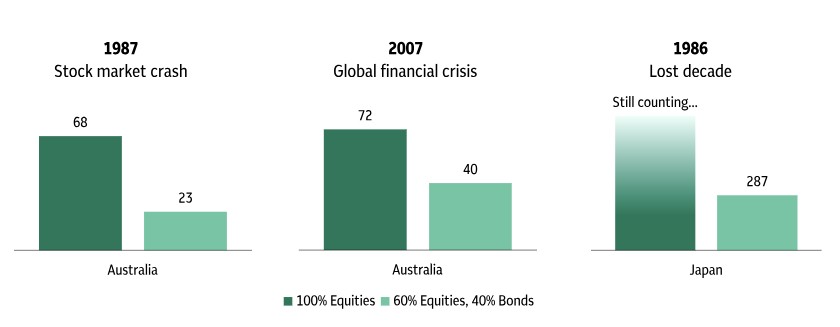
Source: Macquarie and Bloomberg. For Japan, calculation based on the *Tokyo Stock Exchange Price Index and *10-year Japanese government bonds. For Australia, calculation based on *Australian All Ordinaries index and *10-year Australian Commonwealth Government Bond. 1987 period begins October 1987, 2007 period begins November 2007, 1986 period begins December 1986.
2. Income
Bond coupons are contractual payments, unlike company dividends which can be reduced or suspended. This can make bond income more predictable, although payments still depend on the issuer meeting its obligations. Fixed income, therefore, may provide another differentiated source of portfolio income with the potential benefits of consistency and predictability.
Whilst most investors allocate to fixed income to receive regular income payments, it should be noted that bonds can also deliver capital returns (gains or losses) as the market price of a bond is not fixed.
Why fixed income has returned to investor attention
During the period of very low interest rates (after the COVID-19 pandemic in 2020), the income available from many bonds was limited. In Macquarie’s view, the subsequent rise in interest rates has seen bond yields become more attractive and encouraged investors to reconsider the asset class.
Interest rates have a large effect on bond prices. Interest rates and prices act inversely. Hence when interest rates rise, the price of existing fixed rate bonds generally falls. When interest rates fall, bond prices generally rise. This is because the coupon is set at the beginning of the life of the bond, and if interest rates rise, the coupon rate on existing bonds becomes less attractive and bond prices will generally fall. In turn, the yield will rise.
There are also floating rate bonds which are usually linked to a benchmark interest rate like the RBA cash rate. These bonds are also affected by rate changes but in a different way. An interest rate change will affect how much the bonds coupon is, so higher rates see these types of bonds paying higher yield and vice versa.
The price of bonds can often move before central banks change official interest rates, which makes it difficult to consistently time the cycle.
Rather than treating fixed income as a short-term interest rate trade, investors may find it more useful to consider the strategic role it could play in their portfolio and build an allocation that suits their objectives and risk tolerance.
Risks associated with fixed income
Fixed income is generally considered more defensive than shares, but it is not risk free. Interest-rate risk is the possibility that bond prices fall as interest rates rise, with longer-dated bond prices typically more sensitive to interest rate changes or changes in rate expectations.
Credit risk is the possibility that a company’s financial position deteriorates, or it cannot meet its payments. This risk varies materially between high-quality government bonds, companies and lower-rated issuers.
Liquidity can also vary. During market stress, some bonds may be harder or become more expensive to trade and the price, distributions and trading spread of an ETF can fluctuate with the value and liquidity of its underlying holdings.
However, a diversified fixed income ETF may reduce reliance on any single issuer, and its units can be traded on the ASX, but diversification across a range of securities and issuers does not completely eliminate risk.
How fixed income ETFs make allocating easier
Historically, directly accessing the bond market was prohibitive for many investors as most bonds do not trade on an exchange like shares and it involved buying large investment parcels. Fixed income ETFs have reduced these barriers by packaging a portfolio of bonds into a fund that trades on the ASX, to be traded in the same way as a share.
Through a single ETF trade, investors can access a diversified portfolio that may include dozens or hundreds of bonds. While individual bonds mature, an ETF can reinvest the coupon and/or principal payments when a bond matures into new securities, allowing the ETF to continually maintain a portfolio of bonds across a range of issuers, instrument types and maturities.
ETFs provide a way for investors to access fixed income exposure through a traded investment vehicle, with investment amounts generally lower than those required for purchasing many individual bonds directly. This allows investors to adjust their asset allocation based on their objectives including the need for diversification, income or a more defensive allocation.
Ease of access should not be confused with a lack of complexity – investors still need to understand what the ETF owns, how sensitive it is to interest rate and credit risk, and how it fits with the rest of their portfolio. (Like all investments, ETFs have risks. More information on the features, benefits and risks of ETFs is available here.
Fixed income ETFs have made the fixed income asset class considerably more practical to access. Used thoughtfully, they may complement shares and help build a portfolio that is potentially more diversified and resilient to a range of market conditions.
From ASX
The free online ASX Bonds course is a great way learn about the basics of fixed-income investing. The free online ASX ETF course explains the features, benefits and risks of ETFs.
About the author
DISCLAIMER
This information has been prepared by Macquarie Investment Management Global Limited (ABN 90 086 159 060 AFSL 237843) and is provided for general information purposes only. It is not, and should not be construed as, an advertisement, an invitation, an offer, a solicitation of an offer or a recommendation to participate in any investment strategy or take any other action, including to buy or sell any product or security or offer any banking or financial service or facility by any member of the Macquarie Group. This information has been prepared without taking into account any person’s objectives, financial situation or needs. Recipients should not construe the contents of this document as financial, investment or other advice. It should not be relied on in making any investment decision.
Nothing in this document constitutes a recommendation to buy, sell or hold any financial product, security or instrument.
Future results are impossible to predict. This document contains opinions, conclusions, estimates and other forward-looking statements which are, by their very nature, subject to various risks and uncertainties. Actual events or results may differ materially, positively or negatively, from those reflected or contemplated in such forward-looking statements.
No representation or warranty, express or implied, is made as to the suitability, accuracy, currency or completeness of the information, opinions and conclusions contained in this document. In preparing this document, reliance has been placed, without independent verification, on the accuracy and completeness of information available from external sources. To the maximum extent permitted by law, no member of the Macquarie Group nor its directors, employees or agents accept any liability for any loss arising from the use of this document, its contents or otherwise arising in connection with it.
Other than Macquarie Bank Limited ABN 46 008 583 542 (“Macquarie Bank”), any Macquarie Group entity noted in this website is not an authorised deposit-taking institution for the purposes of the Banking Act 1959 (Commonwealth of Australia). The obligations of these other Macquarie Group entities do not represent deposits or other liabilities of Macquarie Bank. Macquarie Bank does not guarantee or otherwise provide assurance in respect of the obligations of these other Macquarie Group entities. In addition, if this website relates to an investment, (a) the investor is subject to investment risk including possible delays in repayment and loss of income and principal invested and (b) none of Macquarie Bank or any other Macquarie Group entity guarantees any particular rate of return on or the performance of the investment, nor do they guarantee repayment of capital in respect of the investment.
The views, opinions or recommendations of the author in this article are solely those of the author and do not in any way reflect the views, opinions, recommendations, of ASX Limited ABN 98 008 624 691 and its related bodies corporate (“ASX”). ASX makes no representation or warranty with respect to the accuracy, completeness or currency of the content. The content is for educational purposes only and does not constitute financial advice. Independent advice should be obtained from an Australian financial services licensee before making investment decisions. To the extent permitted by law, ASX excludes all liability for any loss or damage arising in any way due to or in connection with the publication of this article, including by way of negligence.
More Investor Update articles
Don’t miss the latest insights from ASX Investor Update on LinkedIn
The views, opinions or recommendations of the author in this article are solely those of the author and do not in any way reflect the views, opinions, recommendations, of ASX Limited ABN 98 008 624 691 and its related bodies corporate (“ASX”). ASX makes no representation or warranty with respect to the accuracy, completeness or currency of the content. The content is for educational purposes only and does not constitute financial advice. Independent advice should be obtained from an Australian financial services licensee before making investment decisions. To the extent permitted by law, ASX excludes all liability for any loss or damage arising in any way due to or in connection with the publication of this article, including by way of negligence.