
Dividend darlings and disappointments
- Wed 07 October 2026
- 5 MIN READ
Signs of a recovery in dividend payout ratios in Australia and overseas.
Key points
- This article examines recent dividend trends among, and considers the outlook for, Australian and international companies following the latest profit-reporting season.
- Plato's analysis indicates that dividend payout ratios increased during the periods examined, following several years that Plato describes as a dividend recession.
- Do not read this article as a recommendation to invest in companies mentioned, or in funds that invest in higher dividend-paying companies. Dividends are only one factor when determining if a company is a suitable investment.

Since 2022 until around August this year, Australian income investors have been living through a quiet ‘dividend recession’ as falling commodity prices meant the big resource companies kept trimming their dividend payouts.
But the August 2026 reporting season has broken that drought.
On Plato’s data and analysis, the total dollar value of dividends declared this reporting season in the large-cap universe (S&P/ASX 200 companies) was up 13% on the corresponding prior period. We found 66% of companies raised their dividend, 10% held it flat and 24% announced cuts.
Just as important is the shape of the dividend recovery. Some domestic companies continued to pay dividends during this period, while several commodity companies increased or reinstated dividends during the latest reporting season.
What’s more, this dividend improvement isn’t confined to the ASX – Plato’s data shows global payouts also grew again last quarter.
Gold and copper
In Plato’s opinion, the gold sector, from a dividend perspective, stood out in the August reporting season. A couple of gold miners paid maiden dividends, and several established gold producers delivered dividend increases.
Copper companies also had increased dividend payouts, courtesy of the AI infrastructure build-out driving the copper price higher [copper is a key material in data centres].
Sandfire Resources (ASX:SFR) reinstated its dividend; BHP (ASX:BHP) lifted its payout by 51%, and Rio Tinto (ASX:RIO) lifted its dividend payout by 30%.
Copper now generates 54% of BHP’s earnings [1] – comfortably more than iron ore. The big Australian is now, first and foremost, a copper company. In Plato’s opinion, this is what has funded BHP’s dividend increase.
Iron ore was the main resources disappointment. As of September this year, the iron ore price was down on 12 months ago. Fortescue (ASX:FMG) – the purest iron ore exposure among the majors – cut its dividend by 23%.
Lithium went the other way. With the commodity price up strongly over the year, Mineral Resources (ASX:MIN), IGO (ASX:IGO) and PLS Group (ASX:PLS) all reinstated dividends that were suspended a few years ago.
Banks
In Plato’s opinion, the Commonwealth Bank’s (ASX:CBA) FY26 earnings result looked fine in the rear-view mirror. Full-year profit was up 7%, the dividend rose 4% and CBA’s margins were strong. But the problem may be what’s coming for the Australian banking sector.
Since the Federal Budget, banks have reported lower mortgage application volumes. CBA’s mortgage application volumes have fallen around 15%. The other Big Four banks also experienced similar falls of between 12% to 20%. [2]
However, recent mortgage application data indicates a change in operating conditions for the Australian banking sector.
Plato considers lower mortgage application volumes to be one factor that may affect future bank earnings. The extent and timing of any impact remain uncertain.
Offshore, financials are telling a different story.
The sector generated around 30% of all global dividend income in the most recent quarter – more than any other according to Plato’s analysis.
European banks and insurers, including Allianz (ALV.DE), AXA (CS.PA) and UBS (UBSG.SW), lifted dividend payouts on the back of higher interest rates and strong balance sheets, while US banks have flagged dividend increases after a solid earnings season and a clean pass on their latest financial stress tests.
Consumer stocks
The latest earnings season highlighted a growing divergence in consumer spending, with housing-exposed companies facing headwinds while supermarkets delivered strong results.
The supermarkets, meanwhile, are having a better time. Coles (ASX:COL) and Woolworths (ASX:WOW) both grew profits by around 16% and lifted dividends by a similar amount.
The squeeze on households isn’t uniquely Australian. Plato’s global developed-market data shows global dividend income from the consumer discretionary sector fell 20.9% over the quarter, with carmakers Stellantis (bit.stlam) and Porsche (ETR:P911), along with Unilever (NYSE:UL), driving the decline.
Energy sector
In Plato’s opinion, Ampol (ASX:ALD) was a dividend highlight in the latest reporting season: profit up roughly 370%, dividend up 363% on last year.
Recent high oil refining margins have boosted energy company profits and dividends, although it is uncertain how long these conditions will persist. But the forces behind them are real: Ukrainian strikes on Russian refineries, the Middle East conflict disrupting supply, and China exporting less refined product than it used to.
It is the same case globally for energy majors. Worldwide, Plato’s data shows dividend income from the energy sector jumped 11.7% for the quarter, with ExxonMobil, Chevron and Shell all raising their payouts.
This is also the case globally for energy majors. Worldwide, Plato’s data shows dividend income from the energy sector jumped 11.7% for the quarter, with ExxonMobil (XOM), Chevron (CVX) and Shell (SHEL) all raising their payouts.
Global dividends
According to Plato’s data, companies around the world grew payouts by 5.6% on average in the most recent quarter versus the same quarter a year ago.
Beyond banks and energy, rising defence budgets supported dividend growth at Lockheed Martin (NYSE: LMT), Thales (EPA: HO) and BAE Systems (LSE: BA.), while strong share prices and healthy cash flow allowed NVIDIA (NASDAQ: NVDA), Broadcom (NASDAQ: AVGO) and ASML (NASDAQ: ASML/EURONEXT: ASML) to lift their payouts.
The recent US earnings season underpins the outlook. It wasn’t just a story about a handful of mega-cap tech names - 10 of the 11 sectors reported year-on-year earnings growth, led by energy. About 86% of companies beat analyst estimates – well above the five-year average of 78%, according to Plato’s data and analysis.
US corporate earnings growth was the fastest since 2021, even after stripping out one-off gains at Alphabet (NASDAQ: GOOGL/NASDAQ: GOOG) and Amazon (NASDAQ: AMZN), according to Plato analysis.
AI is a theme to watch. It came up in more earnings calls in company results presentations than ever, but investors are starting to ask harder questions about whether all that spending will deliver revenue.
Dividend outlook
So, is there further dividend growth to come? Plato’s analysis and opinion on this question is set out below.
Plato tracks this with its proprietary models that estimate the probability of dividend cuts across both Australian and global markets.
At home, according to Plato’s dividend cut model, aggregated across the whole market, the dividend cut probability is currently sitting below its long-term average, as the chart below shows.
At the date of the analysis, Plato's model produced an aggregate dividend-cut probability below the model's long-term average– which is consistent with the strong dividend increases in the August reporting season.
Dividend outlook within normal range
Average % change of dividend cuts for Australian market
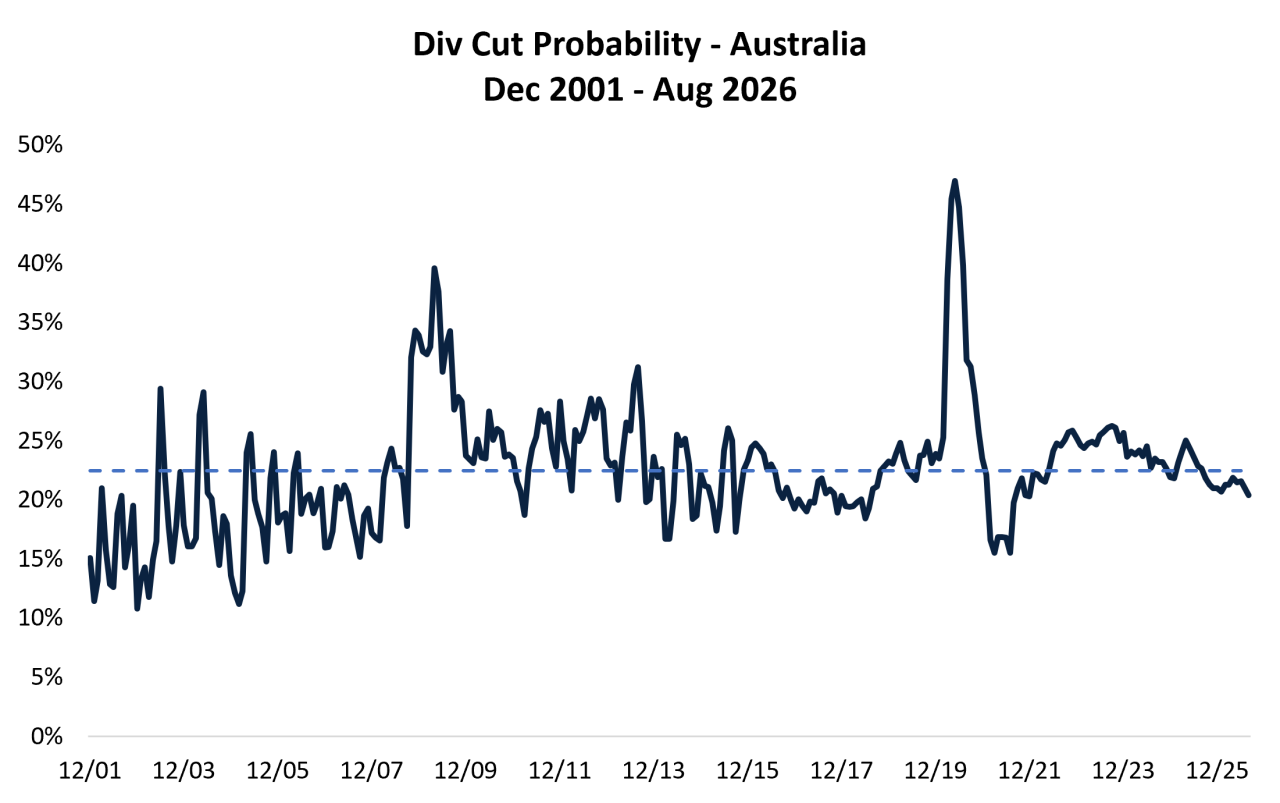
Source: Plato Investment Management
The global model tells a similar story. According to Plato’s model, the risk of a cut in dividends in global developed markets sits slightly below its long-term average, even with ongoing geopolitical tensions in the background. The recent US earnings results are among the inputs Plato considers when assessing dividend-cut risk.
Global dividend cut probability

Source: Plato Investment Management
At the date of analysis, Plato's models indicated that estimated dividend-cut risk was below the models' respective long-term averages in Australia and global developed markets. Actual dividend outcomes may differ materially from model estimates.
Risks to dividend outlook
Globally, risk isn’t evenly spread. Persistent inflation is squeezing consumer-facing names, such as household appliance makers and beverage companies.
Also, tariffs and the ongoing tension around Iran continue to disrupt shipping routes and air travel.
In Australia, higher interest rates and bond yields produce winners and losers in the sharemarket, but broadly speaking this environment can weigh on company valuations, consumer spending and cash available for dividends.
Changes in AI infrastructure spending may affect copper demand. In turn, this may affect the earnings and dividend decisions of some Australian miners. Diversification is one approach some investors use to manage exposure to company-specific, sector and geographic risks. Its suitability depends on an investor's objectives, financial circumstances and needs.
From ASX
Dividend Search allows investors to search dividends for up to 10 ASX-listed companies at a time.
-----------------------------------------
Sources
[1] BHP FY26 Results Announcement. 54% refers to the proportion of underlying EBITDA from copper production.
[2] ANZ says home loan applications fall 12%, records A$1.9 billion quarterly profit; NAB posts 15pc fall in home loan applications for the quarter; Westpac reports 20% drop in mortgage applications after Australia scraps tax breaks.
About the author
DISCLAIMER
The views, opinions or recommendations of the author in this article are solely those of the author and do not in any way reflect the views, opinions, recommendations, of ASX Limited ABN 98 008 624 691 and its related bodies corporate (“ASX”). ASX makes no representation or warranty with respect to the accuracy, completeness or currency of the content. The content is for educational purposes only and does not constitute financial advice. Independent advice should be obtained from an Australian financial services licensee before making investment decisions. To the extent permitted by law, ASX excludes all liability for any loss or damage arising in any way including by way of negligence.
This article is prepared by Plato Investment Management Limited ABN 77 120 730 136 (AFSL 504616) (‘Plato’).
Whilst Plato believes the information contained in this communication is based on reliable information, no warranty is given as to its accuracy and persons relying on this information do so at their own risk. Subject to any liability which cannot be excluded under the relevant laws,Plato disclaim all liability to any person relying on the information containedin this communication in respect of any loss or damage (including consequential loss or damage), however caused, which may be suffered or arise directly or indirectly in respect of such information. Companies mentioned are for illustrative purposes only and are not a recommendation to buy, hold or sell any particular security.
Pinnacle Fund Services Limited ABN 29 082 494 362 (AFSL 238371) is the product issuer of the Plato Australian Shares Income Fund (ARSN 152 590 157) and the Plato Global Shares Income Fund – Active ETF (ASX:PGI2) (ARSN 608 130 838),managed by Plato. Any potential investor should consider the relevant Product Disclosure Statement available at https://plato.com.au/retail-funds/ in deciding whether to acquire, or continue to hold units in a fund. The issuer is not licensed to provide financial product advice. Please consult your financial adviser before making a decision. Past performance is not a reliable indicator of future performance.
The content in this communication is for general information only. Any opinions or forecasts reflect the judgment and assumptions of Plato on the basis of information at the date of publication and may later change without notice. Any projections are estimates only and may not be realised in the future. The information is not intended as a securities recommendation or statement of opinion intended to influence a person or persons in making a decision in relation to investment. Unauthorised use, copying, distribution, replication, posting, transmitting, publication, display, or reproduction in whole or in part of the information contained in this communication is prohibited without obtaining prior written permission from Plato.
More Investor Update articles
Don’t miss the latest insights from ASX Investor Update on LinkedIn
The views, opinions or recommendations of the author in this article are solely those of the author and do not in any way reflect the views, opinions, recommendations, of ASX Limited ABN 98 008 624 691 and its related bodies corporate (“ASX”). ASX makes no representation or warranty with respect to the accuracy, completeness or currency of the content. The content is for educational purposes only and does not constitute financial advice. Independent advice should be obtained from an Australian financial services licensee before making investment decisions. To the extent permitted by law, ASX excludes all liability for any loss or damage arising in any way due to or in connection with the publication of this article, including by way of negligence.