Exploring founder-led companies in global markets
- Fri 05 June 2026
The pros of cons of owning listed global companies still led by their founder.
Key points
- This article considers investing in founder-led companies, where the original founder still leads the organisation or is heavily involved in it.
- Potential characteristics of investing in some founder-led companies may include exposure to companies operating in higher-growth sectors. Potential risks include higher dependency on a key person, poor performance and higher volatility of returns.
- Do not read this article as a recommendation to invest in founder-led companies or funds that invest in them. Seek advice from a licensed financial adviser or do further research of your own before investing in founder-led companies.

Yosuke Tsuji founded Money Forward (a Japanese fintech company) on the conviction that people's relationship with their finances was broken. Today, the company is embedded in the financial lives of individuals and businesses across Japan.
Rick Smith founded Axon Enterprise (a US technology company) after losing two friends to gun violence, driven by a single mission: to make bullets obsolete. Three decades on, he has transformed it from a taser company into the leading digital platform for public safety, operating in 100 countries.
These are not isolated stories. Behind every enduring business is a leader who refused to accept their industry as it was, had the vision to imagine something different, and the tenacity to build it.
Founders are more than the originators of a business - they can be the living embodiment of what financial analysis struggles to capture: exceptional culture, relentless innovation, and visionary leadership. These qualitative factors may influence how these businesses evolve over time.
This article explores what makes founders different, and why some founder company leadership may exhibit characteristics that differ from broader market companies.
Track record
According to Ziller Funds Management's proprietary research (see methodology under the chart below), founder-led companies grew 10 times in value from 2006 to 2026, outperforming the MSCI All Country World Index (AUD) by 3.3% per annum over that period.
Ziller defines a Founder as an active CEO/Chair with executive control of the company they founded. The performance comparison below is based on Ziller’s back-testing of 9% of the 6,600 companies in the MSCI All Country World Index (AUD) that Ziller defines as founder-led, compared to the overall index, over a 20-year period (2006-26).
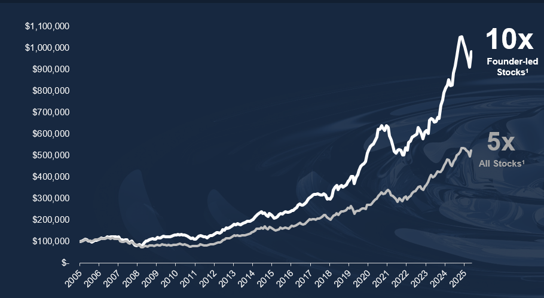
Source: Based on a back-testing analysis of MSCI All Country World Index Constituents from 2006–2026 (6,600 companies) by Ziller Funds Management. All Stocks = MSCI All Country World Index (AUD). Founder-led stocks (9% of total) have been chosen based on Ziller's experience and selections are subjective and in no way meant to be definitive or exhaustive. Founder is defined as an active CEO/Chair with executive control. Whilst every effort has been made to ensure that the information is accurate, its accuracy, reliability or completeness is not guaranteed. Data has been sourced from MSCI and LSEG. Past performance is not a reliable indicator of future performance [1].
What makes founders different
Research by Chris Zook (2014) identifies what he calls the ‘Founder Mindset,’ and highlights three traits common to the most successful founding leaders.
The first is ‘frontline obsession,’ an instinctive focus on the customer which empowers the people closest to them.
The second is an ‘owner’s mindset,’ cutting bureaucracy and thinking in decades rather than quarters.
The third is ‘business insurgency,’ a mission-driven intensity that drives them to challenge incumbents, reshape industries and solve problems others overlook.
Together, these traits shape businesses that can take a long-term view, act with greater speed, and pursue bolder decisions than professional management structures typically allow.
Higher-growth industries
Founder-led companies exist across all sectors, but the founder mindset tends to be most visible where rapid change rewards conviction.
Jensen Huang has spent three decades building Nvidia into the foundational infrastructure of the AI era, convinced long before the market did, that cheap, powerful computing would reshape the world.
Peter Beck founded Rocket Lab with the ambition of dramatically lowering the cost of access to space, opening low Earth orbit to a new generation of commercial and government customers.
These are not niche businesses; they are companies reshaping industries. By investing in exceptional founders, investors are often aligning themselves with the structural growth themes expected to drive a significant share of global growth.
But a compelling industry tailwind only creates the opportunity. Whether it becomes lasting value depends on the quality of the person leading it.
Resilience is a feature of best founder-led companies
Founders are often admired for their vision, but in Ziller Fund Management’s view, it is their resilience that truly distinguishes the exceptional ones.
While the median global CEO tenure is around five years [1], the most enduring founder-led businesses are built over decades, creating an organisational depth and muscle memory that can be valuable when markets become challenging.
Marcos Galperin, founder of MercadoLibre, Latin America's largest e-commerce platform, illustrates this well. During the dot-com crash, when the region's e-commerce was still nascent, he made a defining choice: narrow focus to three core markets and keep investing in reliability, logistics, payments and fraud prevention, while competitors cut corners to survive.
He understood that in Latin America, trust was the product. That conviction, paired with pragmatic decision-making, meant MercadoLibre didn't just survive, it laid the foundation for long-term dominance.
Key risks in founder-led companies
Like any investment approach, founder-led investing carries risks that investors should consider:
1. Key-person dependency
When a business is shaped by one individual, succession can create uncertainty. Investors should monitor whether the founder's influence remains central to the company's direction and be prepared to reassess when it begins to wane.
2. Poor founders can destroy value
Being a founder is no guarantee of success. Poor founders can stagnate, resist necessary change and ultimately destroy value. Rigorous assessment of founder quality is essential.
3. Higher volatility
Founder-led businesses can be more volatile than the broader market. They tend to reinvest heavily rather than pay dividends, meaning returns come primarily through capital growth over time. These characteristics mean outcomes may vary over different timeframes and market conditions.
Conclusion
Founder-led investing is not a shortcut. It requires patience, selectivity and a tolerance for short-term volatility.
From ASX
The ASX SMIDcaps Conference is a great way to learn about ASX-listed small and medium-size companies, some of which are still run by their founder.
--------------------------------
[1] Joyce Chen, Equilar, CEO Tenure Rates, 202
About the author
DISCLAIMER
Please note that these are the views of the writer and not necessarily the views of and Ziller Funds Management Pty Limited (ABN 88 688 720 578) (Ziller) as a Corporate Authorised Representative (CAR 1317129) of Perennial Value Management Limited (ABN 22 090 879 904, AFSL No. 247293) (PVM). Perennial Investment Management Limited (ABN 13 108 747 637, AFSL No. 275101) (PIML) is the Responsible Entity. Ziller, PIML and PVM are part of Perennial Partners Limited (ABN 90 612 829 160, CAR 1293138 of PVM) (Perennial Partners).
This article contains general advice only and does not take account of your objectives, financial situation or needs. Before acting on this general advice you should consider the appropriateness of the advice having regard to your objectives, financial situation and needs. You should obtain and consider the relevant Product Disclosure Statement (PDS) and Target Market Determination (TMD) relating to any financial product referred to in this document before deciding whether to acquire, continue to hold or dispose of that product. The current relevant Target Market Determination, Product Disclosure Statement, and application forms can be found on Ziller’s website at www.zillerfm.com. This document is based on information obtained from sources believed to be reliable and accurate at the time of publication; however, no representation or warranty is made as to its accuracy, completeness or currency. There are risks involved in investing. The value of investments can and does fluctuate, and an individual investment may become valueless. Past performance is not a reliable indicator of future performance. Nothing contained in this document should be construed as a solicitation to buy or sell any security or financial product, or to engage in or refrain from engaging in any transaction. To the extent permitted by law, neither Ziller, PIML, PVM nor any related entity accepts liability for any loss or damage arising directly or indirectly from reliance on the information contained in this document.
More Investor Update articles
Don’t miss the latest insights from ASX Investor Update on LinkedIn
The views, opinions or recommendations of the author in this article are solely those of the author and do not in any way reflect the views, opinions, recommendations, of ASX Limited ABN 98 008 624 691 and its related bodies corporate (“ASX”). ASX makes no representation or warranty with respect to the accuracy, completeness or currency of the content. The content is for educational purposes only and does not constitute financial advice. Independent advice should be obtained from an Australian financial services licensee before making investment decisions. To the extent permitted by law, ASX excludes all liability for any loss or damage arising in any way due to or in connection with the publication of this article, including by way of negligence.