Schools
Sharemarket Game news
Read the latest news and updates for teachers and students participating in the Game.
Schools
Sharemarket Game news
Read the latest news and updates for teachers and students participating in the Game.
Teachers share their experience
Hear it first from teachers who have participated in the Game and have shared their experiences with us - find out more
2026 Game 2 dates
Registrations will open on Thursday 16 July 2026 and Game will run from Thursday 13 August to Thursday 22 October 2026 - find out more
Resources
Congratulations to our winners and to everyone who took part of the Game. We hope teachers and students enjoyed participating in Game 1, 2026 and have learned many valuable real-life investment skills. Teachers, make sure you present your students with a certificate of participation.
| Prize | Syndicate | Student | Student | Portfolio value |
|---|---|---|---|---|
| Overall first and NSW winner | Jack W | Jack (Year 11, Economics) | St Ignatius College Riverview | $71,576.53 |
| Overall second and VIC winner | Vocational Majors | Lachie and Nate (Year 11, Business studies) | Ballarat Grammar School | $68,149.91 |
| Overall third and QLD winner | Aliyah | Aliyah (Year 9, Business Studies) | Cleveland District State High School | $68,017.51 |
| WA winner | Elijah Mob | Elijah (Year 11 / Business, Management and Enterprise) | Carey Baptist College | $67,203.57 |
| ACT winner | Alex | Alex (Year 12 / Accounting) | Gungahlin College | $65,575.28 |
| SA winner | Abhay Felix Aldrin | Abhay, Felix and Aldrin (Year 10 / Mathematics) | The Heights School | $62,446.365 |
| INT winner | Marcus | Marcus (Year 11, Extra-curricular) | Australian International School, HK | $60,609.9 |
| TAS winner | Maya W | Maya (Year 9 / Business & Finance) | Smithton High School | $59,407.57 |
| NT winner | HIVISE | Jacob, Frederick, Ned and Charlie (Year 10 / Commerce) | Haileybury Rendall School | $59,152.285 |
| NZ winner | The Stock Sharks | Daniel and Will (Year 13 / Business studies) | Aquinas College Tauranga | $55,234.33 |
From AI and data centres to lithium miners, defence stocks and tech rebounds, the Schools Sharemarket Game 1 winners showed the range of different approaches participants used during the Game.
While strategies varied widely - from highly concentrated bets to carefully diversified portfolios - a few common themes stood out: strong research, clear conviction, and the ability to adapt to changing market conditions.
Here’s what top syndicates did differently - and what other participants can learn from their approaches.

Jack from St Ignatius College Riverview in NSW
Taking out first place overall, Jack from St Ignatius College in New South Wales, built his strategy around one key idea: invest in companies with clear, near-term catalysts.
His portfolio focused heavily on technology and infrastructure names including IperionX (ASX:IPX), Megaport (ASX:MP1), NEXTDC (ASX:NXT) and Telix Pharmaceuticals (ASX:TLX) - sectors tied to themes like AI, data centres and emerging technologies. This resulted in a relatively concentrated portfolio, with a significant portion of capital allocated to just a handful of high-growth companies.
Rather than constantly trading, Jack largely relied on a strong initial stock selection and made targeted adjustments when needed. His trading activity shows that he exited only a small number of positions during the Game - notably selling Pro Medicus (ASX:PME) after a strong gain and closing out Life360 (ASX:360) at a loss - before reallocating capital into new opportunities.
This more measured approach allowed him to stay focused on stocks he had conviction in, while still responding to changing opportunities.
As he explained: “Even high-quality companies may take longer to realise value, so in a short-term competition it is critical to prioritise stocks with clear triggers for growth.”
A concentrated portfolio built on strong conviction can deliver strong results, but it increases exposure to individual stock performance. Even with limited trading, outcomes depend heavily on getting those key selections right.
Jack's strategy key takeaway:
Success doesn’t always require frequent trading. Careful stock selection, combined with selective and disciplined adjustments, can be just as effective.

Lachie and Nate from Ballarat Grammar School in VIC
Second place went to Lachie and Nate from Ballarat Grammar in Victoria, who built their strategy around identifying undervalued stocks during periods of market weakness - but crucially, this approach was underpinned by a highly structured and research-driven process.
Their portfolio spanned multiple sectors including defence, technology, healthcare and fintech, demonstrating a deliberate approach to diversification while still targeting higher-growth opportunities.
Unlike more instinct-driven strategies, their investment decisions were methodically constructed from the outset.
As they explained: “Every buying decision was backed by extensive research, incorporating fair value analysis, chart patterns, volume indicators, and candlestick analysis to pinpoint stocks that were primed for a breakout.”
This disciplined approach helped them identify opportunities where the market may have overreacted, allowing them to enter positions in stocks that had fallen but showed signs of recovery potential.
Rather than avoiding volatility, they used it to their advantage, combining diversification with analytical conviction to capture gains across multiple trades.
“Being able to buy and sell shares in real time… made it feel like the real thing” they shared.
Risk takeaway:
Targeting undervalued or falling stocks can create opportunities for strong returns, but it also involves the risk that prices may continue to decline if broader market conditions or company fundamentals don’t improve.
Lachie and Nate’s strategy key takeaway:
Combining diversification with a structured research process - rather than relying on guesswork - can help build confidence and support more informed investment decisions.
Aliyah from Cleveland District State High School in QLD
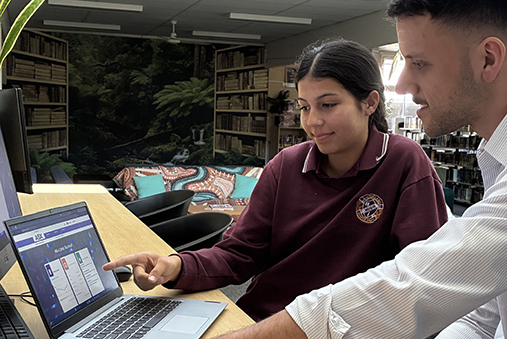
Finishing third overall, Aliyah from Cleveland District State High School in Queensland kept her strategy straightforward - focusing on buying a small number of stocks and mostly holding them through the Game.
Her portfolio included four companies in total - Generation Development Group (ASX:GDG), Megaport (ASX:MP1), Zip Co (ASX:ZIP) and Life360 (ASX:360) - but she only exited one position during the competition, selling Life360 at a profit of over $2,000 while maintaining her remaining holdings.
This resulted in a relatively concentrated portfolio with strong exposure to growth-oriented sectors such as technology and financial services.
While her approach was simple, it reflected a growing awareness of how quickly markets can respond to external events - something that shaped her decision-making as she tracked performance throughout the Game.
“I was surprised how much the price of individual stocks altered each day and how what was happening in the world affected their price” Aliyah highlighted.
Risk takeaway:
Holding a small number of stocks increases exposure to individual company performance. While this can amplify gains, it also means performance is less diversified and more sensitive to price movements in each holding.
Aliyah’s strategy key takeaway:
A disciplined ‘buy and hold’ approach - combined with selective, well-timed selling - can be highly effective, particularly when backed by a clear understanding of market drivers.

Elijah from Carey Baptist College in WA
Elijah, the WA winner from Carey Baptist College, took a dynamic approach that evolved significantly over the course of the Game.
His transactions show that he initially invested across a wide range of companies - building exposure to multiple sectors including resources, financials and smaller-cap growth stocks. This broader spread of positions gave him access to different parts of the market early on.
However, after a few weeks, Elijah made a decisive shift in strategy. Rather than continuing with a diversified portfolio, he chose to reset completely - selling out of his positions and focusing instead on stocks that had experienced the largest price declines, aiming to capture short-term rebounds.
“I decided to sell all of my stocks and invest in the stocks that had the biggest falls… and made five and a half thousand dollars in three days” Elijah observed.
From there, his portfolio became more focused, eventually holding a smaller number of positions including companies like Commonwealth Bank (ASX:CBA) and Mineral Resources (ASX:MIN) alongside other growth opportunities.
This shift highlights a transition from broad diversification to a more targeted, opportunistic strategy as the Game progressed.
Risk takeaway:
Changing strategies mid-way through a competition can unlock new opportunities, but it also introduces risk. Moving into stocks that have recently fallen relies on predicting a rebound - which doesn’t always eventuate.
Elijah’s strategy key takeaway:
Flexibility can be a powerful advantage. Being willing to reassess your approach - and act decisively - may help you take advantage of changing market conditions.

Alex from Gungahlin College in ACT
ACT winner Alex from Gungahlin College focused on highly volatile stocks and used AI tools to support his decision-making.
His trades showed exposure to speculative sectors including lithium, uranium and emerging technology - industries where prices can move quickly in response to sentiment and news.
Rather than holding positions through to the end of the Game, Alex chose to sell all his holdings and finish fully in cash, locking in his performance and avoiding late-stage market movements.
“Using AI helped me make sense of the vast amounts of data available” he commented.
Risk takeaway:
Frequent trading in volatile sectors depends heavily on timing. It can amplify returns but also increases the risk of losses if market movements are misjudged.
Alex’s strategy key takeaway:
Technology can support investing decisions, but strong outcomes still depend on understanding market drivers and managing risk.

Aldrin, Abhay and Felix from The Heights School in SA
The SA winners, Felix, Aldrin and Abhay from The Heights School, took one of the most aggressive approaches in the competition - not by concentrating their portfolio, but by combining broad market exposure with large trade sizes and frequent activity.
Their transactions show they invested across around 26 different companies over the course of the Game, spanning multiple sectors. However, instead of spreading smaller amounts across each position, they consistently placed large trades - often exceeding A$10,000 per transaction - reflecting a high-conviction, high-risk style of execution.
Their strategy also evolved over time, shifting from early experimentation into a more deliberate 'go big' approach - backing positions with larger capital allocations and actively managing trades.
As one of them described: “I decided… I’d buy as much as I could… ranging from A$12k–A$14k. This helped me a lot and was the strategy that struck gold.”
By the end of the Game, they had exited most of their holdings and held a significant portion of their portfolio in cash, locking in gains and reducing exposure to end-of-game volatility.
This high level of trading activity also meant that multiple transactions incurred brokerage costs - an often-overlooked factor that can impact overall returns, particularly when trading frequently.
Risk takeaway:
A highly active trading strategy with large position sizes can amplify both gains and losses. Frequent trading may also increase costs through brokerage, which can reduce overall returns if not managed carefully.
Aldrin, Abhay and Felix’s strategy key takeaway:
There are different ways to take risk - not just through what you invest in, but how you invest. Trade size, frequency and timing all play a role in portfolio performance.

Maya from Smithton High School in TAS.
Tasmania’s top performer Maya from Smithton High School took a more measured approach - spreading her investments across a small number of companies in different sectors to help manage risk.
Her portfolio included five companies - Global X Semiconductor ETF (ASX:SEMI) and Smartgroup Corporation (ASX:SIQ) (technology and industrial-linked businesses), Car Group (ASX:CAR) (online marketplace), Block (ASX:XYZ) (data and digital services), and Elders (ASX:ELD) (agribusiness) - giving her exposure to a mix of industries rather than relying on a single theme.
While not broadly diversified, this approach still reduced the risk of being overly exposed to one sector, allowing stronger performers to help offset weaker ones.
“If one company was losing money, the others could help balance it out” Maya explained.
Risk takeaway:
Investing across multiple sectors can help manage volatility, but with a smaller number of holdings, performance is still influenced by each individual position.
Maya’s strategy key takeaway:
Diversification doesn’t have to mean holding dozens of stocks. Even a small, well-considered mix across different sectors can help balance risk while keeping a portfolio focused and manageable.

Freddie, Charlie, Ned and Jake from Haileybury Rendall School in NT
The NT winners, Freddie, Charlie, Ned and Jake, from Haileybury Rendall School, combined teamwork with a clear, confident approach to investing.
Their portfolio leaned towards growth-oriented and cyclical sectors, including resource-linked companies and other opportunities where price movements can be more pronounced. This reflects a strategy focused on identifying momentum and acting decisively.
“Looking at the history of the stocks helped us make smarter decisions and reduce risk” they observed.
“We made sure to sell as they began to drop - this helped us get ahead fast” they concluded.
Risk takeaway:
Successfully managing risk isn’t just about choosing investments - it also involves knowing when to sell.
Freddie, Charlie, Ned and Jake’s strategy key takeaway:
Combining research with disciplined decision-making can help investors respond effectively to changing market conditions.
The New Zealand winners, Daniel and Will from Aquinas College Tauranga, took a disciplined approach - selecting a small number of stocks and backing their initial choices with confidence.
Their portfolio included five to six companies across sectors such as technology, consumer businesses and resources, providing a level of diversification while remaining focused.
While they largely held their positions through the Game, their strategy also included well-timed selling decisions. They exited five of their holdings during the competition, including positions such as Sandfire Resources (ASX:SFR) and Deterra Royalties (ASX:DRR), where they were able to realise strong profits before the end of the Game.
Despite the temptation to react to short-term movements, they stayed committed to their overall approach - balancing patience with the ability to capture gains when opportunities arose.
“This tested our patience… however we decided on trusting the process and playing the long game” they commented.
“It was really exciting checking the market and seeing what changed” they shared.
Risk takeaway:
Holding positions for longer periods can reduce trading risk but knowing when to sell and lock in gains is equally important, particularly in a shorter-term competition.
Daniel and Will’s strategy key takeaway:
A successful strategy doesn’t have to be purely buy-and-hold or highly active trading. Combining patience with selective profit-taking can help balance risk and reward.
"The game allowed students practical exposure to the economic factors that caused business valuations to rise and fall, and allowed me to branch off onto discussions of various relevant economic concepts, such as supply and demand, firm productivity and the trade off between risk and reward in financial markets."
Mr. Galea, St Ignatius College Riverview, NSW
"I’ve been running the ASX Schools Sharemarket Game in my Year 9 & 10 Business & Finance class for the past five years, and it continues to be one of the highlights of the course. The level of engagement from students is fantastic, they really enjoy the competitive element and love seeing how their investment decisions play out in real time."
Mr. Coombe, Smithton High School, TAS
"The ASX Sharemarket Game became an integral part of each lesson. Students were always excited to check the status of their portfolio and try their best to improve. They also worked to try and understand the ‘why’ of share movements and were able to link world events and how they affected our share portfolios."
Mrs. Blackburn, Cleveland District State High School, QLD
You will notice some changes to the Game scheduled to start on Monday 13 August 2026.
The next Game will have a more streamlined format with a focus on ASX200 companies and a selection of ETFs.
While this means that students will have a smaller range of companies to choose from, this will provide greater focus and less complexity. Everything else will stay the same, including the core functionality and a great learning experience for your students.
Save the date for 2026 Schools Sharemarket Game 2
Registrations open: Thursday 16 July 2026
Game dates: Thursday 13 August to Thursday 22 October 2026
Disclaimer: Information provided is for educational purposes and does not constitute financial product advice. You should obtain independent advice from an Australian financial services licensee before making any financial decisions. Although ASX Limited ABN 98 008 624 691 and its related bodies corporate (“ASX”) has made every effort to ensure the accuracy of the information as at the date of publication, ASX does not give any warranty or representation as to the accuracy, reliability or completeness of the information. To the extent permitted by law, ASX and its employees, officers and contractors shall not be liable for any loss or damage arising in any way (including by way of negligence) from or in connection with any information provided or omitted or from any one acting or refraining to act in reliance on this information.
© Copyright ASX Operations Pty Limited ABN 42 004 523 782. All rights reserved 2026.
In this newsletter, we review the basics to help them place their first trade.
To be able to complete this Game challenge, it is vital that your students take note of all these Game essentials:
Student login portal: Share this link with your students
Problems logging in: Please read ‘How to login’
Prize eligibility: To be eligible, they need to have purchased shares, within the Game, in four different companies over the Game Period. One buy transaction must have been completed by 26 September.

They can put their order in at any time; however, the market is only open between the hours of 10am and 4pm Sydney time. Please note there is a clearing period between 4 pm and 4.12 pm and an order may still be processed over this time.
Tip: If you want to place a trade for the next day, do it after 4.12 pm.
On the ‘How to participate’ page, you will find some steps on how to get started and developing a trading plan. Your students can also review the Game video tutorials and how to guides. And teachers can access the new curriculum-aligned, skill-based learning materials.
When placing an order, they will also need to understand the different types of orders.
An order in the sharemarket is the request you put in to either buy or sell a certain number of shares in a particular company. You can enter either a ‘market to limit’ order or a ‘limit’ order as highlighted in the video tutorial - How to buy shares. Knowing which type of order to use is important so let’s take a look at the difference.
Like any other market, the sharemarket is a place where people buy and sell. In this case, they are buying and selling shares in companies and the goal is to make a profit on those shares. To learn more watch the videos below.
When you enter a ‘market to limit’ order you don’t nominate a price to buy or to sell at. Instead, your order will be filled, as much as it can be, at the current market price then it becomes a limit order.
For example: Suppose you wanted to buy 5,000 shares in XYZ company but there were only 4,000 shares available at the current market price. The system would purchase 4,000 shares for you at the current market price, say $10.00 and then for the remaining 1,000 shares your order would become a limit order for 1,000 shares at $10.00. These shares will only be processed if the price stays at $10.00 or less. If your order is not being processed it may be that the price has moved above $10.00.
You can check your pending orders to see if the order has been completely filled or if it has become a limit order. You can either reactivate the order by clicking amend and making it a market to limit order again or alternatively you can keep it as a limit order but change it to a price you are happy to buy (or sell) at.
If you are having trouble understanding this watch - How to buy shares for a market order example.
A limit order lets you specify the maximum price you are prepared to pay for shares if buying. If selling, it lets you set the lowest price you are prepared to accept.
Your order will be executed at the best price possible. Suppose you want to buy at a limit of $10.00. You will get them at a lower price if there are shares available at a lower price, but if the price is above $10.00 you order won’t be filled.
If you are prepared to sell at $10.00 but no lower you might end up selling at say $10.50 if prices are higher but not at $9.50 because that is below your limit.
Make sure you are clear on what price you are prepared to accept when you put your order in.
If you are having trouble understanding this watch - How to sell shares for a limit order example.
If you don’t like the idea of a ‘market to limit’ order you might consider using a limit order but make sure the price you set is not too far away from the market otherwise your order might not get filled.
In the Game your students will be paying brokerage. Brokerage is the fee a stockbroker charges when shares are bought or sold. Just like the real market, in the Game, every time you buy or sell you will be charged brokerage. Be aware of your brokerage costs if you trade regularly. In the Game, brokerage is $20 for trades up to $10,000 and for each trade over $10,000, brokerage is charged at the rate of 0.2% of the trade value.
In the Game your students cannot put all their money into buying just one company.
They can do this in real life if you wish; however, there is a belief that this is not the best thing to do as it is very high risk.
In the Game they can only invest 25% (of their total portfolio value) in any one given company (this is called the diversification rule). When you go to place an order to buy shares in a company, the system will tell you the maximum of shares you can purchase based on the current market price and your portfolio value. You don’t have to buy that number - you can buy less but you can’t buy more.
To diversify simply means to invest in different companies and/or different industry sectors that don’t tend to move in the same direction at the same time.
This will help reduce the risk of losing money. Let’s say you invested all of your $50,000 in one company and the shares in this company dropped by 30%. This would mean that your $50,000 investment is now worth only $35,000 – that’s a loss of $15,000. Whereas, if you invested in 4 companies (in different sectors with approximately $12,500 invested in each) and the other 3 companies are doing OK, that 30% loss is now only $3,750 – quite a difference.
This example shows how investing across a range of sectors or companies helps reduce your risk. However, also be careful of over diversifying (having just a few shares in a lot of different companies), because you will end up paying a lot of brokerage and if some companies do really well you want to own enough of them to make some good profits.
In Australia, the end of the financial year (EOFY) is June 30. So most publicly listed Australian companies report their full-year earnings results in August and their half-year results in February.
By law, companies listed on ASX must report their earnings, results, and forecasts to shareholders during each reporting season.
Dividends are usually announced during reporting season so in the Game, one of your strategies might be to invest in those companies that have a dividend coming up, in order to take advantage of the additional cash.
Before doing this, it is important to understand what dividends are and how they work.

What are dividends?
Companies use the money they make as profits to pay dividends as a way to reward shareholders. By paying
dividends the company makes itself more attractive to investors.
Companies typically like to keep a consistent pattern to their dividend payments as they know a lot of investors, especially retirees, rely on dividends for income. A lot of investors look at what a company has done in the past to try to get a feel for likely future dividend payments. They can also get more of an idea of what is likely to happen, by paying attention to company announcements as well as what company analysts might say.
This video will help you understand more about dividends.
So how do you receive a dividend?
Companies need to keep track of who owns their shares so they can pay dividends out to shareholders - therefore they need a cut-off date (the ex-dividend date). To be entitled to a dividend a shareholder must have purchased the shares before the ex-dividend date.
In the real world, a dividend will be paid into a shareholder’s nominated bank account on the payment date, sometime after the ex-date. In the Game, a dividend gets paid on the ex-date into your Game account as cash.
Go to the Dividends+ page for all the coming up dividends and their ex-date.

Now that you have learnt more about shares and the sharemarket…and experienced the almost instant processing of orders online, did you ever wonder…how on earth did they do this without the Internet?
Initially, trading took place using a call system (1861 to 1961). Using this system a reader called the names of each company and brokers made a bid or offer. Stocks were called 3 times a day. This system was limited as the market was only open for a very short period each day and there were far fewer companies listed on the market back then. Watch this video - to see how it all worked.
Enter the chalkie! In the 1960s trading changed to a post system (1961 – 1990) where "chalkies" wrote bids and offers continuously in chalk on blackboards, as operators who worked for brokers called out orders. All of this made for a very noisy trading floor. Watch the chalkies in action and see how it all happened.
With the post system, everything that was written on the boards was also typed into a price reporting system. The limitation was that during busy times there could be quite a delay between changes of prices on the boards and when they appeared on screens via the price reporting systems.
The advantage of the ‘post trading’ system over the call system was that the market was open for longer - from 10 am to noon and from 2 to 3.30 pm. Back then there were share markets in each State and prices for the same shares could differ between States.
In 1987 a screen-based trading system was introduced and the individual state stock exchanges were combined to form the Australian Stock Exchange. It started with just a limited range of stocks, and slowly all stocks were moved to this system and the trading floors were closed in 1990. Everyone, no matter where they lived could now trade in the same market at the same prices.
It is important that your students have a Game plan. And if they already do, it is wise to review it, to make sure it is working for them. In this newsletter, we share some questions you can use to prompt the thinking process with your students. They can either go through these questions to review their plan or to get a plan happening. This should give them a better idea as to their direction for the Game.
First, what is your overall investment strategy?
Have you diversified your investment?
This means buying stocks from different sectors rather than all from the same one. This is a great way to help protect your investment.

Have you decided when to take your profits?
If your shares rise by a certain percentage above your purchase price…
If the stock falls or is not performing as you would like, do you have a plan of when to sell?
Have you or your team made any decisions regarding how low you are prepared for a share to go, before getting out?
For example, you might set a certain percentage below your purchase price as the lowest you are prepared to let the share price fall before you sell your shares.
Also, if you decide to sell, what factors or indicators will you use to help you make the decision to step back in?
After answering these questions, and in light of the current market volatility (the price of a share moves significantly up or down), your students will be more prepared, less inclined to panic, and able to make the necessary decisions to stick to their plan.
Here you have a list of the most common mistakes we find syndicates making while participating in the Game. Let your students know this is worth a read, as it may help them avoid making some of these mistakes:
Purchasing small lots in multiple companies.
And this is not just $20 when you buy, it is also $20 when you sell, so you need to consider this.
Not checking your order before submitting
It is important to set up the habit of always checking your order before you submit. Make yourself stop and read the preview order – review the number of shares you want, check it is the correct company, it is a market or limit order, at the price you want, and of course whether it is a BUY order or a SELL order.
Get into the habit of checking each of these things because once your trade is submitted, it can be very difficult to get it back.
Placing your orders too far away
Often we get emails from students wondering why their order isn’t going through. Often what has happened is they have set their buy or sell price too far away from the market, for example, if the share price of a company is at $2.00 and you set a limit to buy your shares at $1.50 - you are going to have to wait until the price gets to or falls below $1.50 before your order is processed, which could be a very long time, if at all.
If your limit order to sell is set at $3.00 – again, you will be waiting until the market hits this price or above before your order is processed.
Placing an order at 4.00 pm for the next day.
Take note that although the market closes at 4 pm there is a clearing period between 4 pm and 4.12 pm where orders will still be processed. If you are wanting to place an order for the next day, make sure it is after 4.12 pm.
Buying just to get the dividend.
So if you buy a company based on the dividend, remember, on the ex-date, the price of the share is likely to fall by the amount of the dividend.
Buying to get the dividend and then selling on the ex-date, will mean you have lost any benefit the dividend gave you as the stock fell by that amount.
It helps to do your research and be sure you are happy with a company and not just base your buying decision only on the dividend.
This is a good lesson for students to not be ruled by their emotions and instead make sure they have a plan and have thought about how they will trade in any type of market.
If they have a plan and stick to it, that can help take some of the emotion out of your trading. For example:

It is difficult to know where this market is going to go and is important to remember that we are not always going to be making the right decision and that we may not be using the right plan, but it is all about learning and experiencing the sharemarket. They need to take a look at their portfolio with that in mind.
Having answers to these questions can help them with some of the emotions they may feel and if their plan isn’t successful, they can review it at the end of the Game and learn from it.
There are a lot of things that can impact the price of a share. Let's review some of them:
The economy: Alongside the impact of global markets, a range of economic factors within Australia can also affect share prices, for example, the overall health of the economy, the level of unemployment and interest rates etc.
Dividends: Another thing that may affect the share price is if a share goes ex-dividend. More often than not the price of a share will fall by approximately the dividend amount when the share goes ex-dividend.
Supply and demand: The sharemarket is a market place like any other. The more people want to get hold of a particular product or in this case a particular share, the higher its price will go. If people no longer want a share, those looking to sell may have to offer it at a lower price in order to sell.
Company announcements: One of the most important factors affecting the price of a share is the company's future earnings. Any changes to the forecast in earnings, either by company management or by market analysts, may impact the share price.
Other factors: Natural disasters such as floods or earthquakes or other disasters (e.g. pandemics) can have a significant impact on the sharemarket. Often, however, these are simply reactions to the unexpected news and the market or shares affected can recover in a very short period of time. It’s helpful not to react to news like this and to take a long-term look at your shares rather than a short-term panic reaction.
You may also find it a little frustrating that often the price of a share at the close of the day isn’t necessarily the same price when the market opens the next day.
The reason for this is that from the time the market closes to the time it opens the following day, there may have been trading on overseas markets, political and economic news may be announced and people may also be revising their investment views.
Any or all of these factors can cause a change in people’s assessment of what is a fair price for a share. Every morning before the market opens, there is an opening auction prior to market open (no trades are processed during this time) however revised or new bids & offers* can be entered – so this may affect share prices at the open.
As students gain an understanding of what influences share prices, this will grow their understanding of the link between the sharemarket and real world events.
Over the last 10 weeks, we hope you and your students have gained some valuable investing skills from your practical involvement. Whether you decide to be part of the next game, or if your students want to take their skills into the real world, here are some tips for them to keep in mind:
But while the strategy for the Game might differ from real life, the Game is still full of practical skills that investors use every day. All the information we’ve covered in our lessons can help your students become better informed and wiser investors, including:

A great way to teach your class about the impact of supply and demand on the market is by creating a Silent Auction.
Word/terminology search
Find words or terms related to the sharemarket or the economy either horizontally, vertically or diagonally.
To use the wordsearch, either:
Or:
Word list:
ASX, materials, ATO, bear, bull, buyback, diversify, dividends, economic, interest, order, price, sectors, spread, takeover, tax, volatility, watchlist
Comprehension check
Students can complete these alone, in pairs or in groups. For more advanced classes they need to attempt them without referring to notes or the internet.
You can create your own sharemarket vocabulary games and tasks using the ASX glossary.
Check out these Equity Mates podcasts to cover the basics and equip you with the knowledge and skills needed to start your investing journey. We hope you will find it useful.

In the final part of this three-part video series, Thomas, the Economist from the podcast Comedian V Economist, explains the different type of charts that investors can use to gather information about the market plus provides some tips on how to read them. Watch now
In the first of this three-part video series, Thomas, the Economist from the Podcast Comedian V Economist, explains the basic concepts of dividends and capital gain and how these can shape your game strategy. Watch now
In the second part of this three-part video series, Thomas, the Economist from the podcast Comedian V Economist, explains the three lenses through which to look at prospective investments: market trends, micro fundamentals and popularity factors. Watch now
The views, opinions or recommendations of the authors of this market update are solely those of the authors and do not in any way reflect the views, opinions, recommendations, of ASX Limited ABN 98 008 624 691 and its related bodies corporate (“ASX”). ASX makes no representation or warranty with respect to the accuracy, completeness or currency of the content. The content in this market update is for educational purposes only and does not constitute financial advice. Independent advice should be obtained from an Australian financial services licensee before making investment decisions. To the extent permitted by law, ASX excludes all liability for any loss or damage arising in any way including by way of negligence.
Comedian V Economist is a product of Equity Mates Media.
All information in this podcast is for education and entertainment purposes only. Equity Mates gives listeners access to information and educational content provided by a range of financial services professionals. It is not intended as a substitute for professional finance, legal or tax advice.
The hosts of Comedian V Economist are not financial professionals and are not aware of your personal financial circumstances. Equity Mates Media does not operate under an Australian financial services licence and relies on the exemption available under the Corporations Act 2001 (Cth) in respect of any information or advice given.
Before making any financial decisions you should read the Product Disclosure Statement and, if necessary, consult a licensed financial professional.
Do not take financial advice from a podcast.
For more information head to the disclaimer page on the Equity Mates website where you can find ASIC resources and find a registered financial professional near you.