• publish

Topic 1: Strategy overview

Introduction

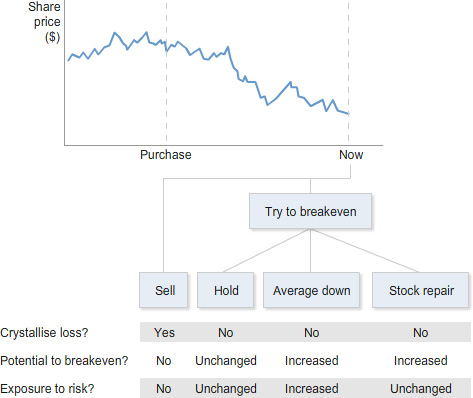
Most investors have had the experience of buying a stock and then seeing the price fall.

Investors typically see their choice as selling the stock at a loss, or trying to break even.

Two 'conventional' ways to break even are:

  • hold on in the hope the share price recovers to the original purchase price, which may take along time, or
  • averaging down, which lowers your breakeven point, but requires you to buy more shares, increasing the risk of your position.

In this module, we look at a third way to break even, an options strategy called the 'stock repair'.

Diagram showing a declining share price chart connected to a comparison table of four response options, including sell, hold and options strategy alternatives.

When can the stock repair be considered?

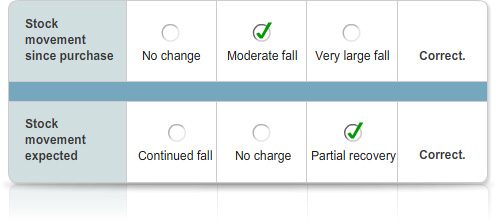
Table showing stock movement scenarios since purchase and expected future movement, with selection indicators used to identify outcomes relevant to an options strategy.

The goal of the stock repair is to get back to break even on a losing stock position in the near term. At that point you can decide whether to continue to hold the stock in the long term or get out of the investment altogether.

The strategy is best implemented when the stock has fallen moderately from your purchase price. If the stock has fallen too far, it may not be possible to achieve breakeven using this strategy.

You think the stock will partially recover in the near term. The strategy does not protect you if the stock continues to fall.

The stock repair is not appropriate if you expect the stock to bounce back strongly, as it places a cap on your upside.


Construction

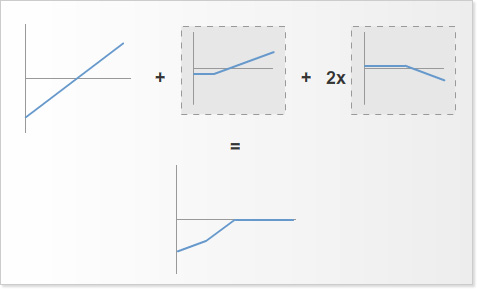
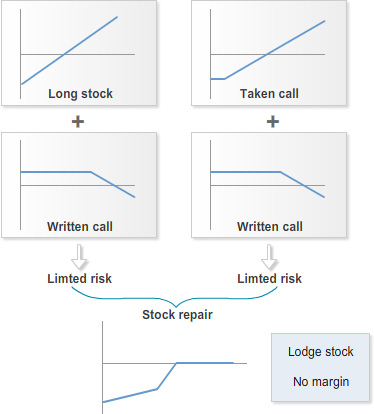
The strategy is a combination of the stock you hold, plus, for every 100 shares:

  • one taken call, with a strike around the price the stock has fallen to, and
  • two written calls, with a strike midway between the price the stock has fallen to and the price you paid for it.


Example

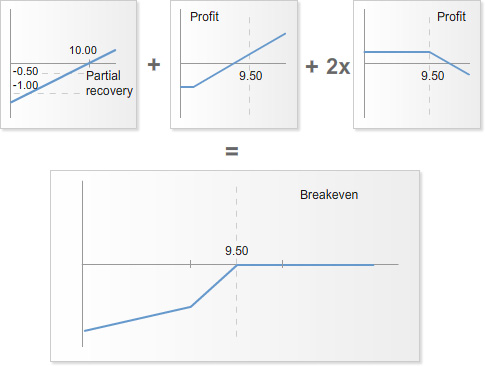
You hold 100 XYZ shares, for which you paid $10.00. Following a fall in the stock price to $9.00, you:

  • buy one XYZ $9.00 call @ $0.38, and
  • write two XYZ $9.50 calls @ $0.19.

The strategy in our example is placed at zero cost (excluding transaction costs).

Diagram showing three payoff-style charts combined to produce a single options strategy payoff profile.

Outcome

Diagram showing three payoff-style charts being combined to form a single options strategy payoff profile with a marked breakeven point.

Your best result is for the share price at expiry to be around the strike price of the written options, at which point you should be at, or close to, breakeven.

At the written call strike:

  • you should be able to sell your taken call for a profit
  • your shares have benefited from the partial recovery
  • your written calls will be worth very little or nothing, giving you the benefit of the premium income.

The net result is that you may be able to break even without the stock getting back to your purchase price.

Topic 2: Profits, losses and breakeven

For most option strategies that include a stock leg, you use the current stock price in calculating your potential profit, loss and breakeven point.

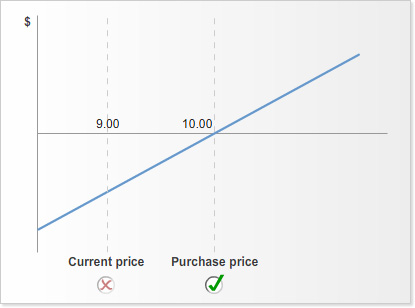
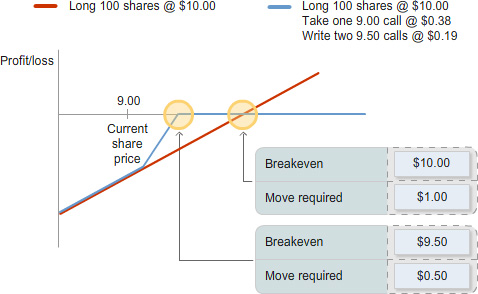
The most useful way to assess the possible outcomes of your stock repair, however, is to use your purchase price for the stock, not the current price. Consequently you take into account your loss on the stock since the time of purchase.

This makes it easier to see at what point the strategy will return you to break even.

Chart showing a rising profit and loss line in relation to current share price and purchase price markers.

Breakeven

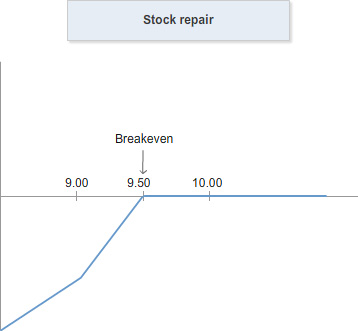
Chart showing the profit and loss profile of an options strategy with a marked breakeven point and share price levels along the horizontal axis.

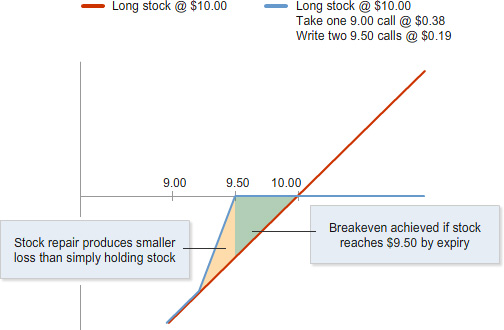
The breakeven point at expiry is around the strike price of the written calls.

Working out your exact breakeven is a fairly complex calculation.

The breakeven depends on:

  • the price you paid for the shares
  • the strike prices of the options you use
  • the credit or debit the strategy was placed for.

In the example, in which you placed the strategy for zero cost, the breakeven point is $9.50.

A tool such as the Strategy Modelling Tool can show you where you will break even.

Strategy outcome

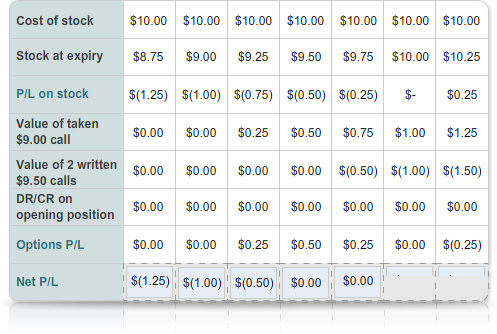
The outcome of your strategy at expiry must take into account

  • the loss on the shares from the time of purchase
  • the outcome of the option legs.

The loss on the shares is the difference between your purchase price and the share price at expiry.

The outcome of the option legs is the value of the options at expiry less the premium you paid (or plus the premium you received) for the strategy.

Table showing profit and loss outcomes for a shareholding and related options contracts across a range of share prices at expiry.

Outcomes at expiry

Rather than considering the strategy in isolation, it generally makes sense to compare the outcome of the stock repair to the outcome if you were simply to continue holding the stock.

The outcomes considered here assume you paid $10.00 for your shares and enter the following strategy when the stock price has fallen to $9.00:

  • buy one XYZ $9.00 call @ $0.38
  • write two XYZ $9.50 calls @ $0.19.

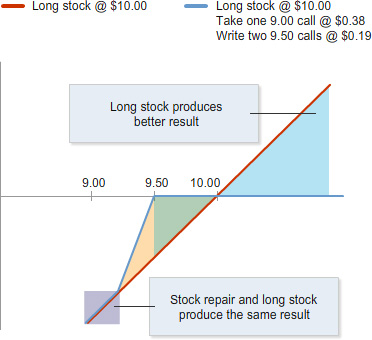
The benefits of the stock repair are gained if the share price at expiry is between the strike of the taken call and the purchase price of the shares.

Chart comparing the profit and loss profiles of a shareholding and an options strategy across different share price levels.

Share price between strikes

You should make a profit on your option legs. The taken call will be in the money, but both written calls will expire worthless. This profit can be added to the improvement in the share price, giving you a better result than simply holding the shares.


Above written strike but below purchase price

Once the share price reaches the upper strike, you get your best result, breakeven.

Any share price increase beyond this does not improve your result, as the increase in value of the stock and the taken call are offset by the increase in value of the written calls.

Share price rises strongly

If the stock rebounds above your purchase price, the stock repair will lead to a worse result than simply holding the shares. The written calls cap your profit for any share price rise above the upper strike.


Share price falls

All options will expire worthless.

The stock repair offers no protection against a continued drop in the share price, but you will not be worse off either.

Chart comparing the profit and loss profiles of a shareholding and an options strategy across different share price levels.

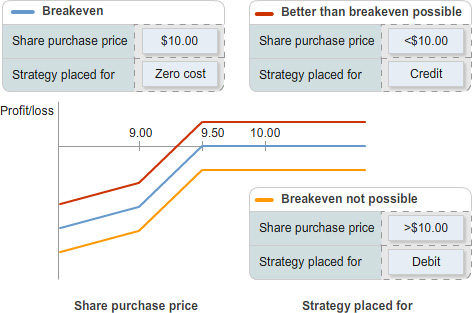
Can I always breakeven with the stock repair?

Chart comparing profit and loss profiles for an options strategy under different share purchase prices and trade entry conditions.

Even if the stock price recovers to the strike of the written calls, it is not always possible to break even.

In some cases, the profit you can make from the options strategy may not be enough to offset the fall in the stock price.

It depends on:

  • how much you paid for the stock
  • the credit/debit on opening the option positions.

On the other hand, it may be possible to do slightly better than breakeven if the stock price has not fallen too far, or if you place the strategy for a credit.

Topic 3: Benefits, risks and other features

Break even sooner

The main benefit of the stock repair is that you can return to break even twice as fast as if you do nothing.

The stock price only needs to recover to around the strike price of the written calls by expiry for you to break even.

Without the option position, the stock needs to return to your purchase price - a recovery that may take a long time, or which may not take place at all.

Chart comparing the profit and loss profiles of a shareholding and an options strategy, with breakeven points and share price movements highlighted.

Consider longer dated options

When creating this strategy, the choice of expiry date for the options will affect the amount of premium you receive.

Writing longer dated options provides greater level of premium income.

Consider that longer dated options mean you are obligated for a longer period of time.


Low cost strategy

Table comparing two options strategies against criteria for lowering breakeven levels and increasing risk, using yes and no indicators for each outcome.

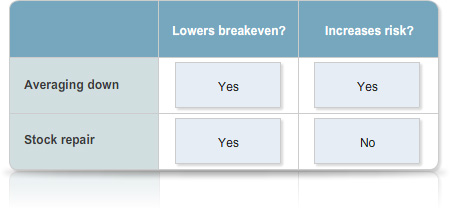
The stock repair can generally be placed for a small credit, a small debit, or at no cost, depending on the market price of the component options.

This means you are not significantly altering the risk you are already exposed to. If the share price falls further, the stock repair will not make your position any worse.

Compare this to averaging down, which lowers your breakeven point, but requires you to buy more shares, increasing the risk of your position.

No margins

As long as you lodge the underlying stock as specific cover with ASX Clear, no margins are payable on the stock repair.

One written call is covered by the shares you lodge.

The other written call is covered by the taken call.

Diagram showing how long stock, taken call and written call positions are combined to create an options strategy payoff profile.

Capped profits

Chart showing a rising share price trend over time in relation to purchase and strike price levels for options contracts.

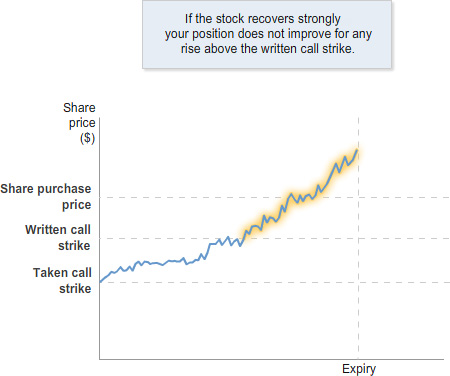
The main disadvantage of the stock repair is that your benefits are limited if the share price makes a strong recovery.

The best outcome the stock repair can offer is breakeven or thereabouts, which occurs if the stock reaches the strike of the written calls at expiry. Any rise in the share price above this point does not improve your position.

If the stock bounces back to above your original purchase price, you would have been better off not having entered the strategy.

No protection against continued fall

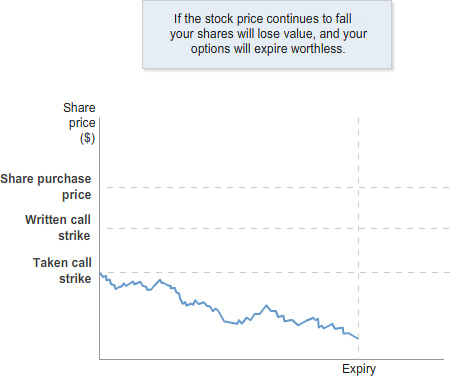
If the share price continues to fall, the strategy will not make your position any worse - but neither will it help you, as both the taken and the written calls will expire worthless.

If your view is that the stock will continue to fall, you might consider cutting your losses and selling.

Chart showing a declining share price trend over time in relation to purchase and strike price levels for options contracts.

Topic 4: Follow-up action

At expiry

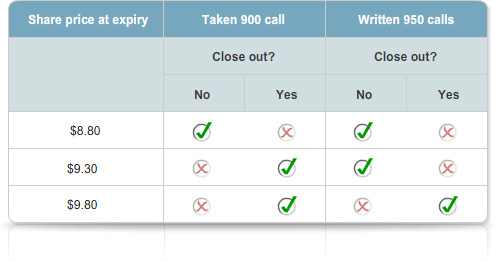
Table comparing whether options contracts are closed out at different share prices at expiry, with tick and cross symbols indicating outcomes for taken and written call positions.

You will need to take action on any legs that are in the money at expiry.

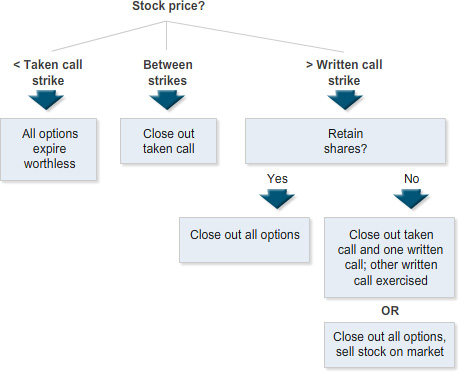
Stock price below taken call strike

All options will expire worthless and you need take no action.


Stock price between strikes

The written calls will expire worthless.

You will need to close out the taken call option on market to realise its intrinsic value.

Stock price above written call strike

If you want to retain your shares, you will need to close out your taken call and both written calls.

If you are happy to let the stock go, you could close out the taken call and one of the written calls, allowing the other written call to be exercised. You will sell your shares at the strike price of the written option. Alternatively, you could close out all option legs, and sell your shares on market.

Flowchart showing possible outcomes for an options position based on the relationship between the stock price and call strike prices

Before expiry

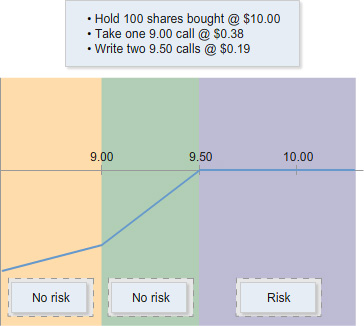
Chart showing the risk profile of an options strategy, with coloured zones indicating no-risk and risk outcomes across different share price ranges.

The stock repair typically is held to expiry, rather than being closed out early. Breakeven is usually only possible at expiry, when time value has fallen to zero.

However, if the stock price rises well above the written call strike ahead of expiry, you might change your view on the stock and believe the price may rise further. If so, you can consider closing out the written calls to remove the cap on your upside.

If you decide not to close out your written calls, you should be aware of the risk of early exercise.

This risk of exercise is greatest if the stock goes ex-dividend during the life of your strategy. If the written calls are deep in the money, you may want to consider closing them out before the ex-dividend date to remove the risk of exercise.
Summary

  • The stock repair can help you to break even more quickly on a losing stock position.
  • The strategy is a combination of stock, one taken call with a strike around the current stock price, and two written calls with a strike midway between the current stock price and the price you paid for it.
  • Your best result at expiry is for the share price to be around the written option strike, at which point you should be close to breakeven.
  • The result is that you do not need the stock to recover to your purchase price to break even.
  • The stock repair can generally be placed for a small credit, a small debit, or at no cost.
  • The stock repair will generally give you a better result than simply holding the shares if at expiry the share price is between the taken call strike and the purchase price of the shares.
  • The main disadvantage is that your benefits are limited if the share price makes a strong recovery.
  • The stock repair offers no protection against a continued fall in the share price.
  • No margins are payable if specific cover is lodged.
  • You will need to take action on any legs that are in the money at expiry.

Practical examples of option strategies are given throughout these modules.

Prices used in the examples were calculated using an option pricing model, and are based on the following, unless otherwise specified:

  • Underlying stock price: $10.00
  • Volatility: 25%
  • Risk free interest rate: 5%
  • Days to expiry: 30
  • The stock does not go ex-dividend during the life of the option
  • American exercise style

Brokerage costs are not included in the examples. It is, however, important to take brokerage costs into account when trading options.

Please note that some payoff diagrams that appear in this course are conceptual in nature, and may not be drawn exactly to scale.

Test your knowledge