• publish

Topic 1: Strategy overview

Introduction

Flat markets generally lend themselves to strategies involving written options.

If prices stay steady, options fall in value due to time decay, benefiting the writer.

In this module we look at two strategies for neutral markets, the written straddle and the written strangle.
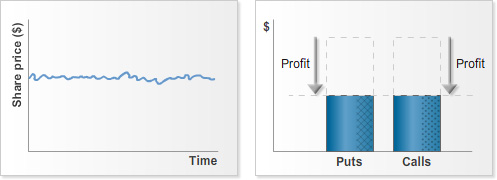
The success of both strategies depends on the stock price remaining around current levels.

If the stock moves significantly in either direction, you can suffer heavy losses.

advancing-options-module_2_Option_pricing_in_detail-topic-1-image-1
advancing-options-module_2_Option_pricing_in_detail-topic-1-image-2

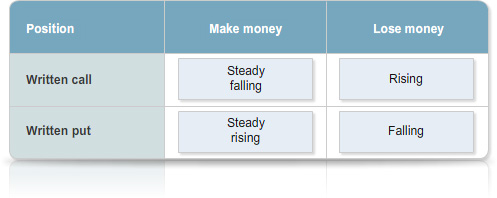
A written option can be said to reflect a neutral outlook, however there is a bias in one direction.

The written call is neutral to moderately bearish, as the maximum profit is made if the stock stays steady or falls.

The written put is neutral to moderately bullish, as the maximum profit is made if the stock stays steady or rises.

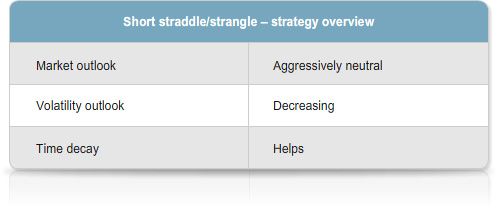
Aggressively neutral

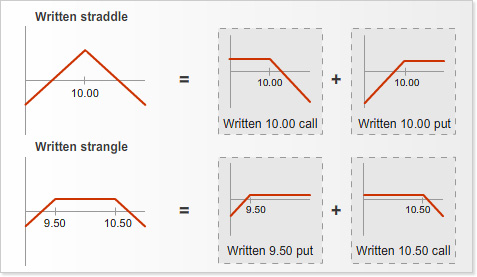
The written straddle and the written strangle also reflect a neutral view, but with no directional bias. They are more aggressive because they seek to earn income from two premiums. Your maximum profit is made if the stock stays steady, and a significant move in either direction will result in a loss.

Both strategies comprise a written call and a written put.

advancing-options-module_2_Option_pricing_in_detail-topic-1-image-3

Construction

Both legs of a straddle have the same strike price. The two legs of a strangle have different strikes.

advancing-options-module_2_Option_pricing_in_detail-topic-1-image-2

Written straddle

The written straddle involves the sale of a call and a put with the same strike. At-the-money options are typically used.


Example

With XYZ shares trading at $10.00, you:

  • write one XYZ 1000 call @ $0.31
  • write one XYZ 1000 put @ $0.26.

The written strangle

The written strangle involves the sale of an out-of-the-money call and an out-of-the-money put.


Example

With XYZ shares trading at $10.00, you:

  • write one XYZ 1050 call @ $0.12
  • write one XYZ 950 put @ $0.09.


Strategy outcome

If the stock price stays steady, both options will lose value as time decay takes effect.

The value of the strategy will fall, enabling you to close out the position for a profit. In the ideal scenario, the options expire worthless, resulting in the maximum profit.

Your profits are limited to the amount you receive on opening the position. However you can generate significant income, because you receive two premiums.

Your loss is potentially unlimited if the stock price makes a significant move in either direction.

advancing-options-module_2_Option_pricing_in_detail-topic-1-image-6

Time decay and volatility

advancing-options-module_2_Option_pricing_in_detail-topic-1-image-4

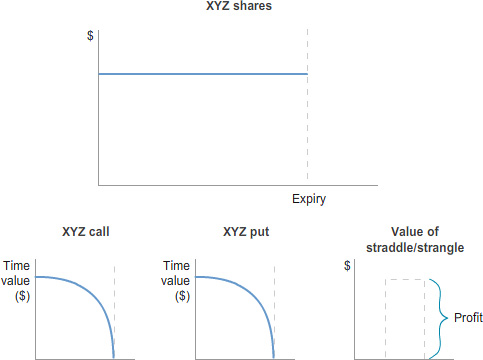
Time decay works strongly in your favour, as the strategy consists of two written options.

Consistent with your view that the stock price will remain steady, your view is that volatility will decrease. A fall in volatility helps both legs of the strategy, while a rise in volatility hurts both legs.

Topic 2: Profits, losses and breakeven

Written straddle: maximum profit, maximum loss, breakevens

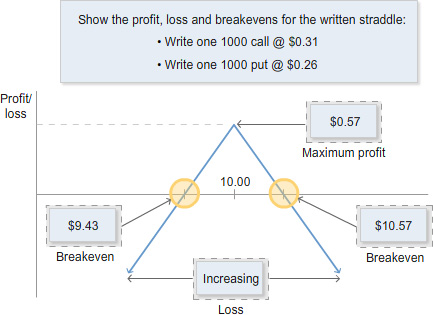
Your maximum profit is the premium you receive for selling the straddle.

Your maximum loss is unlimited. If the share price moves far in either direction, one option will rise significantly in value and you may have to pay much more to close it out than you received on entering the strategy.

There are two breakeven points:

  • the strike plus the premium received
  • the strike less the premium received.
Line chart showing profit or loss for a written straddle with a peak at 10.00, maximum profit labelled 0.57, and breakeven points marked around 9.43 and 10.57, with loss increasing beyond those points.

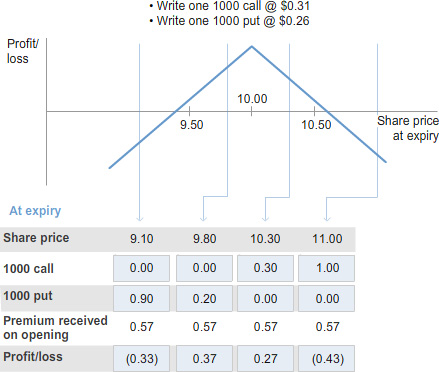
Calculating your profit/loss at expiry

Line chart showing written straddle payoff centred at 10.00 with accompanying table listing share prices, call and put values, premium received, and resulting profit or loss at expiry.

At expiry, one leg will be in the money, and the other will expire worthless. To avoid being exercised, you will have to buy back the in-the-money option.

If the share price is above the strike, you will have to buy back the call. If it is below the strike, you will have to buy back the put.

Your profit/loss is the premium you received for the strategy less the cost of closing out the option.

Written strangle: maximum profit, maximum loss, breakevens

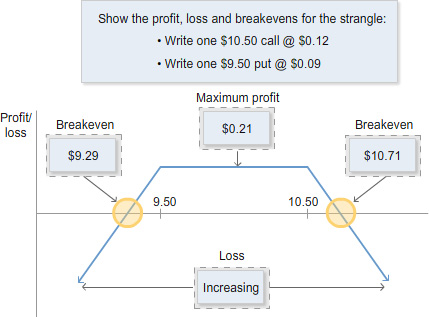
Your maximum profit is the premium you receive for selling the strangle. You will make this if the share price at expiry is between the two strikes.

Your maximum loss is unlimited. If the stock moves a long way in either direction, one option will rise significantly in value and you may have to pay much more to close it out than you received on entering the strategy.

There are two breakeven points:

  • the call strike plus the premium received
  • the put strike less the premium received.
advancing-options-module_2_Option_pricing_in_detail-topic-1-image-6

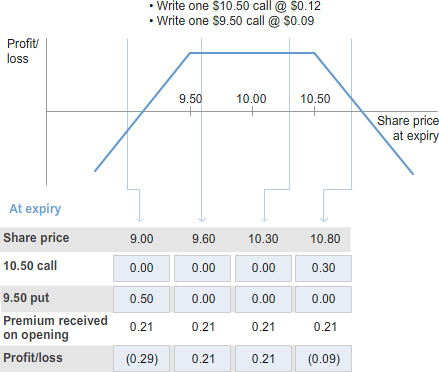
Calculating your profit/loss at expiry

Line chart showing profit or loss against share price at expiry with a flat top and downward sloping sides, accompanied by a table listing share prices, option values, premium received, and profit or loss.

At expiry, if the share price is above the upper strike, the call will be in the money and the put will expire worthless. Your profit/loss is the premium you received for the strangle less the cost of closing out the call.

If the share price is below the lower strike, the put will be in the money and the call will expire worthless. Your profit/loss is the premium you received less the cost of closing out the put.

If the share price is between the two strikes, both options will expire worthless and you make your maximum profit.

Before expiry

You can exit your position at any time.

You may decide to close out early to:

  • limit your losses if the share price has moved unexpectedly, or
  • lock in a profit if the share price has stayed flat.

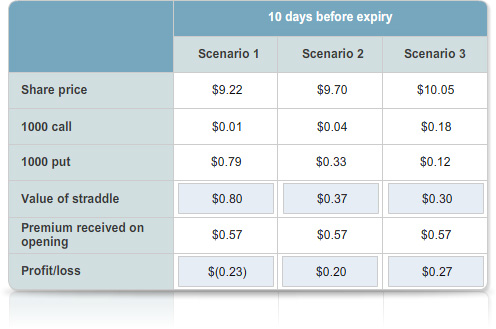
If you close out early, your profit/loss will be the difference between what you initially received for the strategy, and the amount you pay on closing out.

Follow-up action is discussed further in Topic 4.

Table titled 10 days before expiry showing three scenarios with share price, call value, put value, value of straddle, premium received on opening, and resulting profit or loss.

Written straddle vs written strangle

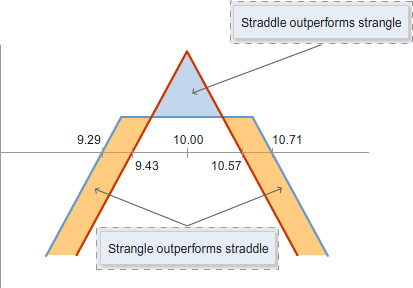
Two overlapping payoff shapes with labelled ranges showing where one strategy outperforms the other, including annotations for straddle outperforms strangle and strangle outperforms straddle.

If you are highly confident the stock price will stay very close to current levels, the straddle will deliver higher profits.

However the straddle involves greater risk, as:

  • the share price does not have to move so far before you make a loss
  • you are always exposed to the risk of exercise,as one leg is generally in the money.

If you think the stock will trade in a fairly narrow range around the current price, but you prefer a lower risk strategy, the strangle may be more suitable.

Because you are writing out-of-the-money options the share price has to move further before you make a loss, and you have greater protection against exercise.

However, the strangle's profit potential is lower.


Written straddle vs. written strangle

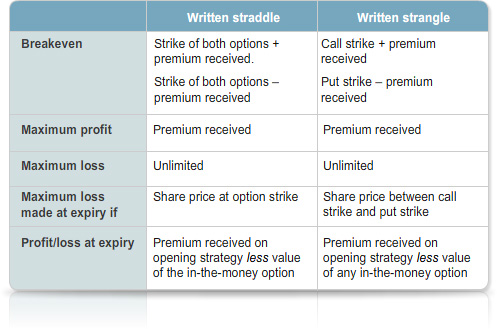
The table below summarises the breakevens, profits and losses of the two strategies.

Top panel showing a flat share price line to expiry, with lower panels showing time value curves for call and put options and a panel showing value of straddle or strangle.

Topic 3: Benefits, risks and other features

Benefits

Table comparing written straddle and written strangle across rows including breakeven, maximum profit, maximum loss, maximum loss made at expiry, and profit or loss at expiry.

High return

Both straddle and strangle generate significant income, as you receive two option premiums.

Compare this to the return from the covered call or the written put, for example, where you receive the single option premium - though with significantly lower risk.

Time decay

Time decay is especially helpful to the written straddle and strangle, as the strategies involve two sold legs.

The options used to construct the strategies are generally made up almost entirely of time value. If the stock stays steady, the value of both legs will fall, benefiting your position.

The effects of time decay are particularly noticeable as expiry approaches and the loss of time value accelerates.


Risks

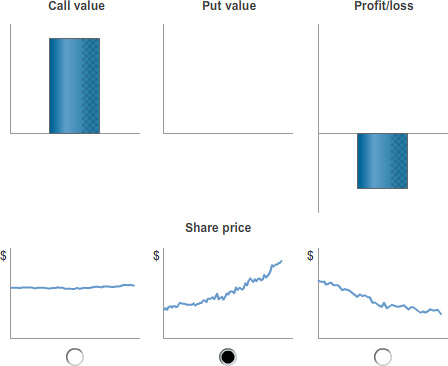
Stock price moves significantly

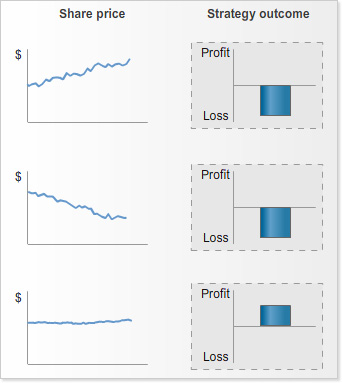
The straddle and strangle are high risk strategies.

The success of both strategies depends on the stock price remaining around current levels.

If the stock moves significantly in either direction, you can suffer heavy losses.

Three rows showing different share price trends over time paired with bar-style outcome diagrams indicating profit and loss ranges.
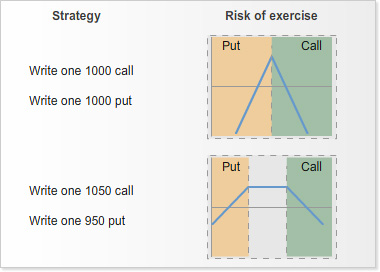
Table listing strategies including writing calls and puts with diagrams showing risk of exercise across put and call regions using coloured backgrounds and line plots.

Risk of exercise

The risk of unwanted exercise is always present with the straddle, as one or other of the options is generally in the money.

If the stock price is above the option strike, your call is at risk of exercise. If the stock price is below the strike, your put is at risk.

The risk of exercise is less of a consideration with the strangle, as both legs are initially out of the money. Early exercise only becomes a concern if the share price moves beyond either strike.

Margins

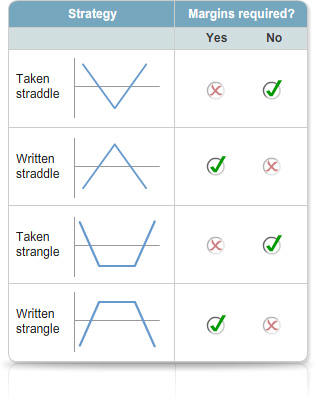
Both strategies involve the payment of margins.

Margins will be higher for the written straddle than for the written strangle, as the straddle is higher risk.

You can use the ASX Margin Estimator for an indication of the margins you will have to pay.

Table showing strategies including taken straddle, written straddle, taken strangle, and written strangle with columns indicating whether margins are required using yes and no with tick and cross icons.

What if I already hold the stock?

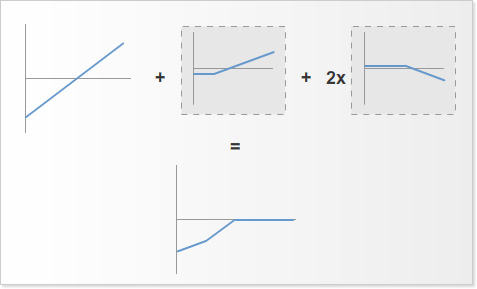
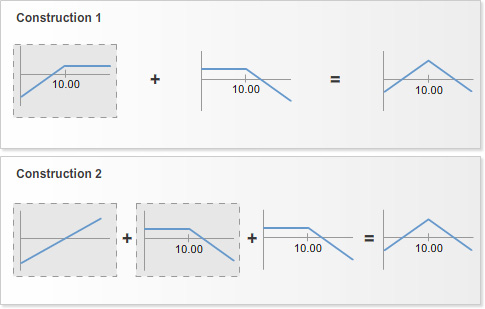
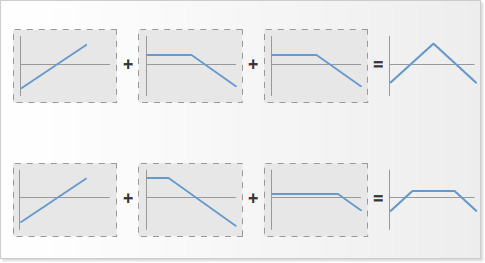
If you already hold the stock, and have the expectation that the price will remain steady, you can achieve the equivalent exposure to the written straddle/strangle by adding written call options to your position.

You write two call options for every 100 shares you hold.

Diagrams showing payoff lines combined using plus and equals symbols to construct resulting option strategy payoff shapes around a central value of 10.00.


The combination of stock plus one of the written calls is equivalent to the written put leg of the 'conventional' straddle/strangle.

Compare this strategy to the covered call, where you write one call for every 100 shares.

However, only one of the calls is 'covered' by your shareholding. If the stock price rises, you face potentially unlimited losses on the uncovered call.

Construction

To construct the strategy using stock and call options, choose the same strike prices you would have used in the conventional construction of the strategy.


Example

You hold 100 shares in XYZ, trading at $10.00.


Straddle

You write two at-the-money calls, the XYZ $10.00 calls @ $0.31.


Strangle

You write

  • 1 XYZ $9.50 call @ $0.63
  • 1 XYZ $10.50 call @ $0.12.
Two rows of diagrams showing payoff lines being combined in different sequences using plus and equals symbols to produce final payoff shapes.

Topic 4: Follow-up action

At expiry

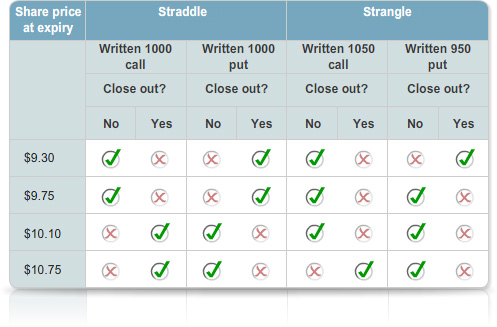
Table showing share prices at expiry alongside straddle and strangle positions with options to close out or not, indicated by tick and cross symbols.

Straddle

If you hold the straddle to expiry, one option will be in the money, and the other will expire worthless.

You will need to buy back the in-the-money option to avoid exercise. If you do not close out your position, you will have to either buy the stock (if the put is exercised) or sell the stock (if the call is exercised).

Strangle

If the share price is between the two strikes, both options will expire worthless, and no action is required.

If the share price has moved far enough (above the call strike, or below the put strike), one leg will be in the money and you will need to close it out to avoid exercise.


Exercise risk

If the share price is very close to the option strike at expiry, you cannot know for certain whether or not your option will be exercised.

For this reason, if on the day of expiry the stock is trading at or very close to the strike, you may consider buying back both legs of a written straddle.

Although this involves a small premium expense, and transaction costs, it avoids the risk of being exercised on both legs.

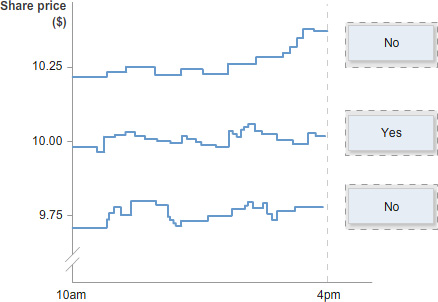
Three small line charts showing share price movement from morning to afternoon with labels to the right indicating yes or no decisions.

Before expiry

You can close out your position at any time.

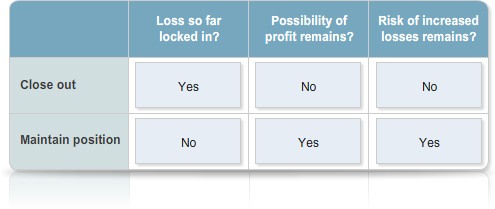
Table comparing closing out and maintaining a position with columns for loss so far locked in, possibility of profit remains, and risk of increased losses remains, with yes and no values.

Stock price breaks out

If the stock price moves strongly early on, it may be wise to reassess your original view.

If your view on the stock has changed, you might consider taking the strategy off. You will probably be closing out at a loss, but by exiting the position you remove the risk of increased losses if the stock price moves further.

The disadvantage is that you remove any possibility of returning to profit, should the share price subsequently reverse.

Share price stays steady

The period close to expiry is when time decay assists your position the most. You will make the maximum profit only if you hold your position until expiry and both options expire worthless.

However, an unexpected move in the stock price close to expiry can quickly transform a winning position into a losing one.

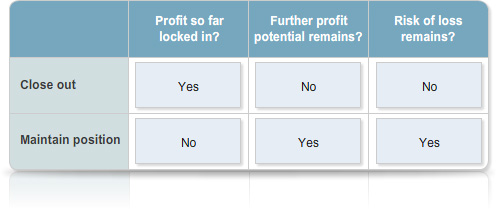
Your choice is

  • close out the position to lock in profits, or
  • hold on, hoping that time decay will increase your profits, but running the risk of a damaging move in the share price.
Table comparing closing out and maintaining a position with columns for profit so far locked in, further profit potential remains, and risk of loss remains, with yes and no values.

Topic 5: Modifying the straddle/strangle

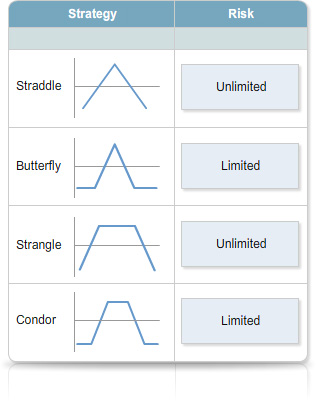
Table listing strategies straddle, butterfly, strangle, and condor with small line chart diagrams and corresponding risk labels showing unlimited for straddle and strangle and limited for butterfly and condor.

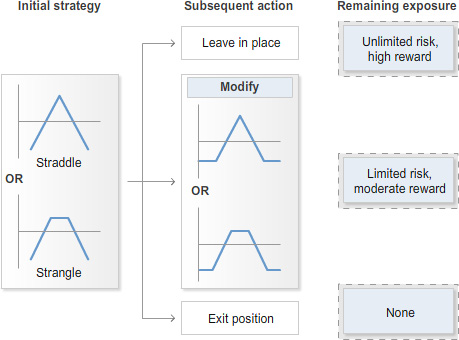
The unlimited risk of the written straddle/strangle arises because of the potential for the share price to move significantly in either direction.

You can limit this risk by adding taken out-of-the-money options to your written position.

Adding a taken call and a taken put, both out-of-the-money, transforms the written straddle into the long butterfly, and the written strangle into the long condor.

For any share price movement beyond the strike of either of the taken options, the rise in value of the taken option will offset the loss you make on the written option.

Example: long butterfly

You write a $10.00 straddle for a total premium of $0.57.

A few days after entering the strategy the share price has risen to $10.20. You decide you are uncomfortable with an unlimited risk exposure, so add the following legs:

  • take one $10.50 call @ $0.16
  • take one $9.50 put @ $0.04.

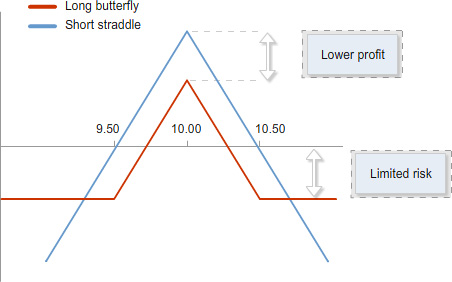
Adding the two taken options limits your risk. If the share price moves above $10.50, or below $9.50, the taken legs provide protection.

However you also reduce your profit potential, as you have to outlay the premium for the bought options.

Line chart comparing long butterfly and short straddle payoff lines centred around 10.00, with labels indicating lower profit and limited risk.

Example: long condor

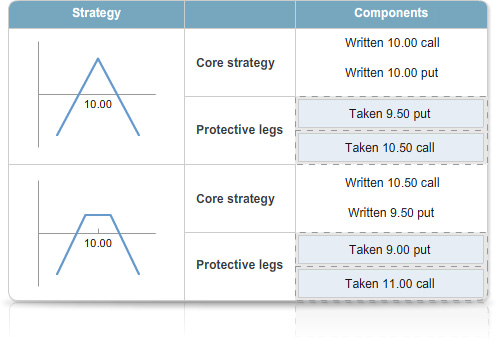
Table showing strategies with sections for core strategy and protective legs, including written call and put at 10.00 and additional taken put and call legs at different strike prices such as 9.50 and 10.50.

You enter the following strangle:

  • write one $10.50 call @ $0.12
  • write one $9.50 put @ $0.09.

The share price starts to show signs of volatility, and you decide you want to cap your potential losses. You add the following legs:

  • take one $11.00 call @ $0.04
  • take one $9.00 put @ $0.02.

Your risk is now limited. Once the share price moves above $11.00 or below $9.00, your losses will not increase.

Your maximum profit has also fallen, due to the expense of the taken options.


The butterfly and the condor are not normally placed as complete strategies at the outset, for two main reasons:

  • it can be difficult to trade all four legs simultaneously at reasonable prices
  • transaction costs are high, as brokerage is usually charged on all four legs.

The addition of the bought options is typically taken later on as remedial action. You may become less confident of your neutral view, and be uncomfortable with the potential for unlimited losses.

Modifying your strategy in this way is an alternative to taking it off altogether.

Flow diagram showing initial strategy options straddle or strangle, branching to leave in place, modify, or exit position, with resulting exposure labels including unlimited risk high reward, limited risk moderate reward, or none.

Reduced margins

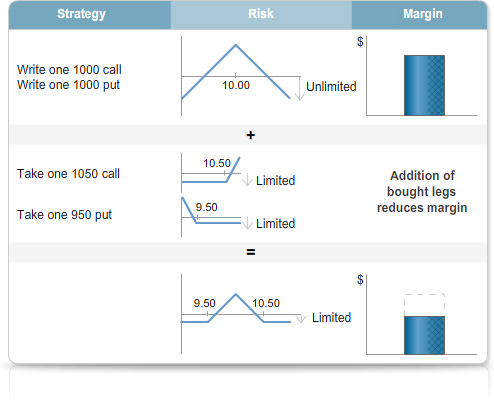
Diagram showing a written straddle with unlimited risk combined with taken call and put legs at different strike prices to form a limited risk position, with a note stating that addition of bought legs reduces margin.

ASX Clear takes into account your bought options in calculating the overall margin obligation.

Because your risk exposure is lower, margins for the butterfly and condor will be lower than for the straddle or strangle.

Summary

  • The written straddle and written strangle are high risk strategies reflecting a neutral view.
  • The written straddle involves the sale of an at-the-money call and an at-the-money put.
  • The written strangle involves the sale of an out-of-the-money call and an out-of-the-money put.
  • Profits are limited to the amount you receive on opening the position. Because you receive two premiums, significant income can be generated.
  • If the stock moves significantly in either direction, your losses are potentially unlimited.
  • Time decay works strongly in your favour. Your view is that volatility will decrease.
  • The straddle can deliver higher profits than the strangle. However it involves greater risk, as the share price does not have to move so far before you make a loss.
  • At expiry, you need to buy back any option that is in the money to avoid being exercised.
  • Both strategies involve the payment of margins.
  • You can limit your risk by adding taken out-of-the-money options to your written straddle or strangle.

Practical examples of option strategies are given throughout these modules.

Prices used in the examples were calculated using an option pricing model, and are based on the following, unless otherwise specified:

  • Underlying stock price: $10.00
  • Volatility: 25%
  • Risk free interest rate: 5%
  • Days to expiry: 30
  • The stock does not go ex-dividend during the life of the option
  • American exercise style

Brokerage costs are not included in the examples. It is, however, important to take brokerage costs into account when trading options.

Please note that some payoff diagrams that appear in this course are conceptual in nature, and may not be drawn exactly to scale.

Test your knowledge