• publish

Topic 1: Why are options margined?

If your option strategy includes written options, you may have to pay margins.

A margin is an amount you must pay to cover the risk of loss on an option position.

In this module we will look at:

  • why options are margined
  • how margins are calculated
  • how you can cover your margin.


Why are options margined?

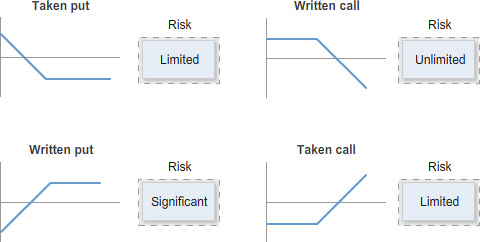
When you buy an option, your risk is limited. The most you can lose is the premium, which you pay up front.

In contrast, a written option involves the risk of significant, and in some cases unlimited loss.

If the option is exercised, the option writer has an obligation either to buy or to sell shares at a specified price, regardless of the market price at the time.

If the market moves against you, you may end up having to pay much more for shares than they are worth, or having to sell them for much less.

advancing-options-module_2_Option_pricing_in_detail-topic-1-image-1

It is essential that option writers are able to meet their obligations under the option contract.

The lodgement of cover protects against the possibility that an option writer will default on their obligations if the market moves against them.

In a broader sense, the margining system serves to protect the integrity of the options market. Option takers can be confident their rights under the option contract will be satisfied, knowing option writers will be required to meet their obligations.


Margin offsets

advancing-options-module_2_Option_pricing_in_detail-topic-1-image-2

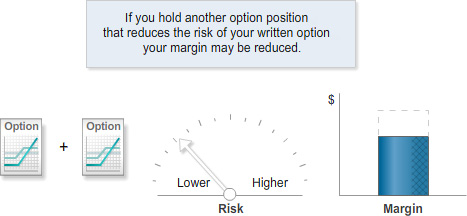
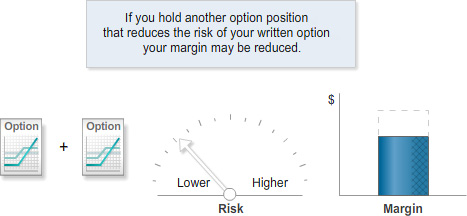
The margin payable on a written option may be reduced, or even eliminated, if you also hold another position that reduces the risk of the written option, such as:

  • a taken option position, or
  • the underlying shares.

In Topic 5, we will look at how these 'offsets' work.


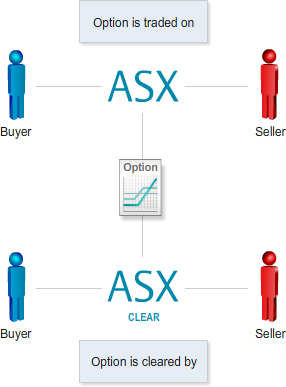
ASX Clear

Throughout this module we will be referring to 'ASX Clear'.

ASX Clear Pty Ltd is a subsidiary of ASX. Its main role is to act as the clearing house for ASX.

One of its functions is to operate the options margining system.

Please refer to Module 10 of the introductory options course for a discussion of the difference between trading and clearing and an explanation of ASX Clear's role.

advancing-options-module_2_Option_pricing_in_detail-topic-1-image-3

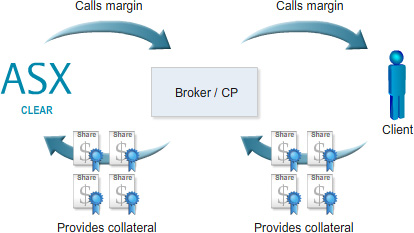
Your broker and ASX Clear

advancing-options-module_2_Option_pricing_in_detail-topic-1-image-2

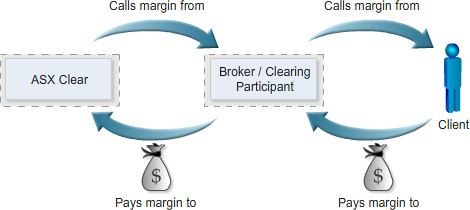
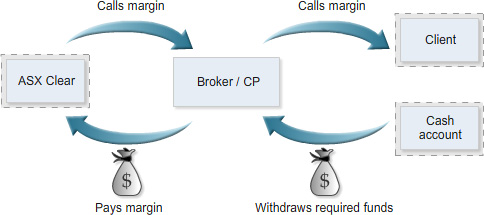
ASX Clear calculates the margin obligation for your options account held at the clearing house.

Your broker is responsible for settling your margin obligation with ASX Clear.

Your responsibility is to your broker, who will require you to have sufficient cash or collateral deposited with them to cover your margin obligation.

Your broker is entitled to call a higher margin from you than the margin ASX Clear calls from your broker.

In Topic 2 and Topic 3 of this module, the margining calculations and methodology we refer to are those used by ASX Clear.

To find out the details of how your broker's margins may vary from ASX Clear's margins, you will need to refer to your broker.


SPAN

When calculating margin obligations ASX Clear uses a system called Standard Portfolio Analysis of Risk (SPAN).

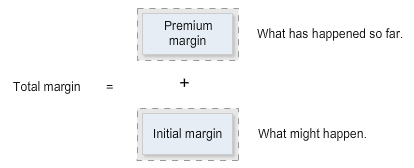
SPAN arrives at a margin by calculating two margin components for each position: the premium margin and the initial margin (also called the SPAN requirement). 


Topic 2: The premium margin

Premium margin and initial margin

There are two elements to option margins:

  • the premium margin
  • the initial margin.

In broad terms:

  • The premium margin is the margin payable to cover the movement in the value of the option since the position was opened
  • The initial margin protects against possible future losses.

Let's take a closer look at the premium margin.

advancing-options-module_2_Option_pricing_in_detail-topic-1-image-6

Calculating the premium margin

advancing-options-module_2_Option_pricing_in_detail-topic-1-image-4

You open a written position by selling an option.

You close out a written position by buying the option back. Closing out your position extinguishes your obligations under the option contract.

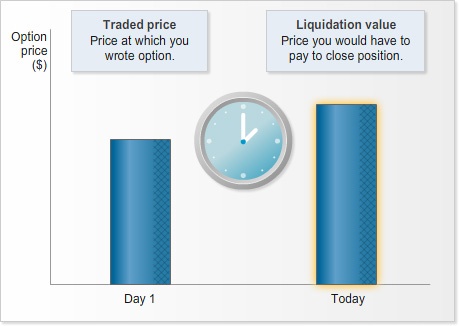
ASX Clear calculates the cost of closing out your position at the end of each trading day and requires that this amount be held as premium margin to cover your position.

The cost of closing out an option is sometimes referred to as the 'liquidation value' of the option.

Debits and credits

ASX Clear recalculates your premium margin at the end of each trading day.

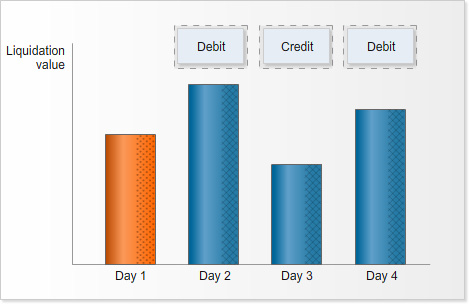
If the liquidation value of the option has increased, your premium margin will rise. Your account will be debited the amount of the increase.

If the liquidation value of your option has decreased, your premium margin will fall. You will receive a credit for the amount of the decrease.

As long as your position remains open, the margining process will result in amounts being debited from or credited to your options account each day as the value of your option changes.

Example

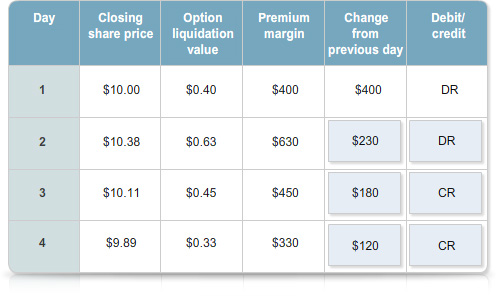
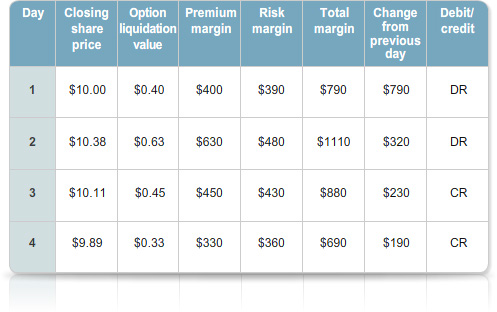
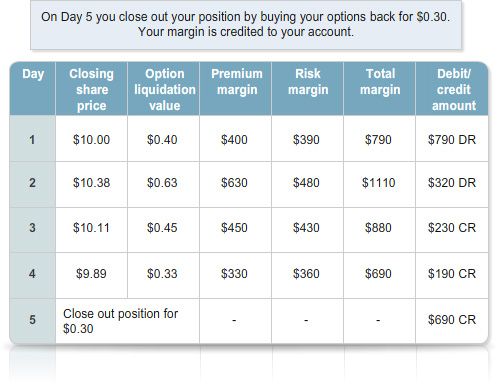
Let's look at an example of how premium margins are applied to a written option position over four trading days.

The example assumes that on Day 1:

  • you write 10 XYZ $10.00 calls @ $0.40
  • contract size is 100 shares per contract.

Topic 3: The initial margin

What is the initial margin?

The initial margin covers the potential change in the price of the option contract assuming the assessed maximum probable inter-day movement in the price of the underlying security.

To calculate the initial margin, CME SPAN 4.0 uses the published price scan range (also referred to as the margin interval).

The price scan range is determined through various observations of the price (or underlying price) over a period of time.


How is the initial margin calculated?

SPAN can be considered as a risk based portfolio approach for calculating initial margin requirements.

SPAN uses risk arrays, which is a set of numeric values that specify if a particular contract will gain or lose value under different conditions (risk scenarios).

The value for every risk scenario symbolises the gain or loss for that contract for a certain combination of volatility change, price change, and decrease in time to expiry.


How is the SPAN requirement calculated? (cont)
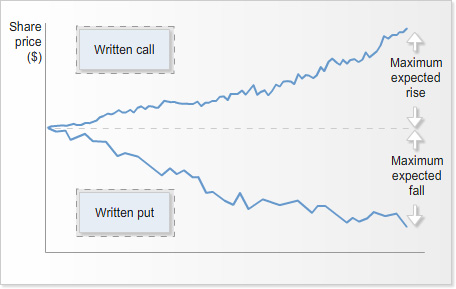
ASX Clear first makes an assessment of the underlying stock's volatility, and determines the maximum probable movement that could be expected from the underlying stock in one day.

This movement is expressed in percentage terms, and is referred to as the 'price scan range'.

For example, a range of 7% means ASX Clear expects the stock is unlikely to rise or fall by more than 7% from its current price over the next trading day.

The scan range is reviewed regularly by ASX Clear.

advancing-options-module_2_Option_pricing_in_detail-topic-1-image-6

Example

Consider the following simplified example:

  • You have written ten XYZ $10.00 put options
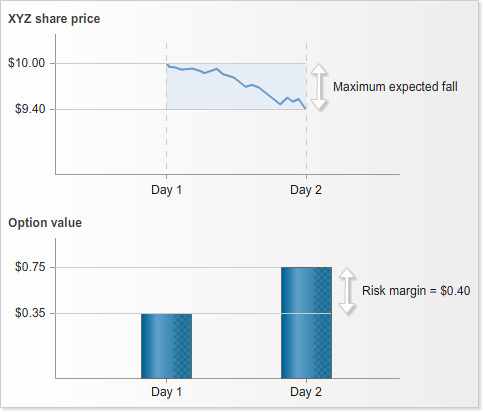
  • XYZ shares have a price scan range of 6%
  • At the end of Day 1, XYZ shares are trading at $10.00
  • Your options are worth $0.35.
  • The 6% price scan range means ASX Clea rexpects a one-day movement in the share price of between -$0.60 and $0.60.
  • ASX Clear calculates that if XYZ shares fall to $9.40 (the full margin interval), your option will be worth $0.75.
  • Your initial margin per share is therefore $0.40, the difference between the current option price and the theoretical price if the shares fall to $9.40.
  • Your total risk margin is $400 (= $0.40 x 10 contracts x 100 shares).

Total margin

Your total margin is the sum of the premium margin and the initial margin.

At the end of each trading day, ASX Clear recalculates your margin requirement.

If your margin requirement has increased from the previous day, your account will be debited the difference.

If it has decreased, you will be credited an amount from ASX Clear.

Let's look at a worked example of how a written option position is margined over four trading days.

The example assumes that on Day 1:

  • you write 10 XYZ $10.00 calls @ $0.40
  • price scan range for XYZ shares is 6%.

What happens when I close out my position?

Your written option position will be margined as long as the position remains open.

ASX Clear will credit the margin amount it holds back to you after one of the following happens:

  • You close out your position
  • The option expires
  • The option is exercised.

Topic 4: How are margins paid?

Cash and collateral

Your broker will ask you to provide enough cash or collateral to meet their margin expectations of you.

Cash cover

You can cover your margins with cash.

Your broker withdraws funds from your cash account when additional margin is required, and credits your account when your margin obligation falls.

Collateral cover

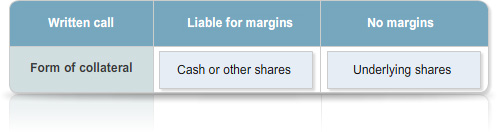
Instead of cash, you can provide your broker with certain other assets to cover your margin obligations (this can include stock and Bank Guarantees).

In practice, most brokers pass the collateral provided by their clients through to ASX Clear to cover the broker's obligation to the clearing house.

For your broker to be able to pass your collateral through to ASX Clear, you will have to sign an Addendum to your client agreement with your broker.

Acceptable collateral

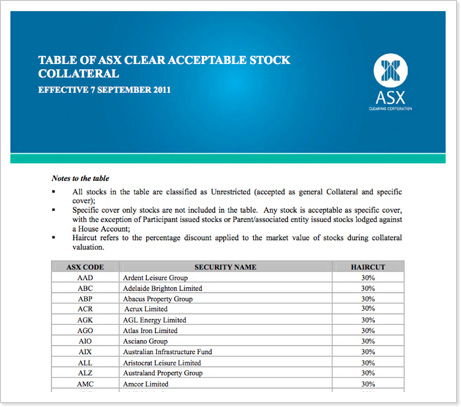
ASX specifies the collateral ASX Clear will accept from the broker. It does not specify the collateral that a broker can accept from its clients.

However, because most brokers pass the collateral provided by their clients through to ASX Clear, brokers generally only accept collateral that is on ASX Clear's 'Acceptable collateral' list.

ASX Clear accepts a range of securities traded on ASX, including securities in any of the underlying stocks listed on the options market.

Securities must be in the form of broker-sponsored holdings. Issuer-sponsored holdings are not acceptable.

Shares bought on margin may qualify as collateral for covered call strategies. You will need to check whether your margin lender has the necessary arrangement in place with ASX Clear.

The 'haircut'

ASX Clear values the securities you lodge as collateral at less than their market value.

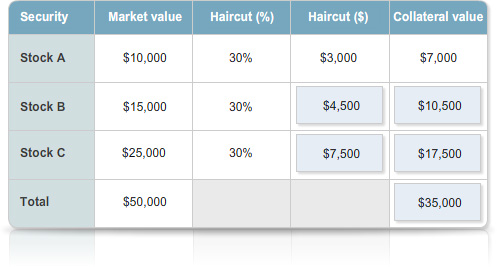
The discount ASX Clear applies to the valuation of your securities is called a 'haircut'. It is typically around 30%, meaning you can apply 70% of the market value towards your margin requirements.

The haircut is designed to give ASX Clear some protection against a sudden fall in the market value of your collateral.

The collateral is revalued daily.

Example

You lodge 2,000 XYZ shares, currently trading at $10.00.

ASX Clear applies a haircut of 30% to XYZ shares.

Market value = 2,000 x $10.00 = $20,000

Haircut = $20,000 x 30% = $6,000

Collateral value = $20,000 - $6,000 = $14,000

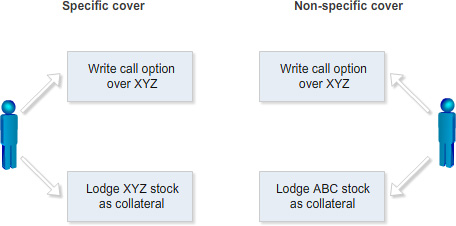
When you write a call option, and lodge the underlying shares as collateral, this may be treated as 'specific cover'. In this case a haircut will not apply.

If the stock held as cover is not stock the option has been written over, it is termed 'non-specific cover', and the haircut will apply.

It is best to speak with your broker about their arrangements for specific cover as these can vary between brokers.

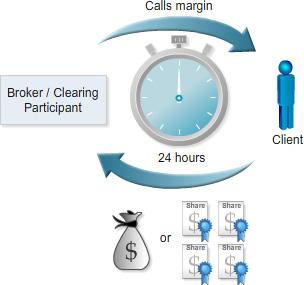
How long do I have to cover a margin? 

Once your broker calls a margin, you have a limited time to provide the necessary cash or collateral.

Unless your client agreement with your broker specifies something different, you must provide cover within 24 hours of the call being made.

If you do not pay in time, your broker can close out your position without further reference to you.

Your broker will call a margin from you only if they do not already hold sufficient cash or collateral. Option writers typically lodge more security than is required when opening a written position to avoid having to provide additional cover on a daily basis.

Intra-day margins

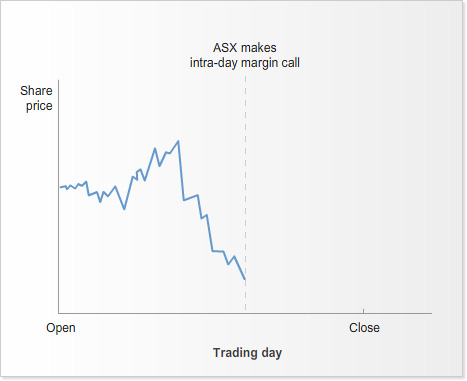
Generally only one margin call is made each day. However, if the market moves strongly up or down, ASX Clear may call for extra margin cover to be lodged during the day (i.e. an intra-day margin call) to cover changes in value of the underlying securities.

Your broker has discretion on whether this intraday call is passed on to you.

Topic 5: Offsets

When do offsets apply?

ASX Clear takes a 'portfolio approach' to margining. It takes into account all your option positions in all underlyings, and considers your overall exposure when calculating your margin.

Your margin obligation will be reduced, or even eliminated, if one of your option positions reduces the risk of another position.

Example

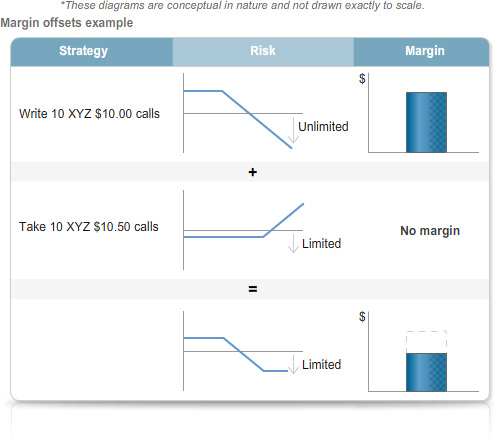
Let's compare two strategies, and how they would be margined.


Strategy 1: Write 10 XYZ $10.00 calls

This strategy has potentially unlimited risk. The higher the share price rises, the greater your losses are.


Strategy 2: Write 10 XYZ $10.00 calls and Take 10 XYZ $10.50 calls

This strategy has limited risk. The price rise that hurts your written calls benefits your taken calls.

Both strategies include ten written $10.00 calls. In calculating the margin for Strategy 2, however, ASX Clear will give a value to your taken calls that will offset the margin on your written calls.

The total margin for Strategy 2 will therefore be lower than the margin for Strategy 1.


Position in the underlying stock

You can eliminate the margin payable on a written call option if you hold the underlying shares.

Lodging the underlying shares as collateral with ASX Clear covers your obligations if the call is exercised. Assuming a contract size of 100 shares, you must lodge 100 shares for each call you have written.

This strategy is known as the 'covered call', and was covered in Module 8 of the introductory course.


For more information

To learn more about how margin offsets are applied, please read the ASX booklet Margins.


Summary

  • ASX Clear margins written positions to ensure that option writers are able to meet their obligations under the option contract.
  • Your total margin consists of the premium margin and the risk margin.
  • The premium margin covers what has happened to your position so far.
  • The risk margin protects against what might happen over the next trading day.
  • ASX Clear recalculates your margin requirement each trading day.
  • If your margin requirement has increased, your account will be debited. If it has decreased, your account will be credited.
  • Your broker will require you to have sufficient cash or collateral deposited with them to cover your margin obligation.
  • ASX Clear values securities you lodgeas collateral at less than their market value. The 'haircut' ASX Clear appliesis typically around 30%.
  • ASX Clear takes into account all your option positions, and considers your overall exposure, when calculatingy our margin.
  • Your margin obligation may be reduced, or even eliminated, if one ofyour option positions reduces the risk of another position.
  • For more information on option margins, please read the ASX booklet Margins.

Practical examples of option strategies are given throughout these modules.

Prices used in the examples were calculated using an option pricing model, and are based on the following, unless otherwise specified:

  • Underlying stock price: $10.00
  • Volatility: 25%
  • Risk free interest rate: 5%
  • Days to expiry: 30
  • The stock does not go ex-dividend during the life of the option
  • American exercise style

Brokerage costs are not included in the examples. It is, however, important to take brokerage costs into account when trading options.

Please note that some payoff diagrams that appear in this course are conceptual in nature, and may not be drawn exactly to scale.

Test your knowledge