• publish

Module 4: Implementing multi-legged strategies

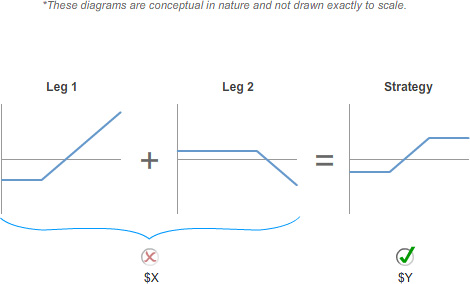
When entering a multi-legged strategy you should think of it as one integrated position, rather than focusing on the component legs. Work out the net amount you want to pay or receive for your strategy. Referring to the current market prices of the component legs can help you to do this. This is the price you specify when placing your order. You do not need to specify the prices for the individual legs.
Topic 1: Entering your strategy

Net price

When entering a multi-legged strategy you should think of it as one integrated position, rather than focusing on the component legs.

Work out the net amount you want to pay or receive for your strategy. Referring to the current market prices of the component legs can help you to do this.

This is the price you specify when placing your order. You do not need to specify the prices for the individual legs.
advancing-options-module_2_Option_pricing_in_detail-topic-1-image-1

Net debit/credit

advancing-options-module_2_Option_pricing_in_detail-topic-1-image-2

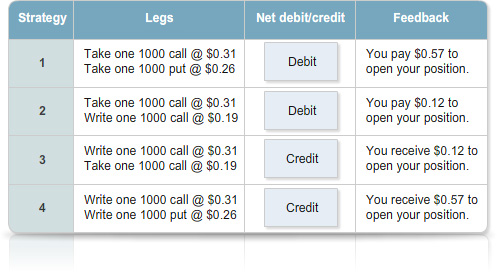
Depending on the strategy you are implementing, you will either pay premium to open your position, or your account will be credited with premium.

When you pay to open your position, this is referred to as a net debit.

When you receive premium, this is referred to as a net credit.

Executing your order

If it is possible to trade the component legs at prices that add up to the net price you specified for your strategy, all legs will be executed simultaneously.

There is no risk of one leg of your strategy being traded, and the other left untraded.

The prices the individual legs are transacted at are irrelevant to you, as long as they add up to the net credit/debit you specified. You can then place your multi-leg strategy as a single order.
 

Example

You want to implement the following strategy:

  • buy one 1000 call
  • sell one 1050 call.

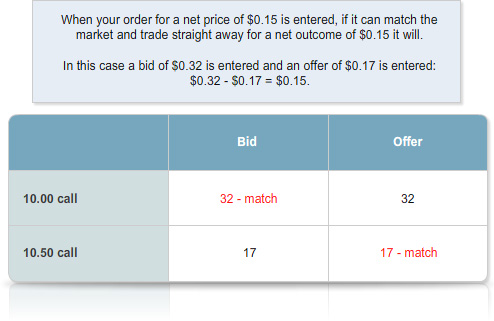
You specify $0.15 as the maximum price you are willing to pay for the strategy.

If it is possible to buy the strategy for $0.15 or better at the current market bids and offers, your strategy will be traded immediately.

If current market prices do not enable you to execute your trade immediately, the system creates new orders, called derived orders, in both legs.

If either of these orders is traded, the other leg of your strategy is executed automatically.

You might buy the 1000 call for $0.30, and sell the 1050 call for $0.15. Or you might buy the 1000 call for $0.32 and sell the 1050 call trading at $0.17.

What matters is that you have entered your strategy at the net price you wanted.

advancing-options-module_2_Option_pricing_in_detail-topic-1-image-3

Topic 2: Exiting your strategy

How can I exit my strategy?

advancing-options-module_2_Option_pricing_in_detail-topic-1-image-2

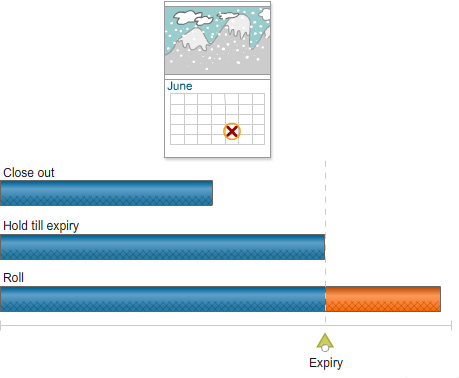
There are several ways to exit your strategy:

  • close out your position ahead of expiry
  • hold your position until expiry
  • roll your position.

Close out

You can close out your position on market before expiry.

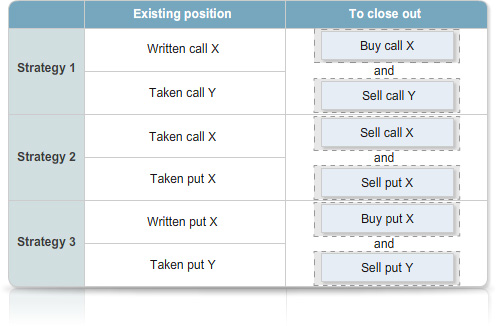
To close out, you will:

  • buy back any written options
  • sell any taken options.

You can specify the net price for which you want to exit your position, just as you did when you entered the strategy. Closing out will crystallise a profit or loss.

advancing-options-module_2_Option_pricing_in_detail-topic-1-image-6

Hold until expiry

advancing-options-module_2_Option_pricing_in_detail-topic-1-image-4

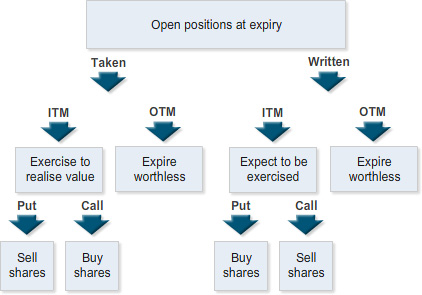
If you do not close out your position before expiry, you can expect that any options you have written that are in the money will be exercised.

If you have written call options, you will have to sell the underlying shares. If you have written puts, you will have to buy the underlying shares.

At expiry in the money options will have some intrinsic value. If you have not sold any taken in-the-money options prior, you should exercise them at expiry otherwise that residual value will be lost.

Roll

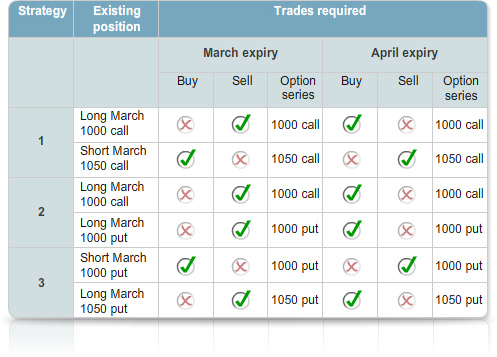
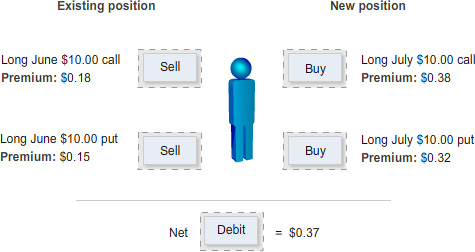
Rolling means closing your existing position and simultaneously opening another position with a later expiry (and possibly different strike price(s)).

To roll your position you will:

  • sell any taken legs, and buy options with a laterexpiry
  • buy back any written legs, and write optionswith a later expiry.

Effectively you are extending the life of your strategy. You would only consider rolling your position if your view on the stock remains consistent.

A roll may be done for a net debit, or a net credit. It depends on:

  • how much you pay/receive to close out yourexisting position
  • how much you pay/receive to establish yournew position.

You can specify the net credit/debit you want to do the roll for. This will be the combined result of your close-out transactions and the opening transactions for your new position.

Rolling a multi-legged strategy can be costly. Brokerage will usually be charged on each leg you transact. Rolling a strategy with two legs could attract four brokerage charges.

Topic 3: Legging in and out

In Topic 1 and Topic 2 we have assumed that you enter and exit your strategy as a single transaction.

The alternative is 'legging in' or 'legging out'.

This means trading the component legs of the strategy at different times.


Why leg in/out?

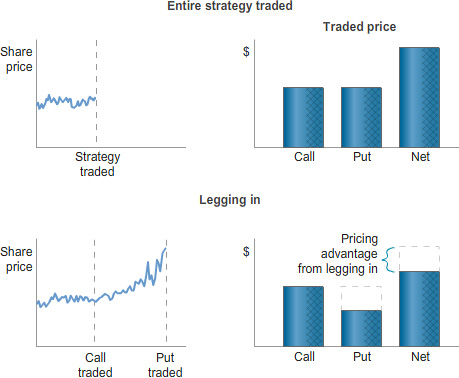
A trader may leg into or out of a position to try to achieve a better price for their strategy.


Example

A trader wants to construct a straddle, consisting of a taken at-the-money call and a taken at-the-money put.

The trader buys the call option first, in the hope the price of the underlying stock quickly rises. If the hoped-for price increase takes place, they should be able to buy the put option for less than it was trading at the time the call was purchased.

The straddle is achieved at a lower cost overall.

advancing-options-module_2_Option_pricing_in_detail-topic-1-image-6

Why leg out?

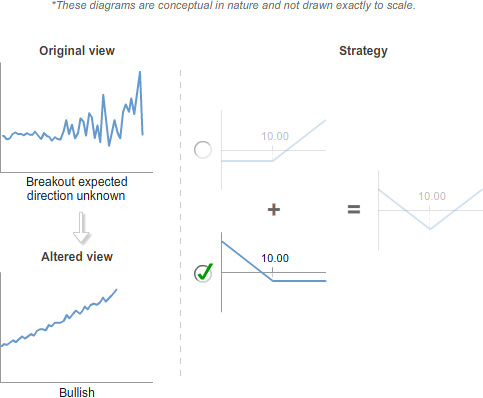
A trader may leg out of a strategy because their view of the stock has changed.


Example

The strategy in the previous example reflects a view that the share price is about to break out. The trader does not attempt to predict the direction of the breakout.

Assume the stock price jumps significantly.

The trader may think that the direction of the breakout is now confirmed, and alter their view to bullish.

Expecting the price to rise further, they may wish to keep only the call in place, and decide to sell the put before it falls further in value.

Risks of legging in/out

Unfavourable share price movement between legs

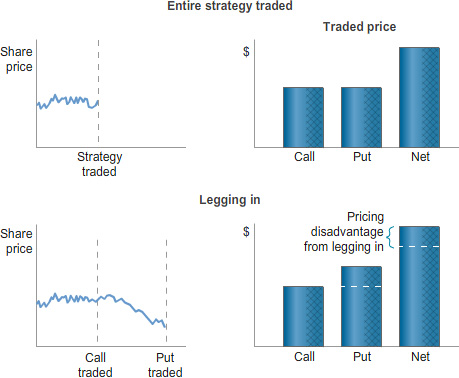
If the stock price moves unfavourably between trading the two legs, you may end up paying more/receiving less than you would have if you had traded the entire strategy as a single transaction.

Continuing our example of legging into the straddle, if the share price falls between the purchase of the call and the purchase of the put, the net cost of the strategy will end up being higher.

Relying on a short term price movement of the underlying stock to achieve a better price for your strategy generally calls for a degree of luck!

Exposure is transformed

Every time you add or remove a leg, your exposure changes.


Example

You have a spread strategy in place comprising:

  • one taken 1000 call
  • one written 1050 call.

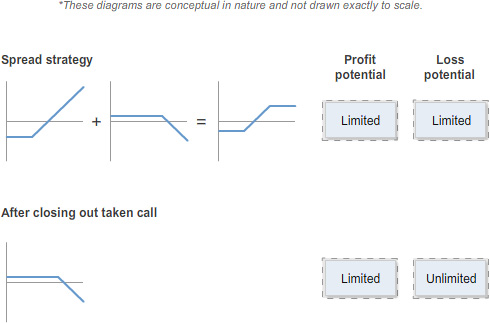
Assume the share price rises strongly. Expecting the price to drop back, you sell the taken call for a profit, and maintain the written call, expecting its price to fall as the shares pull back.

You now have a naked written option position with potentially unlimited losses. The limited risk exposure the spread offered has been transformed by taking off one leg.

Topic 4: Early exercise

If your strategy includes a written option, there is the risk of exercise if the option is in the money.

You need to assess the risk of early exercise on each short leg individually.

As the option writer you have no say in whether you are exercised - it is the taker's right to exercise at any time. If you are concerned about being exercised, it may be wise to close out your position.

When is early exercise likely?

Call options

Any time the share price is above the strike price of a written call, you are exposed to the risk of exercise.

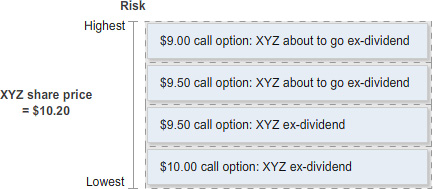
In-the-money calls are more likely to be exercised early if the stock is about to go ex-dividend. The deeper the option is in the money, the more likely early exercise is.


Put options

If the share price is below the strike price of a written put, there is the possibility of exercise.

An investor may exercise a deep in-the-money put early to earn interest on the proceeds from the sale of the stock.

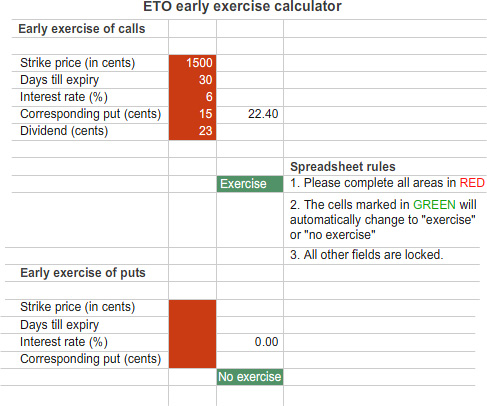
Early exercise calculator

Traders take into account several variables in deciding whether to exercise early.

For call options, these include:

  • interest expense of buying shares early
  • any dividend payable
  • time value (obtained by looking at the cost ofthe put option with the same strike price).

For put options, these include:

  • interest earnt by selling shares early
  • time value (obtained by looking at the cost ofthe call option with the same strike price).

The ASX website has an early exercise calculator to help you work out whether early exercise of an option makes economic sense. To access the calculator, please refer to Early exercise of options.


What should I do if I am exercised early?

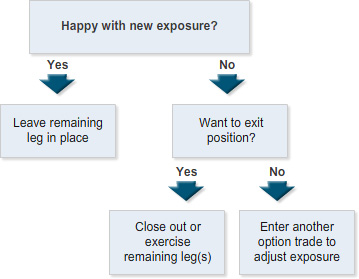
Once one leg of your strategy has been exercised, you must decide what to do with the leg that remains.

If you are happy with the exposure you now have, you can leave the remaining leg in place.

Otherwise, you may decide to close out the remaining leg to exit your position. If that leg is a taken option that is in the money, you could also consider exercising it.

Alternatively you could enter another option trade to adjust your exposure.

Topic 5: Dealing with your broker

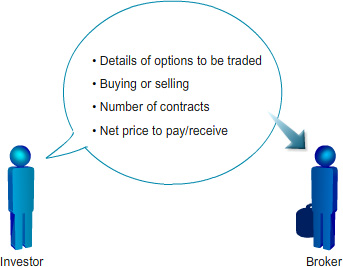
Instructing your broker

Whether you are trading through an execution-only broker, or a broker who gives advice, you need to place your orders with care.

If you trade through an advisory broker, you will probably be instructing your adviser over the phone.

Assuming you want to enter your strategy as a whole, rather than legging in, it is important to give your instruction as the whole strategy, so that your broker enters the strategy into the trading system as a single order.

If you trade online through an execution-only broker, you will be entering the details of your trades into the broker's trading platform yourself.

Brokerage

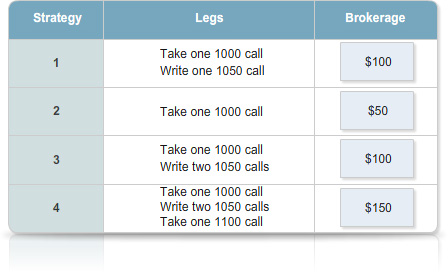
Brokerage rates vary widely.

Brokerage may be charged as a percentage of premium traded, with a specified minimum. Or there may be a fixed cost per trade.

If brokerage is charged per trade, you will pay brokerage on each leg of a multi-legged strategy, even though your strategy is placed as a single order.

In calculating potential profits and losses, it is important to take into account the brokerage you will pay.

Paperwork

Assuming you have been trading options for some time before you take on the more advanced strategies covered in this course, you will already have an options account.

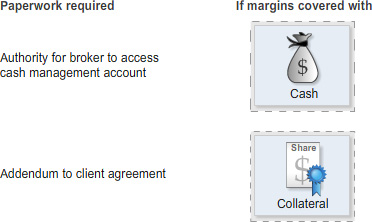
However, further paperwork and approvals may be required if you want to undertake strategies that are margined.

If you are covering your margins with collateral, you will need to complete an Addendum to the client agreement, authorising your broker to lodge your shares with ASX Clear.

If you are covering your margins with cash, typically you would set up a cash management account with your broker, and give the broker authority to access the account when additional margin is required.

Accredited advisers

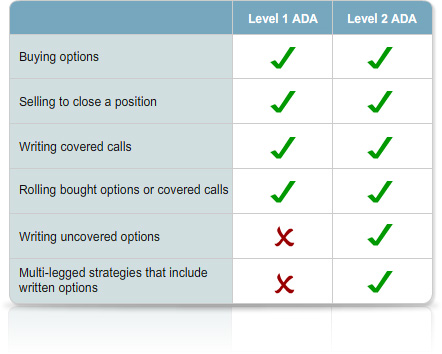
To advise on most of the strategies covered in this course, your adviser must be a Level 2 Accredited Derivatives Adviser (ADA).

A Level 1 ADA may advise on:

  • buying options
  • writing fully covered calls.

An adviser must be accredited at Level 2 to advise on:

  • writing options (other than covered calls)
  • multi-legged strategies involving writtenoptions.

Ask your adviser whether they have the appropriate accreditation for the strategy you are considering.

Summary

  • When entering a multi-legged strategy you should think of it as one integrated position, rather than focusing on the component legs.
  • Specify the net amount you want to pay or receive for your strategy when placing your order.
  • There are several ways to exit your strategy:
    • close out your position ahead o fexpiry
    • hold your position until expiry
    • roll your position.
  • Legging into, or out of, a strategy means trading the component legs of the strategy at different times.
  • You might leg into or out of a position to try to achieve a better price for your strategy, or because your view of the stock has changed.
  • If your strategy includes a written option, there is the risk of exercise if the option is in the money. You need to assess the risk of early exercise on each short leg individually.
  • When dealing with your broker, it is important to give your instruction as the whole strategy, so that your broker enters the strategy into the trading system as a single order.
  • If brokerage is charged per trade, you will pay brokerage on each leg of a multi-legged strategy.
  • Your broker may require further paperwork and approvals if you want to undertake strategies that are margined.

Practical examples of option strategies are given throughout these modules.

Prices used in the examples were calculated using an option pricing model, and are based on the following, unless otherwise specified:

  • Underlying stock price: $10.00
  • Volatility: 25%
  • Risk free interest rate: 5%
  • Days to expiry: 30
  • The stock does not go ex-dividend during the life of the option
  • American exercise style

Brokerage costs are not included in the examples. It is, however, important to take brokerage costs into account when trading options.

Please note that some payoff diagrams that appear in this course are conceptual in nature, and may not be drawn exactly to scale.

Test your knowledge