• publish

Module 7: Strategies for price break-outs

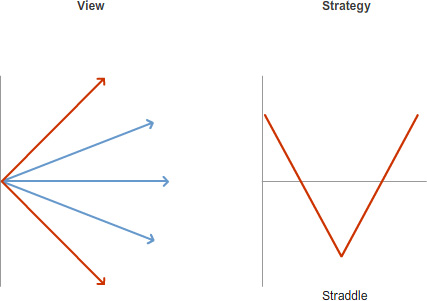
A simple directional view can be traded using one of the 'basic' option strategies. A bullish trader might buy a call, while a bearish trader might buy a put. But what if you think a stock might be about to make a big move - but you don't know in which direction? Is there a strategy that enables you to profit, whether the stock price moves up or down? Before considering this question, it is worth asking when you might hold such a view.
Topic 1: Strategy overview

Introduction

A simple directional view can be traded using one of the 'basic' option strategies. A bullish trader might buy a call, while a bearish trader might buy a put.

But what if you think a stock might be about to make a big move - but you don't know in which direction? Is there a strategy that enables you to profit, whether the stock price moves up or down?

Before considering this question, it is worth asking when you might hold such a view.
advancing-options-module_2_Option_pricing_in_detail-topic-1-image-1

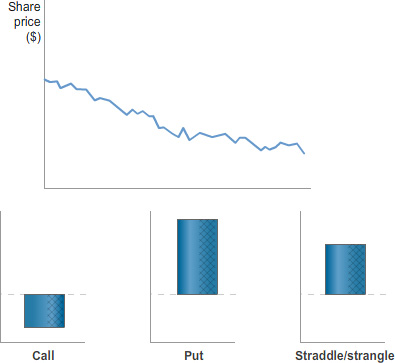
Up or down?

advancing-options-module_2_Option_pricing_in_detail-topic-1-image-2

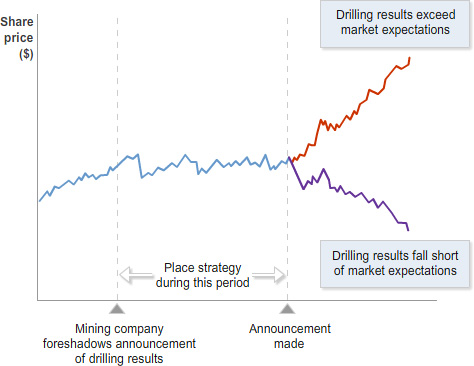
A view that a stock is about to break out from its current price is often 'event-driven', meaning there is an event approaching that you think will have a dramatic effect on the share price.

The event could be something that is relevant only to a particular company.

For example, a mining company is about to release the results of a major exploration program. You might think that if the program has been successful, the share price will rise significantly, but if the results are poor, the share price will slump.

Or the event could be something with broader consequences for the market as a whole, or for a sector of the market.

For example, retail sales figures for the Christmas period are about to be released. You might think that if the figures are much stronger, or weaker, than the market is expecting, the share price of many or all of the listed companies in the retail sector will be significantly affected.


Construction

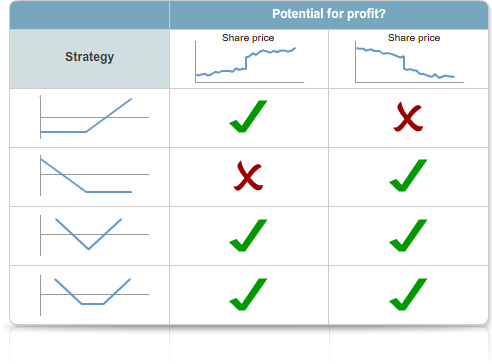
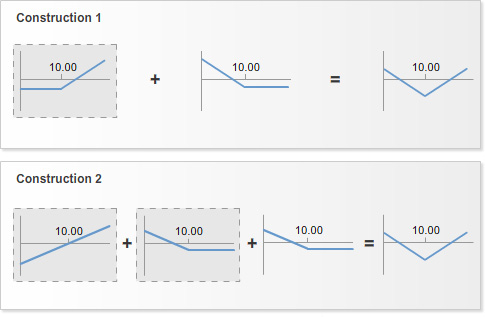
To profit from your view you need a strategy that gives you exposure to both a rise and a fall in the share price.

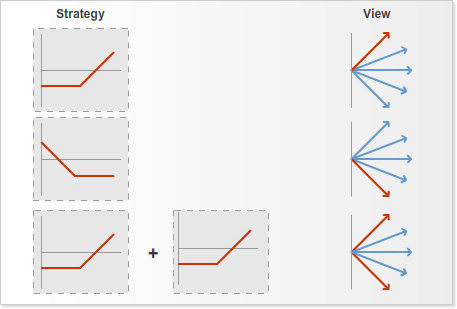
A taken call option allows you to profit if the share price rises, while a taken put allows you to profit if the share price falls. Buying both a call and a put gives you the potential for profit regardless of the direction of the movement.

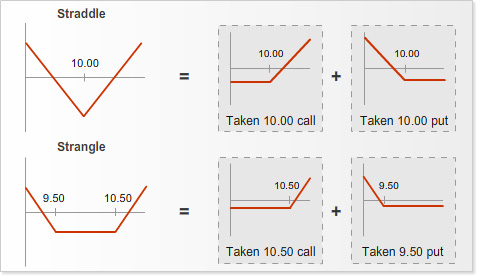
Depending on the strike prices of the options you use, the strategy is known as a 'straddle' or a 'strangle'.

advancing-options-module_2_Option_pricing_in_detail-topic-1-image-3

Straddles and strangles

Both legs of a straddle have the same strike price. The two legs of a strangle have different strikes.

These strategies always use options with the same expiry date.

advancing-options-module_2_Option_pricing_in_detail-topic-1-image-2

The straddle

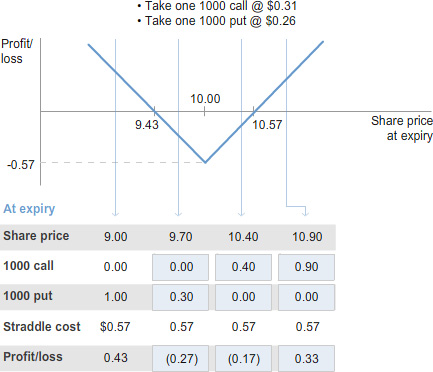
The taken straddle involves the purchase of a call and a put with the same strike. At-the-money options are typically used.


Example

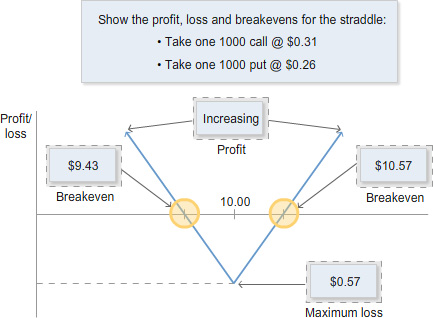
With XYZ shares trading at $10.00, you:

  • take one XYZ 1000 call @ $0.31
  • take one XYZ 1000 put @ $0.26.

The strangle

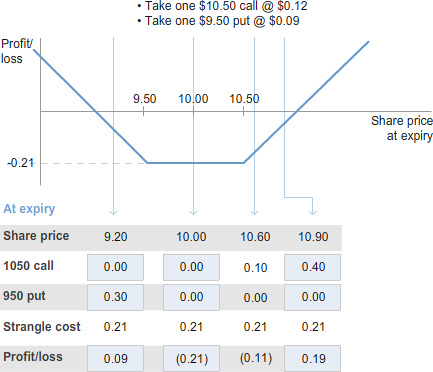
The taken strangle involves the purchase of a call and a put with different strikes. Out-of the-money options are typically used.


Example

With XYZ shares trading at $10.00, you:

  • •take one XYZ 1050 call @ $0.12
  • •take one XYZ 950 put @ $0.09.

As the stock price moves, one option should rise in value, the other should fall.

Your hope is that the stock price moves far enough that the increase in value of the 'winning' option is more than the decrease in value of the 'losing' option.

If this happens, your position will be worth more than the initial cost of the strategy, and you should be able to exit the position at a profit.

advancing-options-module_2_Option_pricing_in_detail-topic-1-image-6

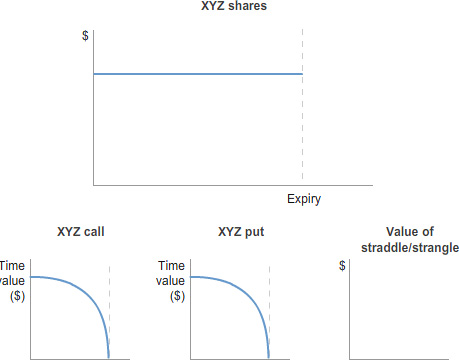
Volatility and time decay

advancing-options-module_2_Option_pricing_in_detail-topic-1-image-4

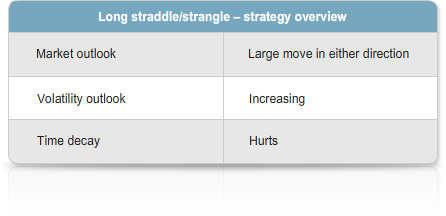
Both volatility and time decay are crucial considerations with the straddle and the strangle.

Consistent with the expectation of a big move in the stock price, your view is that volatility will increase. An increase in volatility helps both legs of the strategy, while a fall in volatility hurts both legs.

As the taken straddle/strangle consists of two bought options, time decay works strongly against the strategy.

Topic 2: Profits, losses and breakeven

The straddle: maximum profit, maximum loss, breakevens

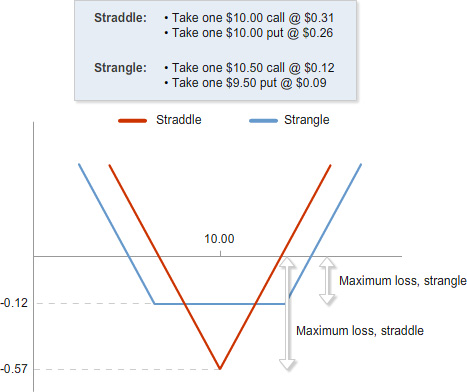
Your maximum loss is the cost of the straddle: the premium you pay for the call, plus the premium you pay for the put.

The taken call offers increasing profits as the share price rises, while the taken put offers increasing profits as the share price falls.

There are two breakeven points:

  • the strike plus the cost of the strategy
  • the strike less the cost of the strategy.

Calculating your profit/loss at expiry

At expiry, if the share price is above the strike, the call option will be in the money, and the put will expire worthless. Your profit/loss is the intrinsic value of the call less the cost of the strategy.

If the share price is below the strike, the put will be in the money, and the call will expire worthless. Your profit/loss is the intrinsic value of the put less the cost of the strategy.

On the rare occasion that the share price is exactly at the strike, both options should expire worthless.

The strangle: maximum profit, maximum loss, breakevens

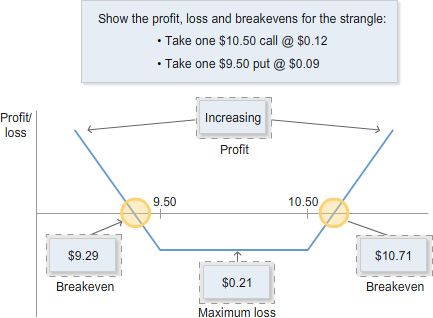
Your maximum loss is the cost of the strangle: the premium you pay for the call, plus the premium you pay for the put.

The taken call offers increasing profits as the share price rises, while the taken put offers increasing profits as the share price falls.

There are two breakeven points:

  • the call strike plus the cost of the strategy, and
  • the put strike less the cost of the strategy.
advancing-options-module_2_Option_pricing_in_detail-topic-1-image-6

Calculating your profit/loss at expiry

At expiry, if the share price is above the upper strike, the call will be in the money and the put will expire worthless. Your profit/loss is the intrinsic value of the call less the cost of the strategy.

If the share price is below the lower strike, the put will be in the money and the call will expire worthless. Your profit/loss is the intrinsic value of the put less the cost of the strategy.

If the share price is between the two strikes, both options will expire worthless and you incur your maximum loss.

Before expiry

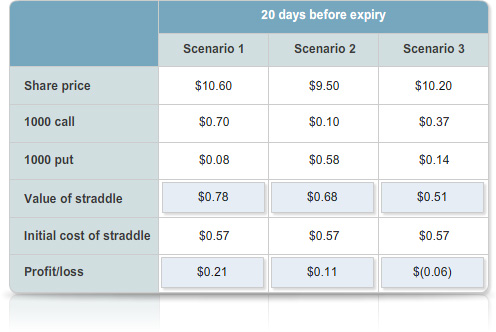
You can exit your position at any time before expiry.

If the expected price movement takes place soon after the position is entered, one option should increase in value, while the other should decrease. Overall, the straddle/strangle should rise in value and you should be able to close out the position at a profit.

If the share price does not move as expected, the strategy will lose value.

Your profit or loss will be the difference between the cost of the strategy and the amount you receive on closing out.

Topic 3: Straddle vs. strangle

Maximum loss

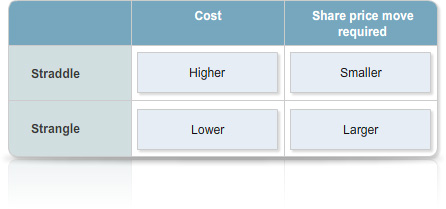
The strangle costs less than the straddle, because you are buying out-of-the-money options instead of more expensive at-the-money options.

In our example, the maximum loss for the strangle is $0.21. You will incur this loss if the share price at expiry is anywhere between the two strikes, $9.50 and $10.50.

Your maximum loss for the straddle is $0.57. You incur this loss at expiry only if the share price is exactly at the strike price of the two options. However, if the share price does not move far from the option strike, your losses will still be heavy.

Price movement required to profit

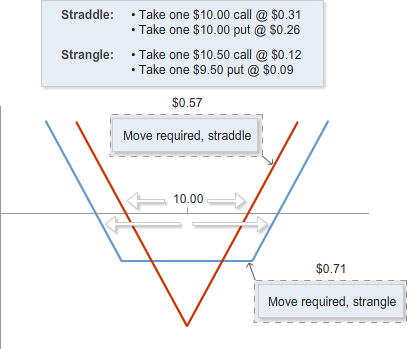
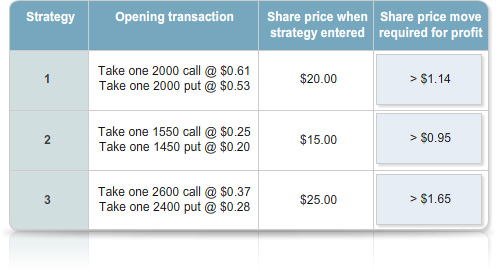
While the strangle is cheaper than the straddle, the share price must move further for the strategy to be profitable at expiry.

The breakevens for the straddle are $9.43 and $10.57, meaning the share price must move by more than $0.57 for you to make a profit at expiry.

The breakevens for the strangle are $9.29 and $10.71. The move required for you to make a profit at expiry is more than $0.71.

How do I decide?

The main questions you should ask are:

  • How much am I prepared to risk losing?
  • How dramatic do I think the price breakout will be?

The choice of straddle or strangle is similar to the decision the bullish trader faces between an at-the-money and an out-of-the-money call.

The out-of-the-money call is cheaper, but less likely to make a profit as the share price has to move further. The at-the-money call costs more, but the share price doesn't have to move so far for you to profit.

Topic 4: Benefits, risks and other features

Benefit: no need to pick direction

When you buy a call or a put, you must decide in which direction the stock price will move. If you get the direction wrong, you will make a loss.

The main advantage of the straddle/strangle is that you have both directions covered. The direction of the movement is irrelevant. All that matters is that the move is large enough.

Risk: large move required

Straddles and strangles both involve the purchase of two options.

At expiry, if the share price has made the expected move, one leg will be worthless. For you to make a profit, the price must have moved enough that the in-the-money leg is worth more than the premium you paid for the two options.

The main risk is that the share price does not move far enough by expiry.

Risk: time decay

Time decay is especially damaging to the straddle and strangle as the strategies involve two bought legs.

Also, because the options are at the money (straddle) or out of the money (strangle), they are generally made up almost entirely of time value, so are hit particularly hard by time decay.

If the share price does not make the expected move, time decay will quickly erode the value of your position.

What if I already hold the stock?

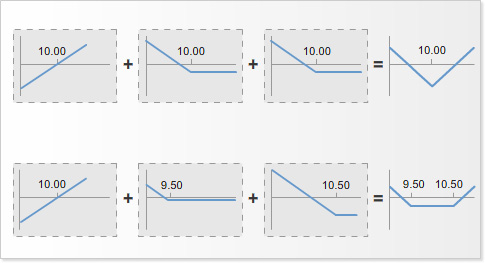
If you already hold the stock, and have the expectation that the price will break out but are unsure of the direction, you can achieve the equivalent exposure to the straddle/strangle by adding put options to your position.

You buy two put options for every 100 shares you hold.

The combination of stock plus one put is equivalent to the bought call leg of the 'conventional' straddle/strangle. You have uncapped profit potential if the stock price rises, and limited losses if the share price falls.

The second put gives you increasing profits as the share price falls.

The net result is that you will profit if the share price moves far enough in either direction.

Construction

To construct the strategy using stock and put options, choose the same strike prices you would have used in the conventional construction of the strategy.

Example

You hold 100 shares in XYZ, trading at $10.00.


Straddle

You buy two at-the-money puts, the XYZ $10.00 puts @ $0.26.


Strangle

You buy

  • 1 XYZ $9.50 put @ $0.09
  • 1 XYZ $10.50 put @ $0.58.

Topic 5: Follow-up action

At expiry

Straddle

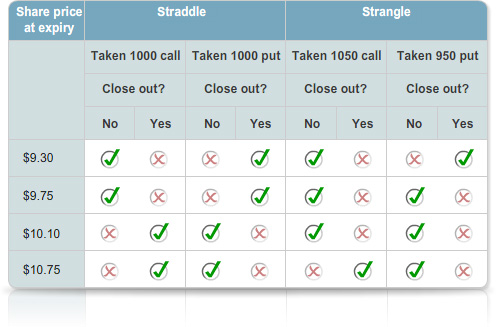
If you hold the straddle to expiry, one option will be in the money and the other option will expire worthless.

If the share price has risen, the call will be in the money. If it has fallen, the put will be in the money. You can

Strangle

If the share price has moved far enough (above the call strike, or below the put strike), one leg will be in the money. You can sell the option on market to realise its value.

If the share price is between the two strikes, both options will expire worthless, and no action is required.


Before expiry

The straddle and strangle are often closed out ahead of expiry, before the most damaging phase of time decay close to expiry is reached.

Share price stays steady

If the share price does not behave as expected, the strategy will lose value as time decay takes its effect. It's also likely that implied volatility will fall, further reducing your options' value.

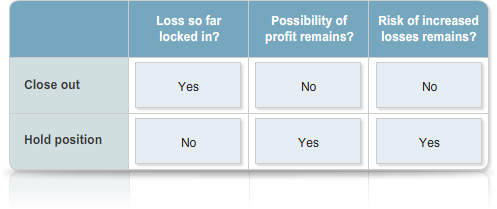
You must decide whether to hold on in the hope the breakout takes place, or close out before too much time value is lost.

The longer the stock price stays steady, the more time decay will damage your position.

Stock price breaks out

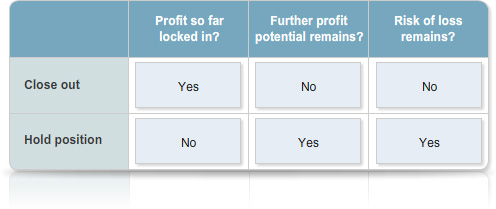
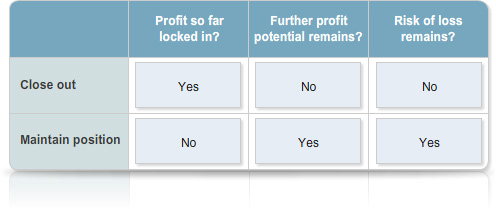
If early on the stock price moves strongly, you can consider taking the strategy off.

The benefit is that you lock in your profit before time decay has a chance to damage your position or the share price reverses.

The disadvantage is that the share price may move even further after you close out, and you could have made a larger profit by maintaining your position.

There is no right or wrong answer. You need to form an opinion on whether the breakout has further to go, and decide whether you are prepared to run the risk the share price will stabilise or reverse.


Legging out

Summary

  • Straddles and strangles give you the potential for profit if the share price move sstrongly either up or down.
  • The taken straddle involves the purchase of an at-the-money call and an at-the-money put. The taken strangle involves thepurchase of an out-of-the-money call and an out-of-the-money put.
  • The most you can lose is the two premiums you pay on opening your position.
  • Your view is that volatility will increase.
  • Time decay works strongly against the strategy.
  • The strangle costs less than the straddle, however the share price must move further for the strategy to be profitable at expiry.
  • The main advantage of both strategie sis that you have both directions covered. The direction the stock price moves is irrelevant. All that matters i sthat the move is large enough.
  • The main risk is that the share price does not move far enough.
  • The straddle and strangle are often closed out ahead of expiry, before the most damaging phase of time decay is reached.

Practical examples of option strategies are given throughout these modules.

Prices used in the examples were calculated using an option pricing model, and are based on the following, unless otherwise specified:

  • Underlying stock price: $10.00
  • Volatility: 25%
  • Risk free interest rate: 5%
  • Days to expiry: 30
  • The stock does not go ex-dividend during the life of the option
  • American exercise style

Brokerage costs are not included in the examples. It is, however, important to take brokerage costs into account when trading options.

Please note that some payoff diagrams that appear in this course are conceptual in nature, and may not be drawn exactly to scale.

Test your knowledge