• publish

Module 10: Cheaper stock or extra cash

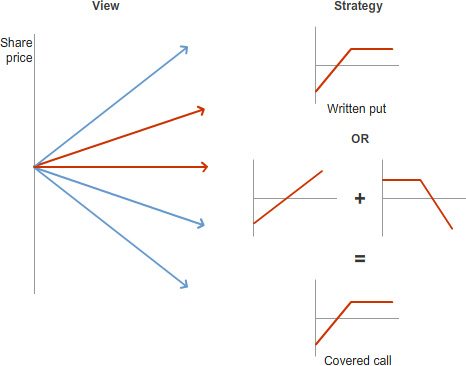
Most option traders are familiar with the covered call and the buy/write. Writing call options over your shares enables you to generate income in flat markets. The premium you receive effectively lowers the acquisition/holding cost of your stock. Fewer traders realise there is another strategy which provides the equivalent exposure, the written put. Although the two strategies provide equivalent exposure, there are more risk management issues associated with the written put than the covered call.
Topic 1: Strategy overview

Introduction

Most option traders are familiar with the covered call and the buy/write.

Writing call options over your shares enables you to generate income in flat markets. The premium you receive effectively lowers the acquisition/holding cost of your stock.

Fewer traders realise there is another strategy which provides the equivalent exposure, the written put.

Although the two strategies provide equivalent exposure, there are more risk management issues associated with the written put than the covered call. These will be discussed in Topic 3.
advancing-options-module_2_Option_pricing_in_detail-topic-1-image-1

The put writer's obligation

advancing-options-module_2_Option_pricing_in_detail-topic-1-image-2

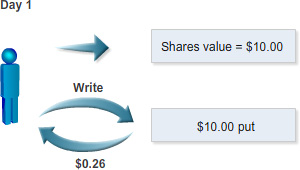
Example: XYZ May $10.00 Put option @ $0.26.

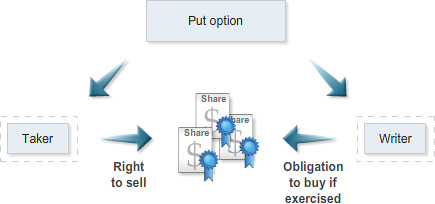
The taker of the put has the right to sell 100 XYZ shares for $10.00 on or before the expiry date in May.

The writer of the put has the obligation to buy 100 XYZ shares for $10.00 if the option is exercised.

The taker pays the writer the premium of $0.26 per share.

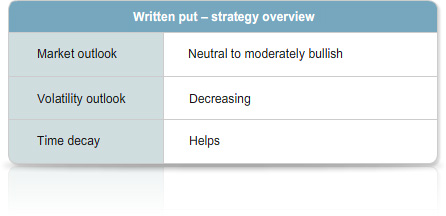
The written put generally reflects a neutral to moderately bullish view.

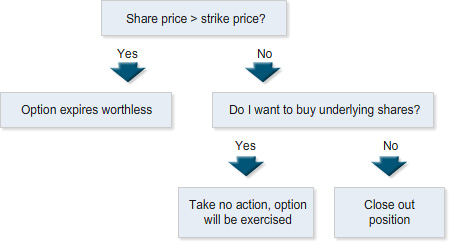
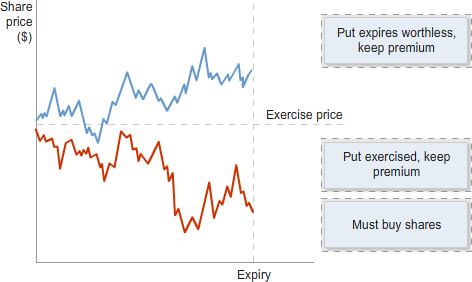
If the stock price at expiry is above the option strike, the put will expire worthless and you benefit from the premium income.

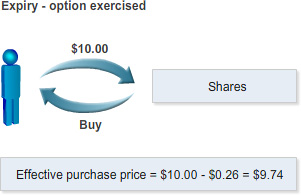
If the stock price is below the strike, the option will be exercised and you will have to buy the stock. However the premium you received effectively lowers your purchase price for the shares.

Time decay and volatility

As with all strategies consisting solely of written options, time decay works in your favour.

Consistent with your view that the stock price will remain steady, your view is that volatility will decrease.

advancing-options-module_2_Option_pricing_in_detail-topic-1-image-3

Topic 2: Profits, losses and breakeven

Maximum profit, maximum loss, breakeven

advancing-options-module_2_Option_pricing_in_detail-topic-1-image-4

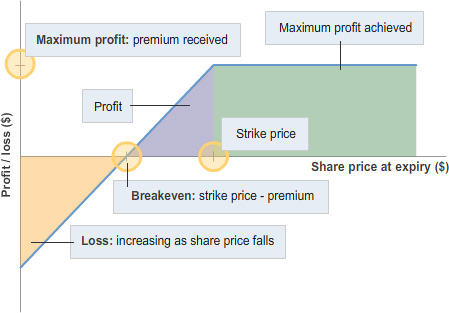
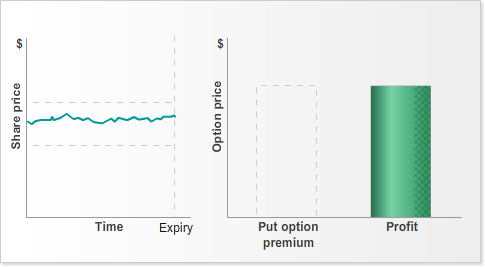
Your maximum profit is the premium you receive. 

Your breakeven point is the strike price less the premium.

Your maximum loss is the strike price of the option, less the premium you receive. In other words, the share price theoretically could fall to zero and you would still have to pay the option strike price if exercised.

Calculating your profit/loss at expiry

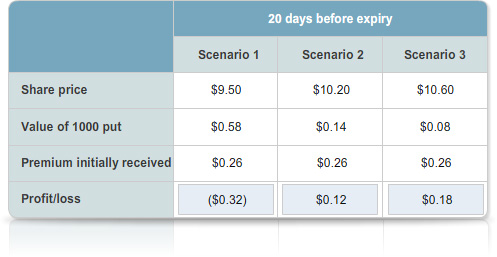
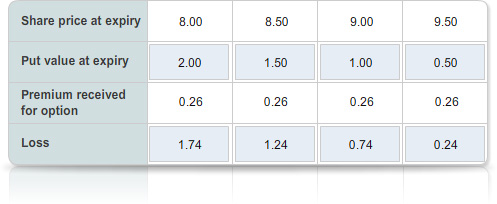
Your profit or loss at expiry is the premium you received for writing the option, less the option's value at expiry.

Scenario 1: Share price above strike
The option will expire worthless. You make the maximum profit, the premium.

Scenario 2: Share price below strike
The option will be in the money. If the share price has fallen below your breakeven you will make a loss. If you do not close out your position, you can expect to be exercised and have to buy the shares at the option strike.

advancing-options-module_2_Option_pricing_in_detail-topic-1-image-6

Before expiry

advancing-options-module_2_Option_pricing_in_detail-topic-1-image-4

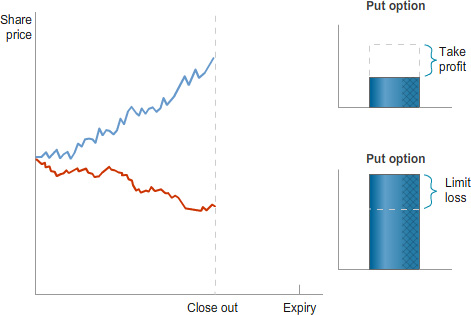
You can exit your position prior to expiry.

You may decide to close out early to:

  • limit losses if the share price has fallen and youare concerned the fall may continue, or
  • lock in a profit if the share price has risen.

Your profit/loss will be the difference between the premium you initially received and the amount you pay to close out.

Topic 3: Benefits, risks and other features

Acquire stock 'cheaply'

If you are happy to hold the underlying stock, writing a put can be a way to acquire shares relatively cheaply.

If at expiry the stock is below the option strike, you do not close out your position, and exercise will take place.

Your effective purchase price is the option strike, less the premium you received. This will be lower than the share price at the time you wrote the option.

Writing a put does not guarantee that you will purchase the shares. If the stock price at expiry is above the strike, the option will expire worthless and you will not be exercised. However, you have made a profit in the form of the option premium.

Writing a put vs. buying stock

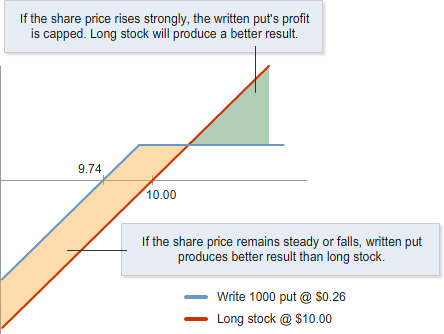
If the stock price falls after you write the put, your effective purchase price may be higher than the stock price at the time of exercise. Because of the premium you received, however, you will still be better off than if you had bought the stock at the time of writing the option.

If the stock price rises significantly after you write the put, your profit is limited to the premium. Buying the stock may give you a better result than writing the option, as there is no cap on the profit from a long stock position if the stock price rises.

Earn income in flat markets

Writing puts enables you to earn income in flat markets.

If the share price stays steady, the option will lose value due to time decay.

A fall in volatility, which is consistent with a neutral market outlook, will also work in your favour.

You can then:

  • close out the position at a profit, or
  • see the option expire worthless (if the shareprice at expiry is above the strike).

Risks

Stock price falls significantly

You can incur heavy losses if the stock price falls significantly. Your losses are limited only by the fact that the share price cannot fall below zero.

If the share price collapses, your written put will be exercised and you will have to pay much more for the stock than its current market price.

For this reason, you should only ever write puts if you have the money to pay for the underlying shares.

Volatility rises

An increase in volatility can damage your position.

Higher volatility leads to higher option premiums, all else being equal, making it more expensive to buy back your put should you choose to close out before expiry.


Written put vs. covered call

At the start of this module we said that the written put can be considered to provide equivalent exposure to the covered call.
Potential profit and loss exposure is equivalent for both strategies

  • limited profits if the share price rises
  • increasing losses as the share price falls.

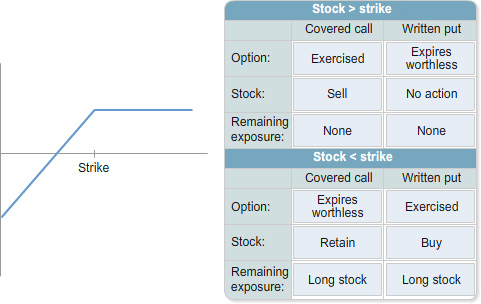
If you hold the strategy until expiry and do not close out any in-the-money option, your remaining exposure is the same

  • if the stock price is above the strike, you willhave no position
  • if the stock price is below the strike, you willhave a long stock position.

If you already hold the shares, the covered call may be simpler to implement, as you need only write calls over your existing shares.

If you do not hold the shares, your choice is

  • buy the shares and write calls, or
  • write puts.

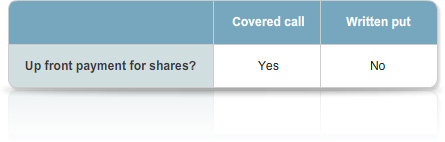
Buying shares and writing calls requires a larger outlay of funds upfront. With the written put, the expense of buying the shares comes later, if you are exercised.

In most cases the payoff from the two strategies will be similar when premiums and cost of funding and potential dividends are taken into account.

Other considerations include:

Margins

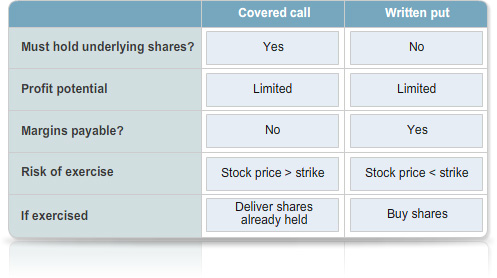
The written put requires the payment of margins. Your broker may even require you to demonstrate you have sufficient cash to pay for the shares if you were to be exercised.

You will not be called for margins on the covered call, as long as you lodge the underlying stock as specific collateral.

Risk of exercise

The covered call is at risk of exercise if the stock price is above the option strike. The written put is at risk if the stock price is below the strike.


Dividends

Check if the stock goes ex-dividend before expiry.

The covered call writer holds the shares, so will receive the benefit of any dividend, whereas the put writer does not receive dividends. (However, option premiums will reflect the value of the dividend.)


Topic 4: Which put to write?

Choice of strike - example

XYZ shares are trading at $10.00.

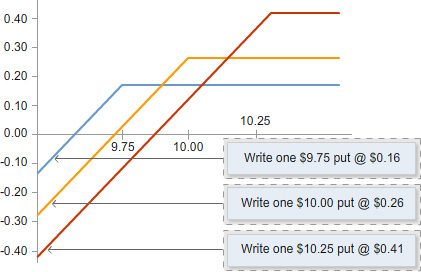
The following puts expiring in 30 days are available:

  • $9.75 put @ $0.16
  • $10.00 put @ $0.26
  • $10.25 put @ $0.41

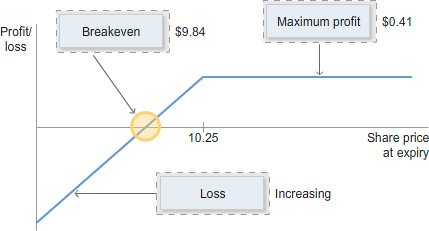
XYZ $10.25 put @ $0.41 

The $10.25 put gives you the largest premium, and therefore offers the greatest profit potential.

However the option is already in the money, and involves the greatest risk of exercise. Unless the share price at expiry is above $10.25, you will be exercised.

Your effective purchase price if exercised is $9.84, the highest of the three options.

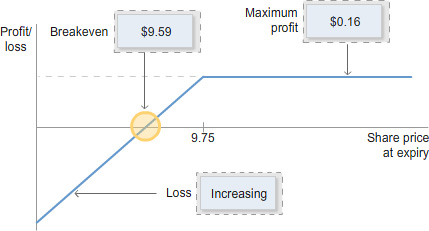
XYZ $9.75 put @ $0.16

The out-of-the-money option involves the lowest risk of exercise. The share price would have to fall at least $0.25 before you face the possibility of exercise.

If exercised, this option results in the lowest effective purchase price of $9.59.

However, the $9.75 put generates the least income - the premium is only $0.16.

XYZ $10.00 call @ $0.26

If the share price stays steady, the at-the-money put gives you the best result. Although it does not pay the largest premium, the $10.00 put has the most time value, so in a flat market it produces the highest return.

It gives you an effective purchase price of $9.74 if the share price falls.

Expiry month

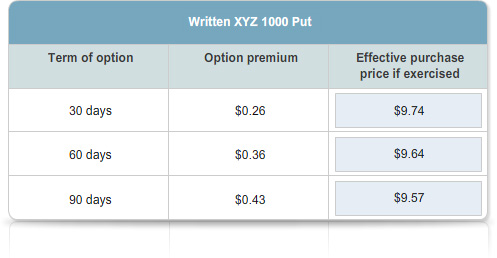
The longer the term of the put option, the larger the premium you receive. This gives you greater profit potential if the share price stays flat or rises, and a lower effective purchase price if you are exercised.

However, the longer the time to expiry, the greater the risk of a damaging fall in the share price.

Topic 5: Follow-up action

At expiry

If the share price at expiry is above the strike, the written put will expire worthless and no further action is required.

If the share price is below the strike, you can expect the option to be exercised. You will have to buy the underlying shares at the strike price.

If you wish to avoid exercise, you need to close out the position ahead of expiry.

Before expiry

If the stock price moves significantly in either direction, you may want to consider exiting the position prior to expiry.

If the stock price has risen significantly, your put will have fallen in value. Closing out the position locks in a profit.

If the stock price has fallen significantly, your put will have increased in value. Closing out the position crystallises a loss, but removes the risk of further damage if the stock price was to fall further. The disadvantage is that you also remove any possibility of returning to profit, should the share price subsequently reverse.

Rolling your position

If you maintain a neutral outlook, you can consider rolling your position. You close your existing position and simultaneously open another with a later expiry and possibly a different strike.

Example

You have written the May $10.00 put @ $0.26.

A few days before expiry:

  • the shares are at $10.00
  • your option is worth $0.11.

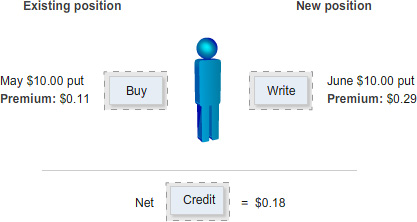
You roll your position by:

  • buying back the May $10.00 put for $0.11,and
  • writing a June $10.00 put for $0.29.

The roll results in a credit of $0.18 ($0.29 - $0.11).

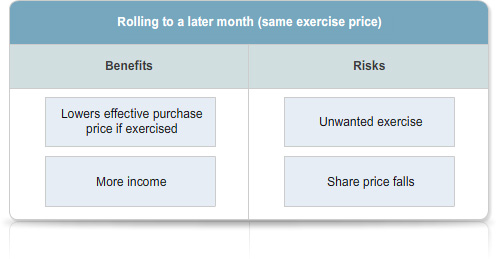
Roll your position

Rolling has earned you additional premium of $0.18.

Factoring in the initial premium, and the additional premium for rolling, you have lowered your effective purchase price if exercised to $9.56.

However, rolling means you are also exposed to the risks of a falling share price for another month.

You should only roll your put if your view on the share price remains consistent with the strategy.

Early exercise

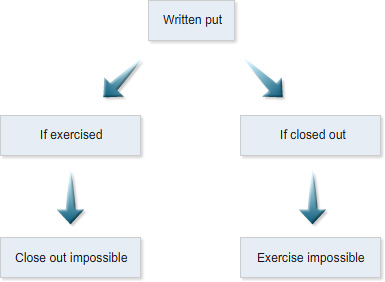
Once you are exercised, it is too late to buy back your option. You must pay for and take delivery of the shares.

If your put is in the money approaching expiry, and you wish to avoid exercise, you need to buy back the option.

Put options are more likely than calls to be exercised early, as exercising a put allows the taker to earn interest on the proceeds from the sale of the stock.

The ASX website has an early exercise calculator to help you work out whether early exercise of an option makes economic sense. To access the calculator, please refer to Early exercise of options.

Summary

  • Writing put options enables you to generate income in flat markets, and can also be a way to acquire stock relatively cheaply.
  • The strategy generally reflects a neutral to moderately bullish view.
  • If the stock price at expiry is above thes trike, the put will expire worthless and you benefit from the premium income.
  • If the stock price at expiry is below the strike, you can expect to be exercised. You will have to buy the underlying shares at the strike price. However the premium you receive effectively lowers the acquisition cost of your stock.
  • Your maximum profit is the premium you receive.
  • Your breakeven point is the strike price less the premium.
  • Your main risk is that the stock price falls significantly.
  • The written put requires the payment of margins.
  • In deciding which put to write, youneed to weigh the premium you will receive against the fall in the share price that would result in a loss, and your effective purchase price if exercised.

Practical examples of option strategies are given throughout these modules.

Prices used in the examples were calculated using an option pricing model, and are based on the following, unless otherwise specified:

  • Underlying stock price: $10.00
  • Volatility: 25%
  • Risk free interest rate: 5%
  • Days to expiry: 30
  • The stock does not go ex-dividend during the life of the option
  • American exercise style

Brokerage costs are not included in the examples. It is, however, important to take brokerage costs into account when trading options.

Please note that some payoff diagrams that appear in this course are conceptual in nature, and may not be drawn exactly to scale.

Test your knowledge